Wednesday, January 09, 2008

The Camel Rider by Prue Mason

This was recommended to me by my public librarian, and I enjoyed it. Books set in the Middle East are obviously timely, and this is a good action/adventure/survival book as well.

Adam puts his passport in with his traveling father's luggage so that he does not have to return to Australia with his mother, but can spend a few more days in the airline compound in Abudai where his family has been living. Unfortunately, shortly after his mother leaves, the city is attacked, a war is started, and he must evacuate with another family. He makes the additional unwise choice of leaving them so he can return for his dog.

Walid, a boy connected with a group of camel racers, unhobbles a valuable camel when the bombing starts. The camel ends up breaking its leg and having to be shot, so Walid is going to be sold to other slavers.

Both boys meet up in the desert and try to make their way back to the city. It is hard for them to communicate, which is portrayed realistically in the book. Using different typefaces, we know what each boy is thinking.

Not only do the boys have to survive in the desert, the men who are after Walid follow them, and there are good case scenes and a lot of details about cultural differences that the boys find. The ending is happy, if a little pat.

This is a good addition to a multicultural collection. Several of my reluctant readers are enjoying Deborah Ellis' The Breadwinner, and this is my next choice for them.

Lemony Snicket

My mother taught me that if you can't say anything nice, you shouldn't say it, which here means that I should poke myself in the eyes with sharp objects, hindering me from saying anything about The Series of Unfortunate Events and also preventing me from having to read the 7th and 8th books tonight.

Children love these books.

I fail to see why. Nothing really happens, or rather, the same thing happens over and over. The children get placed with a somewhat decent guardian. Things go bad. Count Olaf shows up. Things get worse. They improve slightly. The children move on. It is not the plot to which I object so much as the style of writing. It is overly precious, and assumes that we are idiots and want three words defined for us on every page. Even my 4th grader admitted that the first chapters were especially hard to get through.

These are also horribly bound and fall apart constantly. Thanks, Scholastic.

Children do love these. They are different. They are a nice, long series. There is a movie.

I am not looking forward to reading any more of these!

Tuesday, January 08, 2008

Spooks, spirits and Spinelli-- oh, my!

Delaney's The Last Apprentice series is set in a Medieval time, involes traversing the countryside in search of evil creatures to take care of, and is oddly involving. The Revenge of the Witch was a great start, with Tom Ward starting his apprenticeship with the local Spook, who binds boggarts and witches. We see the further implications of this dealing with evil in The Curse of the Bane-- the townspeople count on the Spook but still fear him. In Night of the Soul Stealer, the two travel to the Spook's winter home at the edge of evil, so they can keep a closer eye on the Golgoth and the forces trying to invade their world. It was interesting to see the Spook in weak moments-- he loves a lamia witch, whom he has kept drugged and docile so that he doesn't have to imprison her in the basement. After an encounter with a stone throwing boggart, the Spook is injured and Tom assumes more responsibility. I zipped through all 486 and was horrified at the end when it was clear that there was another book and it wasn't published yet! Oh, the anguish. This is the sort of reaction I want from books, not "Great, have to slog through yet another sequel!"

William Sleator's The Spirit House was a shorter book, but also a good page turner. Julie is not happy that her family is getting an exchange student from Thailand, and when he arrives, things start going poorly in her world. Is it the fault of the spirit house that her brother builds in the backyard? And is the student really who he says he is? There is enough mystery to make up for the lack of action-- the feeling of impending evil is enough to keep me with the story. I will definitely be recommending this to students. I believe there is a sequel, and I am looking forward to that.

Think I still need to pick up Spinelli's Maniac Magee, but read Fourth Grade Rats (again?) and Crash last night. Crash struck me as a boy related protoversion of Stargirl in some respects. Boys who like humorous books could be enticed to read this one, and it does involve football. It veers away from the earlier books in that it is more introspective, but stops short of navel gazing by the way the "odd" friend is treated in a humorous but not mean fashion. Fourth Grade Rats is a short and amusing book for middle schoolers who need something quick; I imagine that actual fourth graders would find it more meaningful.

Monday, January 07, 2008

Neal Shusterman's Unwind

Sometimes, books are well-written, gripping, AND thought-provoking. This dystopian novel from Shusterman is all of that and more. Set in a future America that has been torn apart by a war between ProChoice and ProLife factions, the compromise that has been made is that abortion is illegal, but mothers may abandon their children on people's doorsteps or at massive state orphanages, and children between the ages of 13 and 18 may be "unwound". Three children-- Connor, whose parents make this decision because of his behavior problems; Risa, who is a ward of the state and unwound due to budgetary constraints; and Lev, whose religious parents decided to unwind him at birth because they believe in tithing everything-- meet up on the run from their supposed doom, which is to become organ donors for people who need livers, arms, even brain cells, since technology has advanced to the point where these transplants are easy and effective.

Eventually making their way into an underground system that saves such children, the three get caught up in intrique at a camp whose leader was an author of the Bill of Life, which set up the unwinding process. Feeling guilt over having his own son unwound, he has set up a camp in the dessert for children to bide their time until their 18th birthdays while working for him.

When they try to save this man when he has a heart attack, the three get discovered and sent to a Harvest Camp. Another boy from the camp is "unwound" and we get to hear how this is done. The society has decided that this is not death, since 99 and 44/100th of the children live on. This is a chilling premise that is handled in such a brilliantly delicate manner that I found myself thinking "Is Shusterman ProChoice or ProLife?" For being such a central part of this book, abortion is not really discussed; the reader has to draw his own conclusions on what this society thinks of the sanctity of life, and also what are own society does

A long book, this is not easy to describe, but the most effective part of this book is that the philosophical musing is broken up by car chases, explosions and fights. Things HAPPEN.

If I had my way, this would win the Newbery. Riveting. Chilling. Absolutely excellent.

Several very large fantasy books

Fantasy fans are another group of voracious readers. I don't care much for fantasy, so it's hard to find books that will fill the bill for these students. I can tell when books will be popular even though I don't care for them personally.

Angie Sage's Septimus Heap trilogy (Magyk, Flyte, Physik) is one such series. Nice quests, lots of magical details, easy to follow plots-- all good. Incredibly painful for me to get through. Can't tell you the plots. They wandered through the swamps a lot. People got kidnapped regularly. Still, a very good series to have on hand for avid fantasy fans.

Also read Georgia Byng's Molly Moon, Mickey Minus and the Mind Machine. I really liked the first two books, found the third confusing, and didn't like this one. It was easy to follow-- Molly travels into the future to find her missing twin brother but gets caught in the web of an evil ruler-- but the characters were all rather unpleasant, and I thought the section with all of the evil mutant animals, which was lengthy, dragged a bit. Still, I realize that these are personal objections and not ones that will keep students from enjoying the books. In fact, 8th grade daughter ran off with this one and thought it was great.

Pink books,a law unto themselves

While I would like to have only "pink" books that are really high quality with engrossing discussions of relevant topics, there is such a huge demand for this type of literature that things that are competently written and amusing will have to suffice. I do have lots of girls who will read at least four books a week.

Perfectly competent but a little weak (name dropping, slightly weak plots) are Victoria Ashton's Confessions of a Teen Nanny series. (That title, Rich Girls, and Juicy Secrets.) Two teens work as nannies for the families of students in their school/social circle. Complications ensue. Interesting depiction of students with lots of money, some celebrity, etc.

Also cashing in on celebrity in the Dyan Sheldon sequel to Confessions of a Teenage Drama Queen, Confessions of a Hollywood Starlet. Sheldon does more comedy, and the main characters missteps (and oblivious qualities) make this amusing, although I like her other titles a bit more.

Certainly, these books get checked out frequently, even though I didn't enjoy them as much as Rallison's Revenge of the Cheerleaders.

Why I Read Books

I read so that I can tell my students what books they might like. I read so that I know what to order. I also talk to my students a lot about the sorts of books that appeal to them. There are many books that are perfectly fine, but which the majority of students will not find interesting. My job is to find books that walk that fine line-- thought provoking AND interesting.

One of these was Katherine Brubaker Bradley's Leap of Faith. Kicked out of her public school because she attacked the principal's son with a knife, Abigail is forced to attend a Catholic school. While there, she finds out that she has a flair for theatre, and also thinks a lot about what she believes. Certainly, this is something that a few students would find very compelling, but it suffers from what students calls "nothing happened". That's slightly more polite than my "introspective navel-gazing" description. In short, it's a fine book, but one that would gather dust most of the time. I can only afford books that will get used frequently.

Another book where not much happens is Sharon Creech's Replay. Leo finds his father's teenage journal and is surprised to learn that he liked to tap dance. Child's Language Arts teacher read this and thought it would be good for discussion in class, because it is largely concerned with issues of personal identity and how people change. Leo is involved with a play at school, and there is a lot of discussion about the roles that are cast, and this would also lead to good discussion. Child, however, read about three chapters before returning the book to me and telling me it had no plot. (I.E. Nothing happens.) My 4th grade daughter didn't get that far, because she was sooooo bored. (She's a reluctant reader.) My 8th grader started it but put it down in favor of A Tree Grows in Brooklyn. General verdict: fine book, but it's not going to thrill children who HAVE to read it for class.

Friday, January 04, 2008

My New Favorite Author-- Janette Rallison

This doesn't mean I no longer love Maureen Johnson, but Rallison has burst on the scene with a huge number of really good "pink" books. This is, of course, my shameful and secret love. So many of these books are not quite what I want them to be, but the one I read last night, Revenge of the Cheerleaders was almost perfect.

Chelsea is a cheerleader, but a nice one. Her sister, Adrian, is dating a grunge rock punk (Rick) who pens an album of mean songs about cheerleaders. To get back at Rick, Chelsea plans to tryout for the television program High School Idol, hoping to beat Rick's band. In order to get coaching, she needs to help two unpopular girls gain enough confidence to sing in public. During her supervising of her mercurial sister, she meets a nice, attractive college boy (she's a high school senior) whom she really likes. Complications ensue. Everything works out well in the end.
I appreciated the fact that this was a high school story but not inappropriate. The cheerleaders were all nice and sympathetic characters. The plot twists were surprising but plausible. Lessons were learned. It made me very, very happy.
Liked all the titles by this author, especially How to Take the Ex out of Ex-boyfriend. Check out either Ms. Rallison's blog or web site:

More Jerry Spinelli

I definitely admire the breadth of Spinelli's writing. It's fun to find an author whose next book is not something that you would expect.

For my lower readers, I have his Tooter Pepperday, which is good for fans of Junie B. Jones, and apparently a series. (Girl does not want to move to farm with aunt so father can write full time, but is won over eventually.) The Bathwater Gang is rather Cleary-esque (neighborhood full of kids gotten together by spunky grandma). I don't feel qualified to comment on either, since they were emergent reader "chapter books". I never like these. In first grade, I checked out Carolyn Haywood and Donald Sobel and have never looked back.

Loser was much better than I anticipated. Introspective navel-gazing, to be sure, but very well done, and a very understanding view of a student who struggles and doesn't fit in. This would be very effective for a classroom discussion.

Check out Mr. Spinelli's web site, which is very flashy and fun, to see more about his books. Again, he has such a wide range. Aside from Stargirl, I particularly liked Milkweed (about a boy surviving during the holocaust) and The Library Card. I found Wringer disturbing, but some of my reluctant readers adore it. I would like to read Jason and Marceline (sequel to Space Station 7th Grade) but it's out of print!

http://www.jerryspinelli.com/newbery_003.htm

Thursday, January 03, 2008

Caroline Lawrence, The Charioteer of Delphi

This is the 12th book in the series of mysteries set about 79 a.d., mainly in the port city of Ostia, but also in various other spots. In this, the children go to Rome to solve the mystery of a missing race horse and get caught up in intrigue surrounding the races in the Circus Maximus. Rich in details, these are all fun ways to give students information about ancient Rome in a way that is entertaining and yet very, very informative. There are apparently going to be 18 in the series, which is wildly popular in England. There is even a television program that I wish could be obtained in the states.


I read this on the last day of break, which would account for my slight annoyance at a couple of things. Nubia, the African slave girl, speaks in stilted English. I hate reading anything in dialect. (This is why I haven't abscounded with the new Brian Jacques' book. It can wait until summer. )Nubia could also "talk" to the horses and understand what they were feeling, which seemed odd. I don't think students will mind, and these things were certainly minor issues in a well-crafted series. I am looking forward to the next!

Wednesday, January 02, 2008

McDonald and Draper

Janet McDonald's last book (the author died last year), Off-color, was very interesting. Cameron has a bad attitude about life (many of McDonald's characters do), which I found irritating as a teacher, since she doesn't seem to suffer very much from it. What does bother her is finding out that her father was black. Coming as it does after her mother moves them to a neighborhood where she is around a lot of black girls, it gives her a lot to think about in terms of identity. Since there are a lot of multiracial students, and not much literature that shows them, this is a good book to add to many collections.

Probably the best book I read all break was Draper's November Blues, a sequel to The Battle of Jericho. November's boyfriend died at the end of the first book, in an awful hazing accident. She is starting to comes to terms with that when she realizes that she is pregnant. While Josh's death certainly figures largely in this book (his parents want to adopt the child until they fear that she might be brain damaged after a premature birth), it is really a book about teen pregnancy told in a very delicate way. Like One Good Punch, it shows choices and consequences in a realistic way.

For whatever reason, this sort of book is starting to hold more appeal to me. Held up against something like Jan Slepian's Back to Before, it seems much more relevant. No one has picked up the book about time traveling cousins the whole time it has been at my library, and I can't say that anything about it compels me to make sure that anyone does.

Back to school tomorrow, to see how the students liked the new shipment of books that came in the day before break!

More Spinelli

Who Put that Hair in my Toothbrush (1984) is really two stories-- that of Megin, tomboyish 7th grader who is into hockey, doughnuts, and visiting a friend at a local nursing home, and of Greg, a vain 9th grade boy who loves a girl who has moved away, and is annoyed by his younger sister. Told in alternating chapters, both stories are interesting, but I think the book would be better if they were separated, because then the boys who like romance books would read this. As it is, I don't think it likely that they will wade through Megin's tale.

Spinelli has a very fine comic sense, which is not as evident in his quirky, dysfunctional Newbury attempts like Stargirl and Eggs. He should next write a romance book for 8th grade boys. Nice, clean, funny. Perfect.

The Rise of Lubchenko

Simmons Finding Lubchenko was half fantastic. This was okay. Again, Evan is put into a lot of danger, but spends most of his time goofing off, flying to Europe and hanging out on topless beaches. I hope that this is just building suspense, waiting for his run in with the dangerous spies that want to kill him, but when he finally gets to that point, it is anticlimatic and I'm disappointed. I will have to read a third book before buying it-- these are ultimately unsatisfying despite their really, really promising premise. And I liked Pool Boy, too, for examining the teen angst. Even the angst is treated lightly in Lubchenko. Sigh.

The Last Holiday Concert, Clements

Certainly, Clements is safe for everyone to read. A teacher on the verge of being laid off due to budget cuts gets fed up with his rowdy 6th grade chorus and leaves it to the biggest trouble maker to arrange the whole concert. Despite mishaps, the students learn to work together, and the teacher sees that sometimes he had to let the children work out their own problems. Touching, clever, and sort of boring. Every elementary school library should have all of Clements' work. Except for the Things Not Seen series. Some should have that one.

Like One Good Punch, the ending is unclear. What happens to the teacher who loses his job? And how many teachers let their programs be cut without putting up any fight? Oh, well.

Masquerade, de la Cruz

The second in the Blue Bloods series, this is another one of the vampire books that are fairly mature. While delicately done, there is still the whole issue of "bonding" with her human companion that Schuyler faces that makes me uneasy. The first book was very, very clever ( I still love the tie in with the First Families in New York and vampires); this one was less so. The girls who like Twilight will love this one as well. WHile I won't be handing this to 6th graders, it was awfully fun to read, and I think that some of this would go over the 6th graders' heads.

Assorted Older Sports Books

Will have to keep Slote's Love and Tennis because it is very technical and has a lot of information about tennis and pursuing a professional career. I don't get many students who are seriously into tennis, but if I did, this would be the book for them. Basically, Buddy's mother and father want him to train more seriously than he wants to train-- he'd rather hang out with a potential girlfriend, but he does go to a very intensive tennis camp to see if he has "what it takes".

John K. Tunis' World Series was a decent enough baseball book, with lots of play-by-plays and talk about what the players will do. Unfortunately, since this author died in 1975, the book is also filled with characters with nicknames like Fat Stuff and Babe. These still check out well, and they certainly aren't offensive at all, but they do seem slightly dated. I need to read a few more, but these are for strong readers who are really, really into their baseball!

One Good Punch-- Wallace

This is a bit of a departure from the younger sports series that Wallace has (and I can't think of the titles, of course), but it is very, very good.

Michael Kerrigan, 18, makes some good choices. He is committed to running track, he very competently and responsibly writes obituaries for the local paper, and he is thinking about college. He also makes some very bad choices, including buying four marijuana joints from a friend, who stashes them in his locker. Just before a police dog sweep.

The title comes from a story a friend's father tells him. One good punch was all it took for this man's boxing career to be over. Will one good punch (being expelled for the marijuana) take down Michael?

We don't know. Not to ruin the ending, but Wallace leaves us hanging. I see why ( we are supposed to get, I think, that Michael will not let the punch get him down), but it wasn't very satisfying.

The slim size of this does concern me. This is not necessarily for 6th graders. There is some discussion of making out with a girl friend and also the rather unnecessary supposition that she may be a lesbian. Still, there are a lot of bad choices that students can make, and books that show these choices, as well as the consequences, are good for them to read. Would I let my 6th grade son read this? Yes. Do I have any books I really don't want him to read? No. Am I leaning more toward problem novels with challenging concepts than I have in the past? Yes. The world we live in is a more difficult place than it was when I was in middle school, and some students need to see how decisions lead to consequences without actually having to live through them.

Wednesday, December 19, 2007

New Shipment of Books!!!!!

The last order of the (school!) year. Sigh. 46 books, over half of which are already checked out. There were a few I didn't read, so I snagged those and read them last night:
Carter, Ally. Cross my Heart and Hope To Spy. Why are these so good? The first book, I'd tell you I love you, but then I'd have to kill you has circulated tremendously well-- all I had to do was stand in the front of the cafeteria with the new book and there were four girls fighting over the copy! The blend of spy techniques (everything from countersurveillance to gadgets to martial arts), private school life, and boys is truly irresistable. Do any high school girls really trust boys? And if you are in training to be a spy, do you trust anyone? Having the boys from the Blackthorne Academy show up at Gallagher was inspired. Quite the fun read. I am eagerly awaiting lots more!

Deuker, Carl. Gym Candy. A brilliant, brilliant sports book, dealing with steroid abuse in a realistic but utterly wrenching way. Mick's father was a bigtime high school football start who didn't amount to much later, so he has transfered his passion to Mick. When Mick gets picked for the high school varsity team as a freshman, the pressure to excel becomes intense, and he turns to steroids after extremely hard work doesn't produce the results he wants. Told in a realistic way (Mick doesn't want to do steroids, but the descent into them is shockingly logical), with a surprising ending and ultimate salvation, I am so glad I ordered two copies. Another great book from a true master of sports fiction.

Springer, Nancy. Dusssie. Boys are not going to be thrilled with the first two pages, which state very briefly that Dusie has 1) gotten her period and 2) her hair has turned to snakes. If I can get them past that (and they may not pay much attention, really), they will enjoy this story about the daughter of a gorgon who has to deal with what puberty has wrought-- a head full of snakes. None poisonous, however. After accidentally turning a boy to stone, she has to come to terms with how to best get through the days with a head that hisses and writhes. Some of this it a little contrived, including the ending, but I really liked it. Fans of The Lightning Thief and other mythology books will find this amusing. Spring has a varied body of works, and all of them are good!


How could I not order How Underwear Got Under There: A Brief history by Kathy Shaskan? While only 47 pages long, it was extremely informative. I am not sure 8th graders will check it out to use for their nonfiction oral reports, but it is a well done survey of what people have worn under their clothes. I learned many, many things (my grandmother, for example, graduated from high school before the widespread adoption of the bra!), and it was told in a straight forward but amusing way. I will have to look for other similar books by this author.

Tuesday, December 18, 2007

Angie Sage's Septimus Heap Trilogy

Need a ginormous fantasy series to keep your avid readers happy? Magyk, the first Septimus Heap book, weighs in at 564 pages, and I admittedly blanched when I saw this set, which does indeed start with a map. Still, I liked the Heap family, including the foundling Jenna; their fight to save their kingdom from the evil anti-wizards was sympathetic; and the spells, adventures and creatures will keep the fantasy fans eager for the next book. The only things I found annoying, in the end, were the bold print for any Magyk words and spells, and the long, slow reveal of the identity of Boy 412. I got that the first time we met him. Was I the only one?

I still need to read the next two books, but I am dreading them much less.

http://www.septimusheap.com/

Sheldon, Snyder and Spinelli

All older titles, these.
Sheldon, Tall, Thin and Blonde 1993. One of this excellent authors first books, this story of a girl who is growing away from her best friend is not as fun as Sheldon's other books, but quite good. It's a theme that resonates with so many middle school girls, and it continues to circulate well.

Snyder. The Runaways. 1999. A rather odd story of three children in a small desert town in 1951 who decide to save up their money to buy bus tickets in order to run away. Dani is tired of her mother not working hard enough, Stormy's mother is abusive, and Pixie's parents are wealthy but work too hard and ignore her. Of course, it takes an entire summer of adventures before they manage to scrape up the money. A decent book, but nothing extraordinary. That said, my very worn paperback of The Velvet Room is one of my favorites. Learn more about this author at http://www.zksnyder.com/

Spinelli. Space Station Seventh Grade. 1982. This book made me ask myself the question "Which do I like better; the early years or the improved Newbery quality Spinelli?" Have to go with the early years, since Love, Stargirl and Eggsleft me cold. Space Station is not so much a novel as a collection of stories about various aspects of seventh grade. Some of them are romantic, some sports, so this is the next choice for one of my 8th grade boys who sheepishly asked for books with romance, but sports, too. Of note is the fact that a anatomically specific word was used several times, and there has been no outrage that I have heard. It is part of the semi-gross middle school humor prevalent in this title.

Have to use all of my resources, and there's no reason these books should not go out fairly well.

Trish, circa 1951

A friend loaned me a battered copy of Margaret Maze Craig's Trish which I enjoyed tremendously. In fact, it's what motivated me to finish Magyk. Since this was a title I hadn't read before, it made me realize something I had never realized before: "bad" girls must not have read books in the 1950s. Patricia is a "good" girl, so of course Dick Keating is enthralled by her and sets out to win her by trying to take her to a roadhouse and liquor her up, but he is so impressed by her strenghth of character that he realizes this is a bad idea. Of course, in the end, he thinks she has made free with another boy (which, my goodness, of course she hasn't!) and puts the moves on her, at which point she realizes that she couldn't possibly be in love with him. Every book I've come across has similar themes; girls who actually necked and petted must have had some serious self esteem issues if they did read.

Must quote one part that spoke to me as a mother in the new millenium:
"Saturday night supper was a casual meal at the Ingrams'. It was the one time of the week when Mrs. Ingram waited until the last minute to start preparations. It was, she said, a form of self-indulgence, but after all the bustle of getting ready for Sunday-- baking bread, frosting a layer cake, washing and sorting the vegetables, cleaning and stuffing the chicken (they always had either chicken or roast beeg on Sunday)-- she guessed maybe her family could put up with a hit-or-miss meal.... Tonight they were having cheese omelet, Harvard beets, pickles, freshly baked bread and homemade strawberry jam. "

This was, of course, eaten in the dining room, by candlelight.

Ye gods. And Trish still wanted to fall in love with Dick? In my mind, she would have been burning some undergarments and planning to run off to college and major in astrophysics, but I guess we are still a good 10-15 years away from that.

This is why I love historical teen fiction!

Monday, December 17, 2007

Begging for Change

This sequel to Money Hungry (which I keep ordering and not getting in the shipment) has been a successful read for my students who want fiction about difficult times in the inner city. While Raspberry's mother is doing okay, and the family does have the support of friends, but after the mother is attacked, it becomes more difficult to stay in their neighborhood. Add to this a drug addicted father who shows up from time to time only to steal from Raspberry, and it's a less than optimal situation. Things do improve, however. All in all, a good, solid read about persevering in the face of difficulties.

The Witch of Blackbird Pond

Although I very vividly remember checking this out of the library in 3rd grade, I decided to reread it, since my comprehension after 30 odd years was nil.
Kit comes to the fledgling colonies from Barbados. It is a difficult transition from a warm and prosperous environment to the stark winter of New England with the Puritans. Still, she manages to do her best to become part of her new family, but runs afoul of the community when she befriends a widow who is considered to be a witch.

This would be a great read for those students who are "above grade level". There is a lot to this story, and considering it was written almost 50 years ago, is still worth reading and recommending.

But my child is so advanced....

A couple of good posts on this topic:

http://alixwrites.livejournal.com/84704.html
http://bloodyyank.blogspot.com/2007/12/but-my-child-is-sooooo-advanced.html

I could go on for days about this topic, so it's nice to know that others have thought at length about it, too.

My "rule": Children should read what they like. Will admit to "forbidding" children from checking out both Vanity Fair and Last of the Mohicans; it's never the higher readers who come to the desk with them, it's always someone who doesn't like to read, and those are the two most unexciting books I've ever picked up. I do also censor my collection. I'm not for censoring-- I've helped kids find books at the public library, but I don't want to fight with parents when their children read problem novels for high school students.

That said, I think Alix Flinn's stuff is generally okay for 7th graders, and the occasional 6th.

Friday, December 14, 2007

Authors by the name of Smith

Smith, Marya. Winter-Broken. (1990) This hasn't seen much circulation, but this story of a girl living with an abusive father, abetting mother, and three sisters will appeal to students who like to read about people who are worse off than they are. Dawn finds some salvation at a neighboring farm, where the man who feeds the horse gives her work and encouragement. The book ends without resolution, but we do at least know that Dawn has someone who might help.

Smith, Sherwood. Crown Duel(1997) , Court Duel(1998). These will appeal to fans of Tamora Pierce's Tortall books as well as Wrede's Enchanted Forest Chronicles. Fairly high fantasy, although no maps, and standard adventure of young girl against the evil forces attacking her kingdom. In the first book, Meliara is captured and spends most of the time in rags and cold prisons eating wretched food, in the second, she goes to another court and deals with all of the subterfuge. After I glue the second book back together (I'm doing a lot of this lately), this will go out well, but I wasn't in the mood for it. All those made up names like Charic and Justav annoy.

Sleator, William. The Boxes. I've recommended this for years without reading it, based on students' comments. A rather odd mystery/sci fi/fantasy story about a girl who opens boxes her uncle tells her not to, and then creatures who can slow time emerge and cause trouble. The sequel is Marco's Millions, and I need to read that as well.

Slote, Alfred. Moving In. Probably my favorite of the pile, a gentle story about a boy who moves to a new community with his father and sister because his father has bought a business from the wife of a former friend. Robby would rather go back to his old town, and his sister is worried that the father will marry; complications ensue. This might be better for younger students, but it was Cleary-esque and I enjoyed it. Slote's sports titles circulate well, but my favorite is the futuristic My Robot Buddy, which was written in the 1970s and is funny because the main selling point of the robot is that the father can take it on business and use it as a phone.

My goal today will be to get these into the hands of students. Utilizing all the resources, that's what it's about!

Thursday, December 13, 2007

Mega Biblion, mega kakon

Translated from the ancient Greek: A big book is a great evil.

Not always, but I had a pile of very thick books to slog through. Some of the volumes in this pile had been sitting there for a month, which is never a good sign. If I don't want to pick a book up, what are the chances that a student will. So, while these may be perfectly good books for other people at other times, I can't see them going out at my library:

Sandell. Song of the Sparrows. Arthurian legend in verse. 'Nuf said.

Moriarty. The Spell Book of Listen Taylor. Confusing start, tiny print, just couldn't find a foothold.

McKinley. Dragonhaven. Big disappointment, as I adore McKinley. This, however, was in a voice that I disliked, and was confusing, two things I never have seen in this author's work.I liked the premise, and would buy it for my hard core dragon fans if I had the funds, but sadly must pass.

Bladacci. The Camel Club. A parent recommended this adult espionage title for students, but it meandered a bit. I recommended a parent by this in paperback for a Christmas present, so I will check to see how the student liked it, but I couldn't get into it.

Singer. The Course of True Love Never Did Run Smooth. 1983. Ah, back when all the funny books emulated Paula Danziger in their long titles and New York setting. Concerning students in a Shakespeare production, this has been gathering dust for a number of years, and I can't see anyone being happy when I pressed it upon them. On to a better home.

That all said, Michael Chabon's Summerland (2002) went out for its one circulation a year yesterday, bringing the cost of this item down to $5.00 per circulation. Why I read books before I buy them.

Wednesday, December 12, 2007

Virtual War Chronologs

There are four books in this series: Virtual War(1997), The Clones(2002), The Revolt(2005) and The Choice (2006). They follow the adventures of Corgan and Sharla after they, with the help of Brig, when a virtual war for their society. The aftermath of winning this war isn't explained, and the other books take up the struggles with Brig's twin clones, Brigand (who is evil) and Seabrig.

These are fast-paced, futuristic books, at least after Corgan breaks out of his literal "box" in the first book. They circulate well.

I'm frustrated, though. The library copy of The Virtual War is falling apart in a rather spectacular fashion, and is out of print. The second book is also out of print. I had the same problem with Voigt's Bad Girls-- when the new one came out last year, I bought several used copies as back up, because they are constantly being lost, rendering the rest of the series rather useless.

We'll see how the glue goes before I recommend this too heartily.

Tuesday, December 11, 2007

Beverly Cleary's Teen Books


Guilty confession-- read Sister of the Bride AGAIN over the weekend because nothing sounded good. This still goes out well in my library, and it is quite contemporary, considering it is almost 50 years old. There are some references to "putting up one's hair" and bobbie socks, but it is the warm family relationships, the teen angst (yeah, she made lots of cookies for the jerk and he never asked her out until she refused to mend his shirt and tells him off. Question is-- why did she want to go out with him then?), and the understandably flawed teen characters that make them appealing.
I do appreciate these new covers, which aren't quite the original Joe and Beth Krush illustrations but do bring them to mind and point out that these are, in a way, historical fiction. Another good one is Fifteen, and I loved both of Cleary's memoirs, A Girl From Yamhill and On My Own Two Feet. Fascinating stuff from an author with enviable longevity.

The one where the kid nearly jumps to his death...

Mary Hershey's book has a title that is much too long (... and lands in California), and has a premise I wouldn't normally find appealing. Boy breaks leg so badly it must be amputated when he is young (jumps off ski lift), and blames his father, from who he becomes estranged. His mother needs time alone over the summer to manage her alcholism, so he goes to live with father and new wife in California. New wife is a double amputee. Boy meets girl and wants to impress her so takes up swimming with tough local coach. Spends much time making father angry. Everything works out well in the end.

Somehow, though, this worked. The kid has a reason to be obnoxious to his father, and really, the things he does are mild and rather funny (spends a lot of time eating junk food because father is health nut). I liked Alastair, but I also liked the father and step mother. This will appeal to boys because of the obnoxiousness, but appealed to me because it was a bildungsroman (haven't used that in a while) and I think it's good to see characters grow as people. This is not a goofy book for elementary students, but written with a more mature humor that will appeal to 8th grade boys. THAT'S what we need more of. A few questionable but delicately handled situations, but no language issues. Will definitely buy.

Monday, December 10, 2007

Some of my best friends are books, Halstead

The Able and Talented coordinator sent me a copy of this book (subtitled Guiding Gifted Readers from Preschool to High School), so I felt compelled to read it.

I am the mother of three identified A&T students. I was a bright student myself. So I have trouble taking the advice of this book. I fall into the category of bad librarians doing a disservice for these students: "Some say "It doesn't matter what they read, as long as they're reading." But if we apply this attitude to children who have the potential to become serious readers acquainted with books of substance and literary value, then we do our children a disservice."

Huh. Considering how utterly boring many of the books mentioned in this tome are, I would argue that guiding their reading in this way would do them a disservice. Also, this volume is very light on newer books. Really, there have been other books written since Harriet the Spy.

The reason I react so viscerally to this issue is that I was given the luxury of choosing my own reading material, and it was all over the map. Yes, I read Caddie Woodlawn and The Phantom Tollbooth. But I also read Beanie Malone and a lot of dreadful schlock. Halstead is very big on reading as a way to cope with life. If that is the case, gifted readers SHOULD be reading what their peers are reading, especially the dreadful schlock. It gives them something to connect with.

My 8th grade daughter, who read every Animorph book she could find, is now on an Alcott binge. My 6th grader is reading The Lost Years of Merlin. My 4th grade reluctant reader finished Things Not Seen, and is complaining her way through some nonfiction because she is "supposed" to read it. They will all survive.

Friday, December 07, 2007

The Bloody Battle of Suribachi

This Sterling Publishing reprint of the 1965 title by Richard Wheeler was difficult for me to read. The true story of this man's involvement in the fight to capture Iwo Jima is bloody and relentless. Casualties for one group were 91%. There are many photographs of the battlefield and the dead and wounded. It's all real.

I did appreciate the comment on page 79-- "We all have some of the saveage in us. Happily not too many of us are capable of wanton brutality. Most of us, in fact, keep out brute instincts under control and do our best to steer clear of violence. But we can't help but be fascinated by it. For example: we call outselves peace lovers but make shrines of our battlefields."

This helps in understanding middle school boys' fascination with war. I like being able to give them eyewitness accounts.Maybe it helps them understand who they are or want to be. Since these were written a while ago, they are generally acceptable for middle school students and are not filled with profanity.

To see other titles, check out:
http://www.sterlingpublishing.com

Thursday, December 06, 2007

Shusterman and Skurzynski

Shusterman's The Dark Side of Nowhere was intriguing. What if you and most of your friends are really aliens who have subsumed human DNA and need injections to keep your human form from becoming alien? And you were sent to earth to take it over, but your parents decided the devastation wasn't worth it? And then someone started training you to become alien and take over anyway? Lots of good suspense, a little goofy, and fun. I have a couple of kids in mind for this after I glue the binding back together. Grrrr.

I'll also be gluing Spider's Voice back together, and maybe one on the fans of medieval fiction will be interested in the story of a mute boy who is a servant to Abelard while he is carrying on with Eloise. Rich in details of living at the time, but light on action and adventure. I enjoyed it, but it's not for the casual reader.

Absolutely could not get into Marsden's Tomorrow When The War Began or Oppel's Airborn. Heard good things about them at a conference, but I've been halfway through both of them for weeks now and just can't finish. This is not a good sign, and since I just put in a purchase order for the balance of my yearly book budget, I don't feel as bad about not purchasing them.

Wednesday, December 05, 2007

Snakehead by Anthony Horowitz

Finally got a my hands on a copy, and dedicated the whole evening to reading it slowly and savoring it. Just fabulous. How can you not like a book that starts out with splashing down from space and being recruited by the Australian Secret Service? Throw in Alex's godfather, who was the last person to see his parents alive, a trip to Bangkok where Alex gets involved in a boxing match, and the threat of a bomb that will set off a tsunami that could kill tens of thousands of people along the coast of Australia, and you've got a real page turner. Will Alex save the day? Of course, but all the fun is in how he does it.

Packed with the gadgets we have come to love and wonderfully descriptive and clever writing, this is a worthy addition to the Alex Rider series. Horowitz has clearly done his research to make this all seem real, and somehow makes it seem plausible as well. The only thing I missed in this was some emotion from Alex. He seemed a bit cardboard in this one. There was a lot going on, but he seemed distanced from it. I know that your average teen boy is not going to miss that, but I did. Alex did think about the lonliness that the life of a spy can cause, but I didn't have as good of a grasp of his character in this one, and hope to see more in the future!

Tuesday, December 04, 2007

Shura and Shreve

The flunking of Joshua T. Bates by Susan Shreve is a bit low for middle school students, since it is about a boy repeating third grade. It would be good for fourth graders to read. A little heavy on the teacher going through a hard time as well, but I liked the student who was teasing Joshua being sent back to third grade for a day to see how he would like it!

Gentle Annie by Mary France Shura should have been better, but my eyes kept sliding off the page until chapter 3. Based on the real experiences of a Civil War nurse, something about it didn't keep my attention. Maybe the author wasn't sure about the past that she was constructing for Annie, so that didn't ring true, and by then I was not interested. I do think it would be good for students who are interested in the Civil War, because it gives a lot of details about a side of the battles that is not ordinarily covered.

Some days, no books seem good. Did enjoy the Dorling Kindersley Barbie book, so that tells you where my mind was. (It was a nice historical perspective, and, of course, well-illustrated.

Friday, November 30, 2007

Three Titles For Rare Readers.

L. M. Montgomery's Anne of Green Gables
My very favorite book in middle school. Set in 1890's Canada, this tale of an orphan who gets herself into all sorts of scrapes because of her adventuresome spirit, this is not a book everyone likes. Still, girls who like historical fiction, girls who are quiet, introspective, smart and a little different from their peers, and girls who are fans of Alcott will be served well by this book. I have two students reading this now (I handed it to one after she enjoyed A Tree Grows in Brooklyn!) -- I do a little happy dance whenever anyone checks this book out.


More accessible to a larger audience, Julie Andrews Edwards' (yes, the actress) book Mandy is a book that is absolutely wonderful, but no one can explain why.
Mandy ( and there are better covers available) is an orphan in an English orphange, finds a cottage in the woods that she cares for, and eventually finds a family to love. I have a student who checks this book out twice a year just to reread it. I was given a copy of this in 1974 for Christmas!


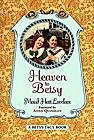
When girls check out Maud Hart Lovelace's Heaven to Betsy, I tell them if it compels them to make fudge, they have to bring me some. Set in the 1890's in Minnesota, I loved the depiction of family and school life at the time. Different from today's life, and yet oddly similar, I read these in high school, mainly in the orchestra pit when I was in musicals, and often did have to make fudge, because Betsy does so often. There is a series of these, and even a Lovelace fan club. Originally published in the 1950s, these can be hard to find.

Thursday, November 29, 2007

Douglas Rees ROCKS!

This is my favorite vampire book for many reasons. Appeals to both boys and girls, is funny, doesn't take itself too seriously, and doesn't have blood and gore. Okay, this makes it less appealing to some students, but the two copies of this we have in the library are never on the shelves. The premise is so clever-- there's a vampire magnet school, and they recruit 'regular' teens because the state requires them to have a swim team!

One of my hobbies is writing authors thank you letters, and Mr. Rees very nicely replied to me recently with the exciting news that he is working on a sequel! My students want it right now! This is one book I have recommended to several of my adult friends, who have also enjoyed it.

Since I read Lightning Time this summer, it has been checked out frequently my my boys who can't get enough war fiction.


I love the French cover (and title) of Vampire High, too. To find out more about this fun author, check out:

1,000 reasons never to kiss a boy by Martha Freeman


Warning: not a middle school book. Unclad frolicking on page 119.

This was a surprise from this author, who usually writes for a much younger audience. I liked the book, I liked Jane, and she ultimately makes the right decisions, but I still am not going to hand this book to any students.

Remember the rule, authors. Objectionable material within first ten pages, please!

Wednesday, November 28, 2007

Narinder Dhami

Bindi Babes, Bollywood Babes and Bhangra Babes all circulate very well in my library. The continuing story of a family of girls living in London, it offers an enticing look into the Indian lifestyle that is new to my students. I was impressed by the tiny details-- differences in cooking, household decorating, and family interaction. Bollywood Babes was especially fun, bringing in an Indian actress from Bollywood films.

I had written to Ms. Dhami a while back, thanking her for writing, and she VERY graciously replied and sent me two books not available in the U.S.-- Dani's Diary and Sunita's Secret. I read the first last night and loved it. It goes back and forth between Dani's adjustment with her new step family, and her grandmother's journal that was kept when her grandmother first came to the UK. I think it's great that Dani has to translate the diary from Punjabi. The problems of fitting in to a new country and dealing with a step family are brilliantly portrayed, and again, the details of a slightly different way of life are fun to read.


Ms. Dhami has a wonderful web site. Check it out to see the much bright UK covers.
http://www.narinderdhami.com/

Sorrells' First Shot

You're a student in a tough military type academy. Your father is the head master and doesn't cut you any breaks. Does it get any worse? Yes. If you're David, your mother has been murdered, and you think that it's a pretty good bet that your father did it.

For a book that is almost 300 pages long, this read very quickly. Between the unpleasantness at school, David's longing to excel at the sport of shooting with the help of a new transfer student who happens to be a girl, and the mystery of his mother's death, this is the best page turner I've picked up since Morgenroth's Jude. This book thankfully eschews the salty language and offers a raw portrayal of a boy trying to get through very difficult circumstances.

Another excellent mystery from the author of Fake ID and Club Dread.

Susan Shaw's Safe

It's a rare book about rape that would be appropriate for most middle school libraries, and this would be the book. 13-year-old Tracy is attacked and almost killed on her way home, by the brother of a boy in her class. Told in a gripping but not graphic way, it's easy to understand the range of emotions that she goes through, and hard to watch her get through each day that follows. This is an important book that would be useful if there were a student who was raped and needed to read an example of one way of coping with the situation, or her friends needed insight into how she might feel. In general, this will be popular with the girls who like problem novels, because it is so very well done. This author's other books, The Boy From the Basement and Black-eyed Susie are also well-crafted and sensitively written.

Tuesday, November 27, 2007

Need some pink books?

Susanna Sees Stars, by Mary Hogan, is one I will buy in its horrible Gibraltar binding, or perhaps a prebind version of the paperback, because it will circulate nonstop for ten years and then stay on the shelf, worn-out and dated. It is one of the many books out now dealing with run ins with celebrity that seem to be so appealing. It's like The Devil Wore Prada for the YA set. Add this to the list containing Douglas' True Confessions of a Hollywood Starlet and Calonita's Secrets of My Hollywood Life.

Kadohata's Weedflower

Kira-Kira, by this author, was very depressing and set during an odd historical period, so it's hard to get students to read it. This book, however, is a very vivid portrait of a family removed from their flower farm and sent to an internment camp because of the national feeling against the Japanese during WWII. This is a fine addition to a limited but interesting body of fiction that includes:
Denenberg: The Journal of Ben Uchinda
Otsuka: When the Emperor Was Divine
Salisbury: Eyes of the Emperor
Garrigue: The Eternal Spring of Mr. Ito
Uchida: Jar of Dreams

Durst's Into the Wild

This book gets five stars for the idea (fairy tale characters have escaped from their world of repetition to our world, only to be sucked back in), and fewer for execution. I loved the idea of Rapunzel's daughter trying to save her mother and all of her friends from "the Wild", but got very confused as to how this all happened.

I loved all of the allusions to the Grimm tales, and thought it was because my own ill-considered half-written novel used those tales, but apparently my opinion was shared. My students have been asking for books that includes spins on classic tales like The Rumpelstiltskin Problem by Vivian Vande Velde (2000) and McKinley's Spindle's End (2000) and Beauty (1978). Napoli's books, especially Zel, are popular, so it's fun to see Rapunzel appear in this one as well. There's a lot of action and adventure, and there is room for another book. 

I enjoyed this, but have to agree with this assessment: "Although the logic of the Wild doesn't bear close scrutiny, the concept behind the story is sufficiently clever that many readers will forgive its inconsistencies." (Booklist)

Milton Meltzer's Tough Times

This is a thin historical novel, but it should not be underestimated. It is the rawest and most personal account of living through the depression that I have ever read. When I was done, I thought "This is autobiographical!", and sure enough, Meltzer was born in 1915, making him `6 when this book was set. We should all write so well at 92!

The details of this book were breath taking. What was it like to have your father's business slowly become less and less viable, until you had to get a job instead of going to school? How hard was it to see a professional man you admire lose his job, and your friend also sink into hard times? When everything around you seemed so dire, how did you go on?

All of my students need to read this. Maybe they would complain less. At the very least, they would learn a lot abou the Great Depression, something which figured very largely in the lives of my grandparents, and which young people today know so little about.

Thanksgiving reading-- unfortunately won't purchase.

Pat Murphy's The Wild Girls is nostalgic and discusses what it's like to feel different while growing up, in the great '50s tradition of expressing this difference by wanting to be a writer. I'm getting old if so many people are writing books set in the '70s now! I loved it, but my daughter, who will read anything, just couldn't get into it, and I can't think of a single student I would give this to.

John Smelcer's The Trap was a wilderness survival story that lacked action, which is what most students want from this sort of fiction.

Loved Elizabeth Levy's Tackling Dad, about a girl who really wants to play football but whose football playing dad doesn't want her to. The problem-- I have three or four books about football playing girls and one football playing girl every five years. Can't get others to read them. Levy did a great job with this one-- love the picture of her in the pads!

Laura Resau's What the Moon Saw was an interesting account of a girl's visit with her grandparents in a very remote area of Mexico, but also had a lot of magic and fantasy elements that were sort of odd. Intriguing, but again, can't think of readers.

Kirkpatrick Hill's Do Not Pass Go, about a boy whose father is incarcerated on a minor drug charge, was also well done, and I am thinking about buying this after hearing a student talking about a relative who was in jail. I'm still not sure.

Francine Prose's Bullyville sounded great in the reviews but started off annoyingly (all of the slang names for the places) and never reeled me in. I had to get it through interlibrary loan, so it must not have intrigued others, either.

Not buying books is hard. So is weeding books that haven't circulated well. Sigh.

Books sent to me randomly by an author

Karen Kingsbury, who is "America's favorite inspirational author" (I never know these things) very kindly sent me two copies of her book A Thousand Tomorrows. In the cover letter, it is described as " a clean love story about a bull rider and a barrel racer, and it deals with cystic fibrosis". This didn't entice me to read the book, but it was better than the letter indicated.

I would describe this as a romance about two people who love each other and pursue their dreams despite the odds, in a Lurlene McDaniel sort of way. Ali rides horses even though her lungs can't handle it-- its the only time she feels really alive. Cody gives up riding briefly to donate part of a lung to her. There is just depressing event after depressing event, and you know it's not going to end well. Again, for girls who want to read something sad, what could be more perfect?

Ms. Kingsbury is donating books to libraries in honor of her brother, Dave Kingsbury, who died unexpectedly. This is very nice of her. I will definitely put this is the collection (I have a student who has just about finished all my McDaniel) but may send the second to another middle school library so that they can have one, too. Many thanks for this kind donation.

Books loaned to me by students

It's always great when students loan me books. It means they trust me with their books, and they believe that I will get them back quickly. I try.

Sarah loaned me Rachel Hawthorne's Caribbean Cruising, an Avon paperback which I enjoyed very much but won't buy for the library. A fluffy beach read about a girl who has graduated from high school on a cruise as part of her mother's honeymoon, it is about her "to-do list" for the cruise. The major thing was rather inappropriate, ala Meg Cabot in Ready or Not.

Elizabeth loaned me a V.C. Andrews' book-- Butterfly, the first in the Orphans series. Having been a big fan of the Flowers in the Attic series in high school (embarassing fact-- owned the whole series in paperback and could not begin to tell you why.), I was intrigued when she had a V.C. Andrews for YA book. Huh, I thought. Since FItA was not the most appropriate book for, well, anyone, I was compelled to pick it up. Butterfly is the somwhat improbable tale of an orphan girl adopted by a paralyzed ballerina and forced to dance. The abuse and unhappiness of earlier works is in evidence here-- they never end happily.

So why do I want to borrow the next one in the series? These would appeal very much to girls in that developmental stage where they love to read about people whose lives are worse than their own.

Tuesday, November 20, 2007

Sure Fire by Jack Higgins with Justin Richards

Notice the wonderful fiery helicopters and the tag line under the title: "Grow Up Fast- Or Else!" That's exactly what Jade and Rich do when their mother dies and they end up with the father they didn't know they had-- a father who happens to be a spy involved in a dangerous bid to secure the formula for a superfuel. (Okay, it ends up being something more sinister, but I won't ruin it for you.) With shade of Alex Rider, the children hunt down bad guys and work on saving their father, and, by coincidence, the entire free world.

Fairly standard plot, but it is the type of story that children crave. Given the number of political/spy thrillers for adults, this should not be a surprise. Apparently this Higgins is "one of the world's most popular authors". I've never heard of him, although Justin Richards is the author of the wonderful The Death Collector. (And the new The Chaos Code, which sounds great.)

This is well-crafted and highly readable, and the children will adore it. Add it to the growing list of spy novels starting with Alex Rider; Jimmy Coates, Traitor and Payback, and the Robert Muchamore. Buy two and be glad for the inevitable sequel!

Two War Books

Sonya Hartnett's The Silver Donkey is set during World War I and follows the story of a blinded soldier trying to make his way home. He is found and helped by two sisters and a brother, who feed him and try to get him to where he is traveling. He amuses them by telling them stories involving donkeys, since his good luck charm is a donkey. A bit vague in the details, this is a lyrical book, and beautifully bound. It is gentle and sweet, and shows that bravery and loyalty are good qualities. Parents and critics will love it. Middle school students won't.


What they really want is what H.R. DeMallie delivers beautifully in Behind Enemy Lines: A Yound Pilot's Story. This covers his enlistment and training on how to fly a B-17 bomber (with a diagram! Map!), then the fateful air battle, in riveting detail, that caused him and his crew to parachute into occupied Holland. From there, DeMallie survived with the help of the people of Holland but was eventually captured and spent the remainder of the war as a POW.

Written using notes that the author kept in 1945, this is raw, immediate, and gives the authentic detail of a real WWII experience that my boys crave. The language is not elegant ("Gee, I was hungry.), but I was riveted by the fact that this was a real story, one that was no doubt repeated time and again. Sterling Point Books, the publisher, has several other volumes of memoirs out that I am looking quite seriously into buying. This will NEVER be on the shelf. Buy two.

On page 8 there is a wonderful quote: "Someone once said "Young men enlist in the service during war time primarily for adventure." I will try to remember that this is why they like to read books about war as well.

Monday, November 19, 2007

Novels in verse

Let it be duly noted that I wasn't liking anything I picked up this weekend, so I was apparently in a difficult mood. I gave up and watched The Prize Winner of Defiance, Ohio, which was a good book AND movie.

The two books I did pick up both happened to be in verse. Such a hard sell, both to me and to students. The first was Trash, by Sharon Darrow. This was the description from Follett: "Graffiti artists Sissy Lexie and younger brother Boy try to maintain a sense of family while living in a series of foster homes and staying with their older sister, until a tragic accident forces Sissy to make decisions about her future."

The poetry was very free verse, and I had a hard time getting that. Students who like to read books about problems such as these are frequently struggling readers, and the use of imagery and poetic language makes this hard to read.

The other was Norma Fox Mazer's What I Believe. This incorporates the problems that her work normally does (father loses job and family must relocate), but is done is a very experimental style. Very good try on lots of poetic forms. Poetically, this is good, but it makes the story hard to read. I think this is the only book by this author that I will be lacking on the shelves.

For aspiring writers thinking about writing a book in verse: please don't. Just don't. I know that college professors of children's literature think they are great, but run the text by an actual young adult first. Please.

Thursday, November 15, 2007

Crossing the Panther's Path

One of my students was a somewhat reluctant reader for the last two years but came in the first week craving books on Native Americans. He's read them insatiably, even the 50 year old biographies. I have been looking for additional titles for him, and came across Elizabeth Adler's book. Just what I needed. For some reasons, many of the books are from the point of view of a girl, and are more about the settlers and the "evil" Indians. This is based on the true story of Billy Calder, who had an Irish father and a Mohawk mother, and who became an interpreter for Tecumseh and helped him try to win back land from the Americans.

This stars out with an arduous trek through the snow from Detroit to his parents' home, and keeps going with strategies, adventure, and battles. While it supported the Native Americans cause, neither the British were portrayed as evil, just with their own agendas. Billy learns a lot about the different tribes, and I think my student will really enjoy this.

Other titles that we've located this year that have been fairly successful were:
Carbone's Blood on the River
Cooney's The Ransom of Mercy Carter
Edmond's In The Hands of the Senecas
Keene's I Am Regina
McGraw's Moccasin Trail
O'Dell's Streams to the River, Rivers to the Sea
Pearsall's Crooked River
Richter's Light in the Forest
Speare's Sign of the Beaver

Combine this with two biographies, and that is a lot of reading! I am so proud of this student, who signed up for a public library card and has even gotten "in trouble" for reading during class. "The right book for the right child at the right time" is certainly working out in this case!

My Apologies to Wendy Mass

I am afraid that I may just not like anything this author has written. The books always sound intriguing, and I pick them up, but just don't get along with them. A Mango-Shaped Space was not something students would ask for, I didn't like the character in Leap Day, and Jeremy Fink just didn't hit the right notes. Heaven Looks a Lot Like the Mall sounded great: girl is hit with dodge ball and dies temporarily, reviews her life through the things she obtained at the mall, and learns to become a better person. Great Cover. Just great.

Objection Number 1: It's a "novel in verse". BIG nose wrinkles when I show these to middle schoolers, and with the very notable exception of Helen Frost, these books are not actually in anything that involves rhyme, meter, alliteration, etc. so to me are not verse. They are simply prose cut up into short lines. Now, I am especially picky about this, since I write traditional poetry.

Objection Number 2: Too heavy on the life lessons. Yes, students are trying to establish identity, but you can't hit them over the head with it. Verging on preachy.

I wanted to like it, but am somehow sad I didn't. Sigh.

Wednesday, November 14, 2007

Tattoo

Jennifer Lynn Barnes' second book, Tattoo, was one I had to pick up because the description was so tempting. Four friends at the mall get temporary tattoo that give them supernatural powers that they need to fight against evil that is set to take over the world-- starting at their prom.

Which they do. There is a lot of Celtic lore and whatnot dealing with how they get their powers and what evil is encroaching, but what I really liked about this book was the snappy, laugh out loud dialog. "I'm on the cheerleading squad. I know what REAL evil looks like." I'd quote more, but my daughter ran off with the book.

A fabulous choice for either girls who liked Twilight or who have to read fantasy against their will. Both will find this fun. The only down side is that it is available only in paperback or the dreaded Gibraltar Bound, a library binding that in reality falls apart the first time a student looks at it. Sigh.

Don't Read These Two on the Same Night

Andrew Clements, of course, does middle grade novels about teachers who don't quite get what wonderful social changes students are trying to effect. Having learned about Ghandi's protests, the 5th graders in No Talking decide that they will have a contest to see who can talk the least, and it gets them into trouble for no particularly good reasons. It's funny, with a sly humor that appeals to all ages, but more importantly, empowers children. This is the case in all of the Clements' books that, as my son puts it, "have a child holding something in front of his face on the cover." Reluctant or struggling readers in middle school turn to these for comfort, so I will buy this one.


If this isn't a glowing review, it's because I read it on the heels of James St. James' Freak Show, about one gay/transgendered boy who moves to Florida and attends a very conservative, preppy school. This is not a middle school book. Much, much language. I'm not even sure it's a high school book. It's meant to be funny, but touch the deeper issues of "Everyone is a freak in some way so we should be understanding of everyone."

I couldn't stomach it, because the main character, Billy, goes out of his way to make himself a target. Sure, in a perfect world we would all be able to show the world who we really are, but in reality, this is a bad, bad idea. So I had trouble feeling sympathy for Billy when he wanted to start the school year and "blend in" by wearing a ruffled pirate shirt. No. Not in high school. Do I, as an adult, wear polyester prom dresses from the '70s to work? Yes. But people do not really see me and do not care. Would I have done this in middle school? No. While amusing, I can't see this as a constructive book to give any student, especially one having trouble fitting in.

Tuesday, November 13, 2007

Andrew Clements' Things Not Seen


One morning, Bobby wakes up and can't see himself. He's not blind-- he's invisible. His parents don't seem to care, and when they are involved in a car accident and hospitalized, Bobby must get along on his own. He meets Alicia at the library, and she befriends him because she can't see anything at all and can't tell at first that he's invisible. I thought it would be horrible.

The only problem with this book is that it is one that sort of defies a convincing description. I really enjoyed it-- the details are spot on, the explanations don't stretch credulity too far, and the reaction of the parents is one with which many students will identify-- no, no, I'm sure it's a big problem for you, but really, it's best if we keep it a secret. We're working on it. These things just take time. Verging on the hilarious when it's something as serious as invisibility, but parents do that all the time with things that are important to children but seemingly inconsequential to the parents.

Bobby is 15, which makes it more believable that he's wandering about Boston by himself, but nothing in this book is inappropriate for younger students who are fans of Clements' other works. I put it on the table for my 4th grade reluctant reader, and it was gone this morning. It will appeal most to middle school students who are starting to find their parents annoying!

Also read Cecil Castelucci's The Plain Janes. If you desperately need graphic novels in your collection, this one has nothing objectionable, but I don't know that the plot really has anything to recommend it. Girl, traumatized by bombing in big city, moves to small town and wants to join a group of unpopular students even though the popular students court her. She then embarks on a plan to install art all over town. I'm trying to think who would ask for it. It might be more successful in high school, with students who are serious about art.

Monday, November 12, 2007

Nothing that thrilled me.

As much as I loved Roderick Townley's The Great Good Thing, The Red Thread just didn't appeal to me, even though time travel was involved.

Finally got ahold of J.D. Guilford's The Edification of Sonya Crane, about a white girl who goes to a predominately black school and passes as biracial in order to fit in. There were some other themes that made it inappropriate for middle school-- mother is addicted to drugs and there are some scenes with her supplier that really curled my hair. Too much sex. Also a lot of gratuitous language. Sigh.

Urban's A Crooked Kind of Perfect was an interesting read, but too young for my library. Girl with agoraphobic dad and high powered mom takes up the organ and works toward competing. A nice book, fun to read, but just not what I need.

Am liking Clement's Things Not Seen more than I thought I would.

Friday, November 09, 2007

Fall Into Reading 2007

The only thing I looked at last night was Nick Hornby's Slam, which would be very good for high school but not middle school. It sounded so good, though, that I had to read until it became apparent that, oddly enough, a book about a 15 year old who gets his girlfriend pregnant is going to have things inappropriate for the average 6th grader. Well done, though.

Since I read anyway, I love to find challenges like the one at:
http://callapidderdays.blogspot.com/

This blog has a lot of parenting issues and is slanted toward Christian mothers, but had some good reviews. I've been trying to keep up with blogs, and it is difficult to find ones that are only dedicated to middle school books.

Still, a challenge is a challenge! I'm up for it!

(I, too, looked at The First Part Last, and seem to recall it had some gratuitous language. I prefer Hanging on to Max or even No More Saturday Nights.)