
What Happened in Hamelin (1979) was on of this well-known author's first books, and it's only been off the shelves six times, twice to the same teacher, so I was apprehensive about keeping it. I'm not an archive, unfortunately.
I don't have Donna Jo Napoli's Breath (I love this author, but there were a couple really questionable scenes), which deals with the same topic, but these would be good books to read together. I loved the twist on the Pied Piper tale that Skurzynski puts on this. The piper doesn't have any magic skills, just good marketing ones. He positions himself to rid the town of rats, which is done by giving them heavily salted pork, denying them all access to water, and then positioning the town's children at the docks with sticks to beat them to death. Gory, but realistic. Told from the point of view of a mistreated baker's assistant who becomes the unwilling accomplice of the piper, this was a dark but fascinating look at medieval life and a realistic explanation of a fable with which students need to be familiar.
Congratulation to this author, also, for keeping up a nice web site. I'm on to Virtual War and the National Parks Mysteries next!
http://gloriabooks.com/index.html
Also read: Jacqueline Woodson's Feathers is not one I will buy. Too young, among other things.
Thursday, November 08, 2007
The Invention of Hugo Cabret
 This is a brilliant book because most people involved in children's literature of any kind worship and adore picture books.
I HATE picture books. Not enough words.
Especially since this book is bound to win every award known to man, I spent quite a lot of time sharing it with students and, shamefully, making fun of it. This is because, at 500 plus pages, it should not start with 40 pages of pictures, and it does. I tried it on about ten hard core fantasy fans who were not at all interested in it.
Then I read this story of an orphaned boy who lives in a French train station and takes care of the clocks, stealing his food and parts for the automaton that his father left behind. It is charming. I love old movies, so having Georges Melies, an early movie maker, as a character was appealing to me, and the whole mystery surrounding the automaton and Georges was captivating.
It was a slight story, and definitely historical fiction. I really don't know who the audience for this would be, other than college professors who sit on awards committees. As I said, the fantasy readers were not thrilled. Reluctant readers are going to look at the length and run screaming. Not many historical fiction fans. Published by Scholastic, this will fall apart in two circulations.
There will be multiple copies at the public library. May not buy this one.
Wednesday, November 07, 2007
Singer and cover art
 Deal with a Ghost was a surprisingly good mystery for older girls who like problem novel. High schooler Delia is living with her grandmother because her mother has moved away to be with a boy friend, and the temptation to take other girls' boyfriends away from them is very strong. However, new friends, involvement in the glee club, and a ghost who has a message for Delia's strict, unloving grandmother distracts her just enough that it only seems like a good idea once, and then only for a short time.
This book has circulated steadily for the last ten years, and I can see why. This will be one I hand out frequently. But come on. What was the deal with cover art in the '80s and '90s? Compare the covers of the new books I have listed. Great improvements in cover art. Students really do judge books by the cover. Which copy of Scared Stiff would you pick up?


Nobody's Princess by Esther Friesner
 Helen of Troy didn't always have the face "that launched 1,000 ships". An akward and tomboyish child, she longed to follow her brother's adventures and balked at the restrictions placed on girls. Not that these held her back in this book-- she learns to fight and ride horses, meets Atalanta and hunts the Calydonian boar, and after consulting with the Pythis at Delphi, sails off to look for the Golden Fleece. The story is to be continued in Nobody's Prize, due out in the spring.
Told in the first person, which made the story seem very immediate, this was a fast read because of all of the action. The girls will pick it up because of the tie with Helen, and the boys will like all of the fighting. I was most enthralled with the portrayal of Helen not as the namby-pamby, beautiful plaything of the gods, but of the real, live Spartan girl with her own agenda. I will be very interested to see how Friesner deals with the rest of the story.
I also read, at the insistence of a language arts teacher, Mildred Taylor's classic Roll of Thunder, Hear My Cry. Certainly, this is a good book that illustrates the prejudice and intolerance that blacks had to suffer in the 1930's. Was it so fabulous that teachers should still be assigning it 30 years after publication? Maybe not. Cassie Logan seemed rather clueless-- did her family really keep her that sheltered that she didn't understand that she would suffer consequences for her refusal to bow down to the cultural mores that kept blacks in "their place"? Combine this with dialect, slow descriptions, and drawn out problems that took forever to be concluded, and this read like a book that (as one of my parent volunteers put it) your language arts teacher would assign to you. Perhaps selections of this would be better for discussion than the whole book, since the reality is that 30 years after publication we still have 150 copies of these for class use, and don't have money to buy something new on the topic.
Tuesday, November 06, 2007
The Boy Who Couldn't Die by William Sleator

I have been recommending this out for several years on the strength of the spooky cover and the fact that it is about zombies, but this is much more philosophical than that. After Ken's best friend is killed in a plane crash, he decides to make sure this doesn't happen to him, and has his soul locked away by a woman who charges him $50 for this task. She keeps control of his soul. Obviously, not a good idea, and during a vacation to test his immortality by swimming with sharks, he meets a girl who tells him that he has probably been made into a zombie and the woman who controls his soul will force him to do a lot of evil. Getting his soul back is quite the adventure, and this is bloody enough for the students who love Darren Shan. I don't know that they will learn that it's not a good idea to sell your soul; even though Ken is regretful, I know enough about teenagers to think that he would do it all over again. This is a great title to have in most collections where the students crave horror!
Miss Spitfire: Reaching Helen Keller by Sarah Miller
 We know that Annie Sullivan had a difficult time teaching the deaf and blind Helen Keller to communicate, but how difficult was it, exactly? This excellent book fills us in on Annie's challenging and sad life before coming to the Keller's, which helps to explain her diligence and devotion. While Helen's actions are wild, this book shows that she was very intelligent, and just needed the opportunity to share that with others. The details of this process is something that the children will fins fascinating. This is a very complete book of Helen's early years; hopefully dedicated readers will go on to read Helen's autobiography or find out more about Annie Sullivan. Pictures, online sources, books and a chronology round out this very engaging biographical novel.
Monday, November 05, 2007
Weekend Reading
Think I've finished the "R" authors, so it's on to "S"!
Pamela F. Service's The Reluctant God alternates between the stories of Lorna, the daughter of an Egytologist, and Ameni, the son of a pharoah, who is chosen by the gods to preserve the tomb of his relatives. Through a quirk of time, the two meet up when Lorna uncovers the tomb, and when part of the artifacts Ameni is meant to guard are stolen, the two track them down and discover what is truly important to life. I liked this more than I thought I would, and students with an interest in ancient times and mysteries will like this as well, although it is a highly descriptive and philosophical work which will not appeal to those who want a quick read.
Service's Phantom Victory also deals with some issues of time-- years ago, the Victory hotel burned to the ground. Brian and Terri both had relatives connected with the hotel, and the two of them use a diary to uncover clues to a lost treasure that could help the hotel be rebuilt. This was a solid mystery that should be popular with my students now that I know that it is on the shelf! It is cursed, however, with bad '90's cover art.
Not as bad as Storm at the Edge of Time, however. (Also by Service.) Another time travel time, set in the Orkney Islands, it's a muddled tale that was hard to follow. Considering that it has only been checked out three times in 14 years, it may be a goner. My daughter wrinkled her nose when she saw it, and didn't unwrinkle it once she started reading.
Ian Serraillier's Escape from Warsaw is a Holocaust tale, and one that has lots of adventure in it. Three Polish children are separated from their parents, who have been taken in different directions by the Nazis. The father meets a young boy, and tells him to look for the children. He eventually meets up with them, and the four make the long and difficult journey to Switzerland. Again, this was hidden in the "S" section, but will now circulate well because it is quite good.
Doris Buchanan Smith's Karate Dancer must have something going for it, because one student checked it out about 9 different times over three years. Troy lives for karate and cartooning, even though his parents don't support his karate. He meets up with Liesl, a dancer, and has such a crush on her that he is willing to take up ballet in order to be with her. There are some bullies from another karate studio, a test for his black belt, and a rather odd scene where a ship hits a bridge in town and many people are killed. That was handled too quickly, and was just jarring. I liked this for Troy's emotions involving all that is going on around him, but there was enough action and description of the karate to interest students with experience in that area. On my pile to booktalk to SSR classes this week as well.
Gary D. Schmidt's The Wednesday Wars is another introspective tale of a boy growing up during the Vietnam Conflict. When half the class goes to Catechism class on Wednesday afternoons, and the other half goes to temple, Holling Hoodhood, the lone Presbyterian, is stuck with Mrs. Baker. He is sure that she hates him, and Wednesday afternoons are filled with classroom chores until she decides to read Shakespeare with him. Misbehaving students, escaped rats, problems relevant to the Vietnam era (a refugee student, wives of soldiers, a sister who wants to be a "flower child"), and a local Shakespeare production all provide fodder for life lessons as well as comic situations.
I liked this, but mainly because it predates my school experience by just ten years, and it is very nostalgic. Definitely a bildungsroman, with all those life lessons. The humor seems forced (we hear about the yellow tights for the Shakespeare production a lot), and I don't know how students will like this one. I am going to think about it before I buy it.
The guilty pleasure of the weekend was Katie Maxwell's Got Fangs. A weird but intriguing story of a girl working in a Goth Faire in Hungary with her mother, this would never be on the shelf because the girl's boyfriend is a vampire. And it's a mystery. Francesca's voice was fresh and amusing. I am looking into a bound version, since this is in paperback and the pages of the public library's version were already coming loose.
Pamela F. Service's The Reluctant God alternates between the stories of Lorna, the daughter of an Egytologist, and Ameni, the son of a pharoah, who is chosen by the gods to preserve the tomb of his relatives. Through a quirk of time, the two meet up when Lorna uncovers the tomb, and when part of the artifacts Ameni is meant to guard are stolen, the two track them down and discover what is truly important to life. I liked this more than I thought I would, and students with an interest in ancient times and mysteries will like this as well, although it is a highly descriptive and philosophical work which will not appeal to those who want a quick read.
Service's Phantom Victory also deals with some issues of time-- years ago, the Victory hotel burned to the ground. Brian and Terri both had relatives connected with the hotel, and the two of them use a diary to uncover clues to a lost treasure that could help the hotel be rebuilt. This was a solid mystery that should be popular with my students now that I know that it is on the shelf! It is cursed, however, with bad '90's cover art.
Not as bad as Storm at the Edge of Time, however. (Also by Service.) Another time travel time, set in the Orkney Islands, it's a muddled tale that was hard to follow. Considering that it has only been checked out three times in 14 years, it may be a goner. My daughter wrinkled her nose when she saw it, and didn't unwrinkle it once she started reading.
Ian Serraillier's Escape from Warsaw is a Holocaust tale, and one that has lots of adventure in it. Three Polish children are separated from their parents, who have been taken in different directions by the Nazis. The father meets a young boy, and tells him to look for the children. He eventually meets up with them, and the four make the long and difficult journey to Switzerland. Again, this was hidden in the "S" section, but will now circulate well because it is quite good.
Doris Buchanan Smith's Karate Dancer must have something going for it, because one student checked it out about 9 different times over three years. Troy lives for karate and cartooning, even though his parents don't support his karate. He meets up with Liesl, a dancer, and has such a crush on her that he is willing to take up ballet in order to be with her. There are some bullies from another karate studio, a test for his black belt, and a rather odd scene where a ship hits a bridge in town and many people are killed. That was handled too quickly, and was just jarring. I liked this for Troy's emotions involving all that is going on around him, but there was enough action and description of the karate to interest students with experience in that area. On my pile to booktalk to SSR classes this week as well.
Gary D. Schmidt's The Wednesday Wars is another introspective tale of a boy growing up during the Vietnam Conflict. When half the class goes to Catechism class on Wednesday afternoons, and the other half goes to temple, Holling Hoodhood, the lone Presbyterian, is stuck with Mrs. Baker. He is sure that she hates him, and Wednesday afternoons are filled with classroom chores until she decides to read Shakespeare with him. Misbehaving students, escaped rats, problems relevant to the Vietnam era (a refugee student, wives of soldiers, a sister who wants to be a "flower child"), and a local Shakespeare production all provide fodder for life lessons as well as comic situations.
I liked this, but mainly because it predates my school experience by just ten years, and it is very nostalgic. Definitely a bildungsroman, with all those life lessons. The humor seems forced (we hear about the yellow tights for the Shakespeare production a lot), and I don't know how students will like this one. I am going to think about it before I buy it.
The guilty pleasure of the weekend was Katie Maxwell's Got Fangs. A weird but intriguing story of a girl working in a Goth Faire in Hungary with her mother, this would never be on the shelf because the girl's boyfriend is a vampire. And it's a mystery. Francesca's voice was fresh and amusing. I am looking into a bound version, since this is in paperback and the pages of the public library's version were already coming loose.
Friday, November 02, 2007
Yellow Flag by Robert Lipsyte
 Kyle would rather play jazz with his friends than race cars, but when his brother is injured in an accident, he has to help out his family and race to maintain the corporate sponsorship they have just received. He's a good racer, which makes it harder for him to walk away and dedicate himself to his music. There's lots of riveting descriptions of racing, but the core story is that of Kyle deciding what is best for both him and his family. There is some very mild language and situations with girls, but still appropriate for middle school.
I would buy this book if only for the following paragraph, which appears on page 5 but really should have started the book. This is good writing. Stuff like THIS should win the Newbery. Children might actually read it.
"Fridays in spring crept on forever at Goshen High. All day Kyle felt like he had one foot mashing the gas, the other standing on the brake. His motor was running hot while his wheels spun in the groove. He felt numb... and sleepy and jittery. He sleepwalked from English to history to geometry. He heard himself answer a question in environmental science, but it might as well have been someone else. Teachers droned on, trying not to let their eyes flick toward the windows, where the thickening yellow light banged against the glass, calling them outside. Kyle's eyes were stuck on the glass."
A must buy. This will never be on the shelf. Hopefully, children who read this will move on to pick up The Contender and other titles by this author.
Revolution is Not a Dinner Party by Ying Chang Compestine

This debut novel brings the Cultural Revolution to young adult students in a compelling and engaging story based on the author's own experiences. Ling's parents both work at the hospital, so the family is considered bourgeois and subject to scrutiny and abuse by the Communist Party. Even though Ling is only 9 when the book starts, the details of how the government affects her daily life are well-explained and gripping. There are notes at the end explaining more about the Cultural Revolution, and more about the author's life as well.
Not knowing much about this part of history, I found this fascinating. Students who like to read about the Holocaust will be interested in this book because of how the governement was treating the citizens. This is a highly readable book that could generate a lot of good conversations in a classroom setting. I will definitely be getting a copy.
Paint the Wind by Pam Munoz Ryan

Maya has been raised by a controlling grandmother who would not talk about Maya's mother. When the grandmother dies, Maya is scared to be sent to her mother's relatives in the Wyoming wilderness. In time, she starts to love the horses there and she learns to deal with her difficult cousin, her great aunt, and the challenges of making her own decisions.
I wanted to like this more, since there is always a demand for horse books. However, the horse references are scattered and take a back seat to the damily drama that unfolds. There are some exciting scenes at the very end when Maya is caught and injured in an earthquake while looking for a wild horse her mother loved, but this did not make up for the fact that I did not like Maya. She was unpleasant at the beginning, and while she improved a bit, I still didn't like this. This would be good for larger collections. This author's Esperanza Rising was much more to my liking. Reading this did give me the idea to recommend Seredy's The Good Master to one of my horse fans!
Thursday, November 01, 2007
Award winning books
Took a BERS seminar yesterday on 101 Best Books for Young Adults. Very interesting, even if I didn't agree with all of the choices. The woman who ran the seminar, Bonnie Kunzel, is very well-read and has an impressive professional record:
http://www.bonniekunzel.com/
The most interesting thing she said, however, was that nowhere in the parameters for determinging awards like the Newbery is it stated that a book must appeal to actual children to win an award. Considering that librarians and teachers use these awards to select books for students, this is somewhat of a problem.
There was also a large discussion of manga, which we were told we should have because children want them and will read them. I am not averse to manga but haven't found a lot that I found worthwhile.
Is there a happy medium between what children want (manga) and what the awards tell us to buy (Higher Power of Lucky, Criss Cross, neither of which should ever be handed to anyone, much less a reluctant reader)? How about something like Jordan Sonnenblick's Notes from the Midnight Driver? Covering serious issues and well-written but also (*GASP*) vastly appealing to students.
In answer to the comments from A.C.: There are not many manga at our school because they are expensive and don't wear well. There are a few, as well as some graphic history and biography books. Diary of a Wimpy Kid does have a lot of pictures, but a text story as well.
http://www.bonniekunzel.com/
The most interesting thing she said, however, was that nowhere in the parameters for determinging awards like the Newbery is it stated that a book must appeal to actual children to win an award. Considering that librarians and teachers use these awards to select books for students, this is somewhat of a problem.
There was also a large discussion of manga, which we were told we should have because children want them and will read them. I am not averse to manga but haven't found a lot that I found worthwhile.
Is there a happy medium between what children want (manga) and what the awards tell us to buy (Higher Power of Lucky, Criss Cross, neither of which should ever be handed to anyone, much less a reluctant reader)? How about something like Jordan Sonnenblick's Notes from the Midnight Driver? Covering serious issues and well-written but also (*GASP*) vastly appealing to students.
In answer to the comments from A.C.: There are not many manga at our school because they are expensive and don't wear well. There are a few, as well as some graphic history and biography books. Diary of a Wimpy Kid does have a lot of pictures, but a text story as well.
Shane, by Jack Schaefer
Not a fan of westerns, never seen the movie with Alan Ladd, 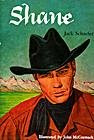 and had my doubts as to whether this 1949 title should be kept.
It should.
I haven't decided on a reader for it yet, because the first half of the book is a lyrical character study of a drifter who arrives at a farm in Wyoming in 1889. While the family is happy, trouble is brewing. The father hires Shane to help with the work, and ends up getting more help than he bargains from the enigmatic stranger whose every move whispers "danger".
Once we find out that the evil rancher Fletcher is trying to take over all the small farms in the area using Wild West tactics (Won't seel your land? Fine. We'll just shoot and kill you.), we see how useful Shane is. Told from the point of view of the young son, this is more a look into what it takes to "be a man" and stand up for what is right than it is a shoot-em-up western, although the action picks up halfway through the book and there are a lot of bar room brawls and gun battles.
I have to see the movie now, and someone must read this. It is a difficult book, though-- the father and Shane are both trying to do what is best for the family, even though it might be hard for them personally. I found Shane's sacrifice a touching change from the modern depiction of family interactions. As much a product of the 1950s as the 1890s, Shane's character is a vanished piece of Americana worth preserving.
Really shouldn't mention Pamela Service's Stinker from Space in the same breath as Shane. I didn't even realize I had this book, but it will now be newly popular. A very thin book, it has an Accelerated Reading level of 6.8, making it hugely appealing to many students like my son who just want to get their AR book out of the way so they can read whatever they like.
A space alien crashes to earth and sends his spirit to the only somewhat dexterous creature around-- a skunk. Karen is oddly drawn to the animal, feeds him cookies and takes him home. Of course, complications ensue, and Tsynq Yr must be returned to his home despite all the comic obstacles.
 and had my doubts as to whether this 1949 title should be kept.
It should.
I haven't decided on a reader for it yet, because the first half of the book is a lyrical character study of a drifter who arrives at a farm in Wyoming in 1889. While the family is happy, trouble is brewing. The father hires Shane to help with the work, and ends up getting more help than he bargains from the enigmatic stranger whose every move whispers "danger".
Once we find out that the evil rancher Fletcher is trying to take over all the small farms in the area using Wild West tactics (Won't seel your land? Fine. We'll just shoot and kill you.), we see how useful Shane is. Told from the point of view of the young son, this is more a look into what it takes to "be a man" and stand up for what is right than it is a shoot-em-up western, although the action picks up halfway through the book and there are a lot of bar room brawls and gun battles.
I have to see the movie now, and someone must read this. It is a difficult book, though-- the father and Shane are both trying to do what is best for the family, even though it might be hard for them personally. I found Shane's sacrifice a touching change from the modern depiction of family interactions. As much a product of the 1950s as the 1890s, Shane's character is a vanished piece of Americana worth preserving.
Really shouldn't mention Pamela Service's Stinker from Space in the same breath as Shane. I didn't even realize I had this book, but it will now be newly popular. A very thin book, it has an Accelerated Reading level of 6.8, making it hugely appealing to many students like my son who just want to get their AR book out of the way so they can read whatever they like.
A space alien crashes to earth and sends his spirit to the only somewhat dexterous creature around-- a skunk. Karen is oddly drawn to the animal, feeds him cookies and takes him home. Of course, complications ensue, and Tsynq Yr must be returned to his home despite all the comic obstacles.
Deltora Quest

My weekends have been Fantasy Death Marches recently. In order to finish all of the "R" authors, I had to get through Philip Reeve and Emily Rodda.
If you have students who have never read fantasy but need to or would like to start, this would be a decent introduction. There are many standard fantasy elements-- quasi-medieval setting, magic, a quest, good versus evil, riddles, etc. The first series is 8 books long; I don't have the other books in my library. For a complete listing of titles in order, please consult:
The Shadow Lord has made the king of Deltora all but useless; removing the jewels from the Belt of Deltora is the final act that unseats the royal family and brings despair to the entire kingdom. In order to fight the evil, Lief, Barda, and Jasmine go to each of the kingdoms to locate the jewels, then need to locate the heir to the throne. There are some nice twists and turns, and the books are short (about 130 pages each), but there are a lot of cliches, and not much new. We did have some fun when the group met evil doers that spoke English, but backwards: I went around chanting "fresh meat soon!" and unnerving the children.
I asked several of my students about their experience with the book, and many had picked them up in the 3rd or 4th grade, and that seems about right for these books.
Diary of a Wimpy Kid

Middle School is hard enough. Combine it with a small brother, totally unreasonable parents who ground you from video games, a best friend you don't like, and people who are mean to you at school and what do you have? Just about everybody's life.
This will be a tremendously appealing read to a lot of 6th grade boys. The diary format, the goofy illustrations, and the sneaky, unpleasant tone that Greg has will make them laugh. They will identify with Greg's attempts at being popular, avoiding bullies, and making it through the wilderness that is middle school. Certainly much of the book made me laugh as well. I will buy it.
Did I like it? No. I read a good review at Your Neighborhood Librarian (http://yourneighborhoodlibrarian.blogspot.com/) that pretty much sums up how I felt, and I think that being an adult female does make it hard for me to like this book. Still, it will be good for students who have already read Captain Underpants a billion times. Perhaps that is the thing-- for me, it lacks some cleverness. Knowing that students would pick it up avidly, I wanted to like it more.
Tuesday, October 30, 2007
Creepy and bloody
Gina and Dann Gershon's Campy Creepy Time looked very promising, with a picture of fangs in braces on the front cover and a description that included children sent to a summer camp where they are turned into monsters and then sold to space aliens. Unfortunately, the main character, Einstein P. Fleet, was pudgy and unlikable, and I thought that this would be a good ending for him. This also seemed strained and I couldn't suspend disbelief long enough to buy the premise. Perhaps a younger audience might appreciate this more, but middle school students rarely want humorous vampires and werewolves. There is a web site:
http://www.campcreepytime.com
It is blocked at my school as a "malicious site". No idea.
Also read Felix Salten's Bambi, from 1928. This is surprisingly readable, and it was interesting to find out about Faline's weak twin, Gobo, who spends a winter with humans and becomes desensitized to danger. That wasn't in the Disney version! The preface recommends this book for sportsmen, probably because there are a lot of bloody scenes in the book, complete with descriptions of how the animals feel about the devastation. This was a good book, but I am at a loss as to whom to recommend this. Not really animal lovers, since there is such devastation, but I'm not sure that the children who hunt want to read it, either. I'll leave this one as a serendipitous find.
http://www.campcreepytime.com
It is blocked at my school as a "malicious site". No idea.
Also read Felix Salten's Bambi, from 1928. This is surprisingly readable, and it was interesting to find out about Faline's weak twin, Gobo, who spends a winter with humans and becomes desensitized to danger. That wasn't in the Disney version! The preface recommends this book for sportsmen, probably because there are a lot of bloody scenes in the book, complete with descriptions of how the animals feel about the devastation. This was a good book, but I am at a loss as to whom to recommend this. Not really animal lovers, since there is such devastation, but I'm not sure that the children who hunt want to read it, either. I'll leave this one as a serendipitous find.
Monday, October 29, 2007
Horses
Susan Saunders Kate's Secret Plan was somewhat uninspired. Set in 1926, a young girl wants to enter a horse racing/cattle cutting contest, but can't because girls aren't allowed to race. She wears her brothers clothes, wins the contest, and nothing more is really said. I don't think the issues would have resolved themselves this quickly. Poor line drawings do not help this book, which has been here seven years and only been checked out once.
Sam Savitt's Vicki and the Brown Mare, though published in 1976, was still pretty good. I loved the illustrations, which were done by the author. Vicki is trying to raise money by exercising neighbor's horses and breaking ones with bad habits. A lot of discussion about specific issues with horses, but a glossary is at the end. There are several other books in the series, but I unfortunately don't have them. I will keep this one for my students who love horses; they will enjoy it.
I was sad to see that Mr. Savitt passed away in 2000. More information about him can be found at:
http://www.samsavitt.com/about.html
Sam Savitt's Vicki and the Brown Mare, though published in 1976, was still pretty good. I loved the illustrations, which were done by the author. Vicki is trying to raise money by exercising neighbor's horses and breaking ones with bad habits. A lot of discussion about specific issues with horses, but a glossary is at the end. There are several other books in the series, but I unfortunately don't have them. I will keep this one for my students who love horses; they will enjoy it.
I was sad to see that Mr. Savitt passed away in 2000. More information about him can be found at:
http://www.samsavitt.com/about.html
Friday, October 26, 2007
Sebastian Rook's The Vampire Plagues


Some historical settings, some mystery, some adventure... and vampires!
Published only in paperback by Scholastic, these books will not appeal to the students who love New Moon and Vampire Kisses. Instead, students who like survival fiction, or books with chases and fighting will find Ben, Jack and Emily's adventures to save the world from the evil that is the vampire Camazotz enthralling.
The cheese factor is pretty high, (I can't say "Camazotz" without giggling) and the writing a bit uneven (some slang and situations that don't ring true for the time period), but the plots are well delineated and the story easy to follow. I read a review that accused this of being too gory and dark for children, and I would disagree with that. R.L. Stine has much more gore, and that completely unaplogetic. Here, children are saving the world from evil. Gore will be involved. Also, students are not bothered by things that are dark. In fact, I think that middle school has a huge developmental stage where children crave dark things. Perhaps it makes their own trauma in middle school seem not so bad.
A fine read. Do need to read all three books to get the whole story, and in order.
Thursday, October 25, 2007
Dyan Sheldon

Big fan of Sheldon's. Her Sophie Pitt-Turnbull Discovers America and the sequel I Conquer Britain were such fun, and of course, Confessions of a Teenage Drama Queen is a perennial favorite. I think there was even a movie.
What I like best is that the stories are, at first glance, pink and fluffy, but conceal hidden depths. This is especially true of Planet Janet. At first, these read like a less-annoying Louise Rennison (note: annoying only to people older than dirt, like me), with Janet, a British girl, keeping a diary of her attempt to explore the Dark Phase of her life, which she envisions as being full not only of black clothes, but jazz, yoga, and flirtations with vegetarianism. There are some deeper issues--parents divorce and date-- but in general, this is about Janet and her attempts at navigating her universe.
These have not circulated well, probably due to the very dark covers, but when I said to my 8th grade daughter "These are a bit like Louise Rennison", she practically yanked it out of my hands and ran to her room with it. These will NOW circulate well.
What struck me most was how funny these were for me as a parent. I don't know how funny my daughter will find Janet's trip to the grocery store-- she goes on and on how it takes forever and how she is doing her mother's job and yet will not be thanked (she's buying vegetarian food for herself). Even the beginning of the first book is a sly dig at the self-absorbtion of teenagers:
"Talk about self-centered! Me! Me! Me! Me! ME! That's all anybody in this house cares about. I was trying to have a normal conversation over supper (the way people do in films, etc.), not some Great Intellectual Discussion (I know my family's limits, believe me), when I realized that no one was listening to me. I stopped dead right in the middle of explaining about what happened at lunch (which was v dramatic and emotionally stressful), and no one so much as glanced my way. "
Will be interested to see if my daughter feels vaguely insulted. For more info on the v fab author, visit her web site at:
Wednesday, October 24, 2007
Collins/Rideout The Black Sheep
 Feel compelled to get a book that deals with reality shows, just to reflect the current trends? This would be the one. Much more readable and deeper than The Actual Real Reality of Jennifer James (6/19/2007), the only problem I have with this one is the cover-- it should be pink, to reflect the content. There is some whining by the main character, but that also reflects the current trends. In the end, Kendra learns a bit about being grateful, and expands her horizons. Is this great literature? No. Is this a good period piece about reality shows? Yes. It will circulate well.
Almost tempted by Veronica Bennet's Cassandra's Sister. It would be good to hand to students who want to read Jane Austen but can't get through it. Written in a similar, slow-paced period style, it tells the story of Jane Austen's early life and examines why she went on to write. Less intriguing but more appropriate than this author's Angelmonster, I'll recommend this, but from the public library.
Sebastian Rooks Vampire Plagues: London, 1850 was better than I remembered when I picked it up during Book Fair last year. Readers of New Moon are not going to like this one, but readers of Darren Shan might be tempted. More historical adventure than a vampire saga, I found myself intrigued by the end of the book and want to find out how the children fight off the vampire god with the silly name I can't remember. They go to Paris, and then Mexico, I believe. A little light on historical detail, or I would give it to students who need to read a historical Accelerated Reader book in November.
Tuesday, October 23, 2007
All Quiet on the Western Front
Erich Maria Remarque's 1929 novel of the First World War is hard to read. I don't understand why adolescent boys are so fond of this kind of fiction. It's brutal. Do they expect something of the "glory" of war? If so, they will not find it in this book. Remarque starts out with food, latrines, and boots. WWI was fought in the trenches, and was devastating to the soldiers. We see all of this-- the gas, the bombs, the illness. Written in German, it is an especially good lesson that the politics in a war don't matter that much to the people who lose the most. Soldiers are soldiers, no matter what nationality, and they are doing what they have been told to do. This is a haunting book, especially since it deals with a war fought 90 years ago. Apparently, we have not learned much in that time. The length of this book makes it suitable for stronger readers; the subject matter is delicately, if powerfully handled.
On the "Just didn't do anything for me" list:
Wollman's Switched: too much MySpace talk, implausible plot.
Casely's The Kissing Diary: no one asks for divorce books, generally too much information.
Chases' So Not the Drama: too many characters, too many plots, nothing pulled me in. HS?
That said, I did read about half of each one, since I had a girl not like Alanna: The First Adventure because it was boring. Once she read the entire first chapter, she was hooked. I can only like about 1/4 of the books I read-- it's all I can afford for the library!
On the "Just didn't do anything for me" list:
Wollman's Switched: too much MySpace talk, implausible plot.
Casely's The Kissing Diary: no one asks for divorce books, generally too much information.
Chases' So Not the Drama: too many characters, too many plots, nothing pulled me in. HS?
That said, I did read about half of each one, since I had a girl not like Alanna: The First Adventure because it was boring. Once she read the entire first chapter, she was hooked. I can only like about 1/4 of the books I read-- it's all I can afford for the library!
Monday, October 22, 2007
Full Throttle and Photo Finish
The last two books in Matthew Reilly's Hover Car Racer series are just as fast paced as the first. The good and bad are clear cut, the main character embodies all the good characteristics we try to teach students (Never give up!), and there are lots of edge-of-your-seat races. I particularly liked the fact that Jason did not win every race, but he learned from the races that he lost. I think that reluctant readers will like these, but also avid readers who like Star Wars. I am trying the series out on my son to see what he thinks of it. Definitely looking for more from this author.
Did not, however, feel warmly toward Anna Feinberg's Number 8. There were some things to recommend it (OCD, troubled home life, mystery), but it started so slowly, and went back and forth in points of view, so didn't grab me. Perhaps for high school students?
Did not, however, feel warmly toward Anna Feinberg's Number 8. There were some things to recommend it (OCD, troubled home life, mystery), but it started so slowly, and went back and forth in points of view, so didn't grab me. Perhaps for high school students?
The Hungry City Chronicles


Philip Reeve's four book series will make fantasy/sci fi fans very happy. These sizeable books are packed full of technical details as well as action, adventure and intrigue. Set in a futuristic society where cities move about, and large citie "eat" smaller ones, the main characters, Hester and Tom, are trying to live quiet lives and not succeeding.
I am not a great fantasy or sci fi fan, so these were a challenge for me. Better than Pullman's His Dark Materials series (involved the dreaded talking animals) but not as good as Pierce's Song of the Lioness, these were on par with Artemis Fowl. In fact, that's what they most reminded me of, because I couldn't find much likeable in any of the characters. Also, the whole society was so unpleasant that I really didn't want to spend time there. These are, however, very personal reasons. The writing is strong, and students will not have these objections. I would not recommend these to students who were not very avid fantasy fans, but for those students, these will be a good selection.
Friday, October 19, 2007
Weeding
It's so hard to get rid of books, especially when they are nice and new and haven't been read much, when my six copies of Stormbreaker are all held together with duct tape and I glue a two foot stack of books back together each week! (Or volunteers do! Thank you!)
There are reasons books stay pristine. Read one last night that had a dopey cover, silly title, and a description that didn't make me want to read it. I showed it to all three of my children and got the same reaction-- that slight, almost imperceptible nose wrinkle. Now, if I read a book and discover it has merits, by all means, I keep it. But this poor, unfortunate book didn't. So it is going to a better place where it will be happier. After 20 years, it should have gone out more than 8 times.
The publishers are doing a good job making cover art more timeless. Now if they could just make books where the pages don't separate entirely from the cover!
There are reasons books stay pristine. Read one last night that had a dopey cover, silly title, and a description that didn't make me want to read it. I showed it to all three of my children and got the same reaction-- that slight, almost imperceptible nose wrinkle. Now, if I read a book and discover it has merits, by all means, I keep it. But this poor, unfortunate book didn't. So it is going to a better place where it will be happier. After 20 years, it should have gone out more than 8 times.
The publishers are doing a good job making cover art more timeless. Now if they could just make books where the pages don't separate entirely from the cover!
Survival Fiction/ Night of the Howling Dogs

Graham Salisbury's Eyes of the Emperor is his best work. Everything else pales in comparison to that, but he is always a solid, dependable author.
Night of the Howling Dogs is based on the true story of a scout troupe camping in Hawaii and getting caught up in an earthquake and subsequent tsunami in 1975. Salisbury visited the site with one of the survivors, which adds an immediacy to the story.
There is a lot of set up before the event-- there are rivalries and problems in the scout troupe, as well as description of the preparations for camping, and the camping before hand. What will sell the book, however, is the scenes involving the catastrophe. Just yesterday I had a student who wanted, very specifically, books about natural disasters, and I was able to send her off with Ruckman's Night of the Twisters and Cotton's Quake. This is a book to add to that.
Survival fiction has some die hard fans. Here are some additional titles. And yes, the list should probably be called "If you liked Hatchet". A quirky list with older titles.
Blackwood. Wild Timothy.
Carter. Between a Rock and a Hard Place.
Dygard. Wilderness Peril. River Danger.
George. My Side of the Mountain.
Gutman. Getting Air.
Hobbs. Downriver.
Houston. Frozen Fire.
Howard. The Ostrich Chase.
Kehret. Earthquake Terror.
Kelleher. Rescue!
Korman. Island, Dive, Everest (all series).
Marshall. Walkabout.
Mazer. Snowbound.
Napoli. Stones in Water.
Smith. Peak.
Mikaelson. Touching Spirit Bear.
Phleger. Pilot Down, Presumed Dead.
Roth. The Iceberg Hermit.
Night of the Howling Dogs is based on the true story of a scout troupe camping in Hawaii and getting caught up in an earthquake and subsequent tsunami in 1975. Salisbury visited the site with one of the survivors, which adds an immediacy to the story.
There is a lot of set up before the event-- there are rivalries and problems in the scout troupe, as well as description of the preparations for camping, and the camping before hand. What will sell the book, however, is the scenes involving the catastrophe. Just yesterday I had a student who wanted, very specifically, books about natural disasters, and I was able to send her off with Ruckman's Night of the Twisters and Cotton's Quake. This is a book to add to that.
Survival fiction has some die hard fans. Here are some additional titles. And yes, the list should probably be called "If you liked Hatchet". A quirky list with older titles.
Blackwood. Wild Timothy.
Carter. Between a Rock and a Hard Place.
Dygard. Wilderness Peril. River Danger.
George. My Side of the Mountain.
Gutman. Getting Air.
Hobbs. Downriver.
Houston. Frozen Fire.
Howard. The Ostrich Chase.
Kehret. Earthquake Terror.
Kelleher. Rescue!
Korman. Island, Dive, Everest (all series).
Marshall. Walkabout.
Mazer. Snowbound.
Napoli. Stones in Water.
Smith. Peak.
Mikaelson. Touching Spirit Bear.
Phleger. Pilot Down, Presumed Dead.
Roth. The Iceberg Hermit.
Crash Course by Reilly

Wow! Imagine that all transportation ran on the magnetic waves the earth puts out, and you could travel across the US in 90 minutes. Of course, there is a lot of interest in hover car racing, and we get to follow Jason to the International Racing School in this book. There, he finds all sorts of intrigue and danger as he learns to be a great racer.
Is this book cheesy? Oh, definitely! Did I care? Not at all. Jason's car is called the Argonaut and the cartoon pictures of the characters, especially La Bomba Romba are over the top, but the writing is solid. I loved it and I don't even like cars! I don't know that I have ever read a "penny dreadful" from years long past, but this was full of the action and adventure that I imagine those potboilers were. Now that I've read this, it will fly off the shelves as if all six magnetos are at 100% power. Photo Finish and Full Throttle are the other two in the series, and I am looking forward to them!
Is this book cheesy? Oh, definitely! Did I care? Not at all. Jason's car is called the Argonaut and the cartoon pictures of the characters, especially La Bomba Romba are over the top, but the writing is solid. I loved it and I don't even like cars! I don't know that I have ever read a "penny dreadful" from years long past, but this was full of the action and adventure that I imagine those potboilers were. Now that I've read this, it will fly off the shelves as if all six magnetos are at 100% power. Photo Finish and Full Throttle are the other two in the series, and I am looking forward to them!
Thursday, October 18, 2007
Ribbit! by Bender and Bender

Was skulking around the Barnes and Noble (our corporate sponsor-- parents, go there so they give our school free stuff!) waiting to enter a chance to win a school visit from Rick Riordan when I met the lovely Bender family, who were there to talk about their great new picture book, Ribbit!: Flip and See Who Froggie Can Be. (Don't get distracted by the game on the web site:)
http://www.harpercollinschildrens.com/harperchildrens/harperchildrensimages/game/ribbitgame.swf
Obviously, this is too young for the middle school, but if you have to give any gifts to younger children, they would find this endlessly fascinating. Even my 6th grade son was enthralled this morning. "Really? 3,000 combinations?" he said. He was still working on Cowboy Chad when I left. The illustrations are awesome-- bright, shiny and realistic but with that slickness that computer manipulation adds that makes you want to touch the picture to see if you can feel the lace. The authors are primarily photographic artists ( http://www.benderimaging.com/) and admitted that the words for the book came a little late.
That would be the only thing I would change. They did a credible job, but I'm a stickler for scansion and rhyme being perfect. It would also be especially clever if the second and fourth lines of each accompanying verse ended in an "ee" sound, so that even when you flipped the pages, the verses would rhyme. Something like "Cowboy Chad/with a smart goatee/rounds up steers/ and shouts 'Oooo-eee!" and "Gorgeous Greta/ so pert and pretty/ sings in the opera/ of a major city". It would be a lot of fun playing with the word and rhyme combinations, and would add another layer of silliness to a wonderful book.
It sounds like there may be other works in the offing, so I'll look forward to those with interest.
I bought a copy of Ribbit for my brother. Maybe now he will give me back The Ele-trich and the deck of Mixies cards.
http://www.harpercollinschildrens.com/harperchildrens/harperchildrensimages/game/ribbitgame.swf
Obviously, this is too young for the middle school, but if you have to give any gifts to younger children, they would find this endlessly fascinating. Even my 6th grade son was enthralled this morning. "Really? 3,000 combinations?" he said. He was still working on Cowboy Chad when I left. The illustrations are awesome-- bright, shiny and realistic but with that slickness that computer manipulation adds that makes you want to touch the picture to see if you can feel the lace. The authors are primarily photographic artists ( http://www.benderimaging.com/) and admitted that the words for the book came a little late.
That would be the only thing I would change. They did a credible job, but I'm a stickler for scansion and rhyme being perfect. It would also be especially clever if the second and fourth lines of each accompanying verse ended in an "ee" sound, so that even when you flipped the pages, the verses would rhyme. Something like "Cowboy Chad/with a smart goatee/rounds up steers/ and shouts 'Oooo-eee!" and "Gorgeous Greta/ so pert and pretty/ sings in the opera/ of a major city". It would be a lot of fun playing with the word and rhyme combinations, and would add another layer of silliness to a wonderful book.
It sounds like there may be other works in the offing, so I'll look forward to those with interest.
I bought a copy of Ribbit for my brother. Maybe now he will give me back The Ele-trich and the deck of Mixies cards.
Falling from Grace by Jane Godwin
The other day, I reinforced the idea that children should not take candy from strangers. Falling From Grace reminds them not to drink from open containers from strangers, and for goodness sake, don't go into their houses!
Of course, the stranger is the key to the whole mystery.
This book looks like a fairly simple tale of a girl who goes missing off the coast of Australia. I didn't expect so many plot twists. Told from alternating viewpoints of the girl's sister and a boy on vacation, it ends up being a compact and tightly written mystery involving a creepy man and a lot of misplaced suspicion. There are enough elements to make this appeal to students who like problem novels, and there's nothing that would make this inappropriate for any age. I don't want to give away the plot, and the clues start dropping early, but this will be a good addition to my mystery collection. The only problem is that this is set in Australia, and it does mention that in June, when the children are off for vacation, it's winter!
Mary E. Ryan's The Trouble with Perfect (1995) has not seen much circulation, but it should. Kyle is a good student, but too short for basketball. This wouldn't bother him so much, but his "deficits" are thrown in his face whenever his father gets drunk, which is often now that his job is in jeopardy. This is a realistic but somewhat sanitized account of how parents have problems too, and children are affected by them. The ending is a bit too neat, but it's better to have a positive example of obtaining help and coping for children who might be in the same situation. I have a couple of readers who will both enjoy and benefit from this title.
And yes, I'm about done with all of the "R" authors but Philip Reeve. I'm going to try to take the Hungry City Chronicles home for Thanksgiving and read them all.
Of course, the stranger is the key to the whole mystery.
This book looks like a fairly simple tale of a girl who goes missing off the coast of Australia. I didn't expect so many plot twists. Told from alternating viewpoints of the girl's sister and a boy on vacation, it ends up being a compact and tightly written mystery involving a creepy man and a lot of misplaced suspicion. There are enough elements to make this appeal to students who like problem novels, and there's nothing that would make this inappropriate for any age. I don't want to give away the plot, and the clues start dropping early, but this will be a good addition to my mystery collection. The only problem is that this is set in Australia, and it does mention that in June, when the children are off for vacation, it's winter!
Mary E. Ryan's The Trouble with Perfect (1995) has not seen much circulation, but it should. Kyle is a good student, but too short for basketball. This wouldn't bother him so much, but his "deficits" are thrown in his face whenever his father gets drunk, which is often now that his job is in jeopardy. This is a realistic but somewhat sanitized account of how parents have problems too, and children are affected by them. The ending is a bit too neat, but it's better to have a positive example of obtaining help and coping for children who might be in the same situation. I have a couple of readers who will both enjoy and benefit from this title.
And yes, I'm about done with all of the "R" authors but Philip Reeve. I'm going to try to take the Hungry City Chronicles home for Thanksgiving and read them all.
Wednesday, October 17, 2007
Almost but not quite.
Always a bummer when books sound good but don't quite fit what I need.
David Klass's Firestorm, the first in the triology, has the same breathless, downhill sort of narrative voice that made You Don't Know Me so compelling to read. Lots of action helped speed along the beginning. However, there was too much sexuality for middle school; it was well handled and not graphic, but just too much information for my students. Also, after a while I just wanted to know what the heck was going on. Why was Jack being chased? This would be a good choice for high school, and the environmental portion is wonderful, but I don't see it being a successful read at this age.
Loved Katherine Hall Page's Club Meds. The idea that a student continuing to come to terms with his disorder and medication would be bullied into giving it up to a student who is dealing Ritalin is great, but there were too many gratuitous f-bombs and a lot of sexuality as well. Again, great for high school.
Conor Kostick's Epic sounded good in the description-- futuristic society where your entire life is predicated on how well you do in a computer game-- but somehow didn't interest me. The students who want books about computer gaming don't have very long attention spans. A better choice would be Rune Michaels' Genesis Alpha.
David Klass's Firestorm, the first in the triology, has the same breathless, downhill sort of narrative voice that made You Don't Know Me so compelling to read. Lots of action helped speed along the beginning. However, there was too much sexuality for middle school; it was well handled and not graphic, but just too much information for my students. Also, after a while I just wanted to know what the heck was going on. Why was Jack being chased? This would be a good choice for high school, and the environmental portion is wonderful, but I don't see it being a successful read at this age.
Loved Katherine Hall Page's Club Meds. The idea that a student continuing to come to terms with his disorder and medication would be bullied into giving it up to a student who is dealing Ritalin is great, but there were too many gratuitous f-bombs and a lot of sexuality as well. Again, great for high school.
Conor Kostick's Epic sounded good in the description-- futuristic society where your entire life is predicated on how well you do in a computer game-- but somehow didn't interest me. The students who want books about computer gaming don't have very long attention spans. A better choice would be Rune Michaels' Genesis Alpha.
Tuesday, October 16, 2007
Brandon Mull's Candy Shop War

Don't take candy from strangers.
Even strangers who run shops. Especially if the strangers ask you to do increasingly illegal errands for them while they are drugging the authority figures in your life with white fudge. Even if the candy they give you is magic and makes you fly or makes your enemies sprout fur, DON'T TAKE THE CANDY.
This book creeped me out. So students will love it.
Like Mull's Fablehaven, the children are in control of a lot, there is action and adventure, as well as some interesting magic.
I'm just disturbed. I was expecting something like Mrs. Piggle-wiggle. This is far more complex and involves a lot of evil. Evil with a smile. This objection is purely because I am an adult; I'm curious to see what the students think!
Even strangers who run shops. Especially if the strangers ask you to do increasingly illegal errands for them while they are drugging the authority figures in your life with white fudge. Even if the candy they give you is magic and makes you fly or makes your enemies sprout fur, DON'T TAKE THE CANDY.
This book creeped me out. So students will love it.
Like Mull's Fablehaven, the children are in control of a lot, there is action and adventure, as well as some interesting magic.
I'm just disturbed. I was expecting something like Mrs. Piggle-wiggle. This is far more complex and involves a lot of evil. Evil with a smile. This objection is purely because I am an adult; I'm curious to see what the students think!
Monday, October 15, 2007
Rrrrrrrr we there yet?
My trek through the stacks continues! Still held up at Philip Reeve's Hungry City Chronicles.
Richter, Hans Peter. Friedrich. 1961.
In flashback format, we follow the life of Friedrich, a young Jewish boy, through the eyes of his best friend and neighbor, a Gentile. We are shown how everyday occurrences change over time and become more and more difficult for Friedrich's family. An informative time line is included at the end of this book. This is a slow-paced and introspective work; the Holocaust is of great interest to many 8th graders, and is studied as part of the language arts curriculum. This work is better suited to students who have started with other, more immediately engaging titles such as Moskin's I am Rosemarie, Orlev's The Man from the Other Side or Spinelli's Milkweed.
Robinet, Harriette Gillem. If you please, President Lincoln. 1995
This book is hampered by the title: if it were called Survivor: Ile a Vache it would circulate more. Set just before the Civil War, this story follows Moses, a house slave of a Catholic priest. After escaping, he ends up on a ship of slaves being sent to an island near Haiti to set up a colony and grow cotton. The slaves are ill treated on the ship and in no condition to fair well on the island; smallpox and starvation run rampant. Eventually, the slaves are retrieved and taken back to the US, where Moses and an older man make a life for themselves. An afternote describes how President Lincoln at first thought that relocating freed slaves would be a good idea, but how he changed his mind. It was too late for the group Moses was with, and many people died. Written in a story telling style, this book will appeal to students who like adventure fiction and need to read something historical.
Ruckman, Ivy. Night of the Twisters. 1984.
Based on an actual event in Grand Island, Nebraska in 1980 (my family had friends who lost their house at this time), this follows two boys who are left alone right before the twisters hit. A short and easy-to-read book (which, oddly enough, has the rather high Accelerated Reader level of 6.9 assigned to it!), this story is suspenseful and realistic. Dan and his friend must take care of Dan's infant brother while surviving the storm, which was quite devastating. The details make the danger immediate, but all turns out well in the end. This is used in the 6th grade as a class novel. A good choice, since it should appeal to most children.
Ruby, Lois. Skin Deep. 1994.
There aren't many books about students involved with Neonazi groups, and this one is well balanced. We can understand why Dan gets involved with a local skin head group; he is recently relocated, living in a small aparment with his mother and two sisters, and unable to find a job or join the swim team because of Affirmative Action. This is a bit overdone, but helps to make the point. It was interesting how Dan first starts dressing the part, and then actually joins a group involved in hate crimes, because that is one thing antidrug programs teach parents-- before students get involved in behaviors, they often dress the part. Walking a very fine line, Ruby shows how Dan goes along with the group until they threaten someone he knows and likes, and he then understands that hating others is not the way to improve his own situation. A very tricky subject, and adroitly handled.
Also read Jacqueline Wilson's Candyfloss. This is a book for younger students than I thought, but the 6th graders who think they want to read Rennison's Georgia Nicolson books but aren't ready for them will enjoy it. Floss's mother and stepfather are relocated to Australia for six months and she decides to stay in England with her father, who runs a chip shop. Things are not going well for her father, and there are many problems that arise while she is staying with him. Cathy Cassidy's fans will also find this enjoyable-- a pleasant mix of problems with humor.
Do not see Gregory Maguire's What-the-Dickens meeting any needs in my collection, but since my daughter is a HUGE fan of Wicked, I am having her read the book to see if it is something she likes.
Friday, October 12, 2007
National Book Award Finalists
Because I know that I am not going to discuss these books (having decided they don't fit the needs of my library, not because of my extreme prejudice against award winners. Really.), if you follow this sort of thing, I defer to Leila Roy at Bookshelves of Doom:
http://bookshelvesofdoom.blogs.com/bookshelves_of_doom/2007/10/national-book-a.html
http://bookshelvesofdoom.blogs.com/bookshelves_of_doom/2007/10/national-book-a.html
Blood Brothers by Harazin
Don't know how I missed commenting on this one, but Ronni gives a perfect description, and I agree with her completely!
http://ronnisreviews.blogspot.com/2007/08/blood-brothers-sa-harazin.html
There are a lot of new CSI type books, and while it alarms me that students are watching these shows, the books are well done and not nearly hard to deal with. Alane Ferguson's The Christopher Killer series is wonderfully done. Boys who like Blood Brothers may also like Morgenroth's Jude, which is a little grittier than I usually like, but for a longer book has enticed a lot of reluctant readers.
Thanks, Ronni! Tell your friend this is circulating really well at my library!
The author himself tags this as "for readers 14 and up".
http://saharazin.com/
http://ronnisreviews.blogspot.com/2007/08/blood-brothers-sa-harazin.html
There are a lot of new CSI type books, and while it alarms me that students are watching these shows, the books are well done and not nearly hard to deal with. Alane Ferguson's The Christopher Killer series is wonderfully done. Boys who like Blood Brothers may also like Morgenroth's Jude, which is a little grittier than I usually like, but for a longer book has enticed a lot of reluctant readers.
Thanks, Ronni! Tell your friend this is circulating really well at my library!
The author himself tags this as "for readers 14 and up".
http://saharazin.com/
Meyer, Gantos and Fredericks
The idea of being a princess mesmerizes middle school girls, and the story of Caterina de' Medici, as told by Carolyn Meyer in Duchessina is full of the grandeur of royalty, and well as the danger. When her parents died shortly after her birth, Caterina was forced to rely on relatives for her care, and was used by many of them to achieve political ends. Widespread bad feelings for other members of her family put her in constant danger, and she is not safe even while staying with nuns at a convent. Eventually forced into marriage with a man who does not love her, Caterina tries to find happiness for herself despite her unpleasant circumstances. Historical notes inform us that Caterina is remembered historically as something of a villain, but this book (part of the Young Royals series that also includes Patience Princess Catherine, Doomed Queen Anne, Mary, Bloody Mary and Beware, Princess Elizabeth) offers a detailed look at what daily life was like for a spirited young woman growing up in a difficult time. These books are a great way to lure girls into historical fiction.
Reading Jack Gantos' I am Not Joey Pigza is not like a plastic slide, "kid-friendly, but also kid-boring" (Page 9). It is definitely more akin to the metal kind that Joey likes to grease with Wesson oil and slide down. Like this stunt, the ride is frenetic and thrilling, but ultimately painful. Joey Pigza has never led an ideal life, but this story is sadder than the other, and hits dead center at the number one concern students have-- establishing personal identity. His father, who abandoned him at birth, shows up with a new identity. His mother is thrilled with the new stability that the father offers and agrees happily with all of the changes-- new names, a new house, and a new source of income. Joey's dad, however, soon shows his accustomed behavior and even Joey realizes that constant playing and lack of responsibility doesn't lead to a good outcome. Fans of this series will enjoy this books for its frenetic style and amusing anecdotes, but it is an ultimately disturbing book with an unsettling ending. Joey Pigza Swallowed the Key is read as a class novel in our school, and readers of this new title would benefit from discussing this book and thinking about the issues involved with some guidance.
Mariah Fredericks' The True Meaning of Cleavage is a book whose excellent and thought-provoking content overrode the provocative cover, but her new Love: In the Cards didn't grab me. There was a lot going on, and I somehow felt that I had come in in the middle of the story and never really caught up. It was hard to keep up with the large cast of characters, and I could not become emotionally invested in the main character. Still, the cover is graphically pleasing, and the idea of using Tarot cards to predict romantic outcomes will appeal to the insatiable readers of "pink" books. There are two more books planned in this series, but I may pass.
Thanks to Anne Levy at http://www.bookbuds.net for providing some tips for bloggers. I will try to improve my posts. My real audience is students and parents who are looking for something good to read, but I would like to be a resource for librarians who don't have time to read books but want to know if something is worth purchasing. I'll try to write in book talk format, but that is hard when I don't intend to purchase a book because I didn't like it. I treat my school library very much like a personal collection, and I find that if I don't like a book it frequently doesn't get as much use. Since funds are limited, I do have to purchase carefully, and this often means finding reasons NOT to buy books.
Reading Jack Gantos' I am Not Joey Pigza is not like a plastic slide, "kid-friendly, but also kid-boring" (Page 9). It is definitely more akin to the metal kind that Joey likes to grease with Wesson oil and slide down. Like this stunt, the ride is frenetic and thrilling, but ultimately painful. Joey Pigza has never led an ideal life, but this story is sadder than the other, and hits dead center at the number one concern students have-- establishing personal identity. His father, who abandoned him at birth, shows up with a new identity. His mother is thrilled with the new stability that the father offers and agrees happily with all of the changes-- new names, a new house, and a new source of income. Joey's dad, however, soon shows his accustomed behavior and even Joey realizes that constant playing and lack of responsibility doesn't lead to a good outcome. Fans of this series will enjoy this books for its frenetic style and amusing anecdotes, but it is an ultimately disturbing book with an unsettling ending. Joey Pigza Swallowed the Key is read as a class novel in our school, and readers of this new title would benefit from discussing this book and thinking about the issues involved with some guidance.
Mariah Fredericks' The True Meaning of Cleavage is a book whose excellent and thought-provoking content overrode the provocative cover, but her new Love: In the Cards didn't grab me. There was a lot going on, and I somehow felt that I had come in in the middle of the story and never really caught up. It was hard to keep up with the large cast of characters, and I could not become emotionally invested in the main character. Still, the cover is graphically pleasing, and the idea of using Tarot cards to predict romantic outcomes will appeal to the insatiable readers of "pink" books. There are two more books planned in this series, but I may pass.
Thanks to Anne Levy at http://www.bookbuds.net for providing some tips for bloggers. I will try to improve my posts. My real audience is students and parents who are looking for something good to read, but I would like to be a resource for librarians who don't have time to read books but want to know if something is worth purchasing. I'll try to write in book talk format, but that is hard when I don't intend to purchase a book because I didn't like it. I treat my school library very much like a personal collection, and I find that if I don't like a book it frequently doesn't get as much use. Since funds are limited, I do have to purchase carefully, and this often means finding reasons NOT to buy books.
Thursday, October 11, 2007
Gutman, Cabot and Heldring
Have to classify Dan Gutman's Getting Air as a fantasy. Any child who does not like this is dead inside and I can't help. Four children going to see a skateboarding competition (oddly enough without parents) and a plane full of ladies going to a knitting convention are highjacked by terrorists of some unspecified fanatical religious bent. The children overcome the highjackers and crash the plane. They survive with the help of one of the ladies and the beautiful flight attendant. When they are rescued (after turning the wreckage into a half pipe), they find out the terrorists wanted to crash into the US Capitol building, so are rewarded with all sorts of product sponsorships and tv appearances.
Hoaky? Yes. Will the children love it? Yes. Even the cover is great! Mr. Gutman needs to drop whatever he is doing IMMEDIATELY and write a series of skateboarding books. Right now. I think I can trust him to go light on the moral lesson that most skateboarding books want to throw in.
Meg Cabot's Pants on Fire was okay. After a while, it started to remind me of How to be Popular. Good stuff, and I enjoyed it, but it was fluffier than usual. Luckily, even though much kissing was involved, it wasn't like Ready or Not, and I don't feel bad having it on the shelves. Note to publishers: Please stop putting pictures of girl's with bare stomachs on the covers. In 15 years it will just look stupid.
Newcover Thatcher Heldring has a strong start in Toby Wheeler, 8th Grade Benchwarmer. Almost perfect sports novel. Right length, action well-balanced with life problems, realistic rivalry, and even the triumphant ending was believable. I liked the idea of a self-proclaimed "gym rat" joining a team and having a few problems fitting in. Mr. Heldring, hurry up and write some more. Stick mainly to basketball and football, maybe some skateboarding. Feel free to follow Toby into high school. Perhaps Toby Wheeler, 9th Grade ...well, that shows you how little I know about sports. But it would be easy to tell students what was next in the series! There are never enough sports books for middle school boys!
Hoaky? Yes. Will the children love it? Yes. Even the cover is great! Mr. Gutman needs to drop whatever he is doing IMMEDIATELY and write a series of skateboarding books. Right now. I think I can trust him to go light on the moral lesson that most skateboarding books want to throw in.
Meg Cabot's Pants on Fire was okay. After a while, it started to remind me of How to be Popular. Good stuff, and I enjoyed it, but it was fluffier than usual. Luckily, even though much kissing was involved, it wasn't like Ready or Not, and I don't feel bad having it on the shelves. Note to publishers: Please stop putting pictures of girl's with bare stomachs on the covers. In 15 years it will just look stupid.
Newcover Thatcher Heldring has a strong start in Toby Wheeler, 8th Grade Benchwarmer. Almost perfect sports novel. Right length, action well-balanced with life problems, realistic rivalry, and even the triumphant ending was believable. I liked the idea of a self-proclaimed "gym rat" joining a team and having a few problems fitting in. Mr. Heldring, hurry up and write some more. Stick mainly to basketball and football, maybe some skateboarding. Feel free to follow Toby into high school. Perhaps Toby Wheeler, 9th Grade ...well, that shows you how little I know about sports. But it would be easy to tell students what was next in the series! There are never enough sports books for middle school boys!
Wednesday, October 10, 2007
Time, money and Tanglewreck by Jeanette Winterson

Having been forced to buy eight overhead projectors out of the hard-earned book fair money, money is a problem now, but I'm good on time. Seem to have enough. After reading Jeannette Winterson's Tanglewreck, I'm very glad, because I'm still trying to get my mind around it, since I've decided to add it to my list of purchases at some point in the dim future (or maybe yesterday, depending on how Time goes.)
While dealing with the same topic as Kate Thompson's The New Policeman (everyone seems to lack enough time), this is an edgier treatment. In Policeman, there is a fairly benign leak; in Tanglewreck there are people who are stealing time, using it for their own evil purposes, and causing time tornadoes and other disasters in the modern world.
Not a surprise is the fact that Silver, our heroine, is an orphan, and only she can save the world. She is given evil caregivers, some allies, and an indeterminate path to ultimate salvation. She travels through time and space (or are they one and the same?) and ultimately triumphs. Good stuff. Well-written, fast-paced, and intriguing enough to keep my hard-core fantasy fans reading for at least a week, scratching their heads and thinking "How was that again?"
Must pair this with the Michael Lawrence Withern Rise trilogy. Another great old house and thought provoking variances in time.
I think I'll go try to repair an overhead. Must be easier than repairing a gem encrusted Timekeeper!
While dealing with the same topic as Kate Thompson's The New Policeman (everyone seems to lack enough time), this is an edgier treatment. In Policeman, there is a fairly benign leak; in Tanglewreck there are people who are stealing time, using it for their own evil purposes, and causing time tornadoes and other disasters in the modern world.
Not a surprise is the fact that Silver, our heroine, is an orphan, and only she can save the world. She is given evil caregivers, some allies, and an indeterminate path to ultimate salvation. She travels through time and space (or are they one and the same?) and ultimately triumphs. Good stuff. Well-written, fast-paced, and intriguing enough to keep my hard-core fantasy fans reading for at least a week, scratching their heads and thinking "How was that again?"
Must pair this with the Michael Lawrence Withern Rise trilogy. Another great old house and thought provoking variances in time.
I think I'll go try to repair an overhead. Must be easier than repairing a gem encrusted Timekeeper!
Tuesday, October 09, 2007
Good news and bad news
The good news is that after five years of buying books, I finally feel that I can meet most needs. Horror is still a tough one, since horror fans will often not read anything else, but we have a balanced collection of mystery, sports, war, humor, etc., and enough pink books to keep even my three book a week readers in books.
The bad news is that my budget is low, low, low, and the remainder of my purchases this year must be very carefully picked and I won't be able to order until March. This is sad when I read something really good like Robert Muchamore. Perhaps I will break down and go to the trouble of a small order.
My reviews may henceforth become pickier!
Last night: Okay, Sister Souljah's The Colder Winter Ever is NOT for students. Didn't think so, but it came up when I was doing mulitcultural purchases (which have all gone out very well), so picked it up. Hmmm. Lots of drugs and sex, as well as bad grammer.
I did my best with Catherine Fisher's The Oracle Betrayed, since I was hoping it would be a new fantasy to add. Took me three nights, and even now I can't really tell you what happened. The girl is the Bearer of the God, which means she carries scorpions in a bowl and kills the archon with one so it will rain, but it only does a little, then they find a boy who will be the next archon, but people don't want him to be... not a lot of action, mainly politics concerning this god and the keepers. I'll see how my daughter likes it, but my biggest fantasy readers are boys, and I don't see this one being interesting enough.
So I thought that Derek Landy's Skulduggery Pleasant would be good, since it has a great cover, and the idea that a skeleton is helping this girl is a good one, but there was something unsuccessful about the writing. (Page 168: "The gap was gaping. It was a gaping gap.") I'll think about it.
Letters from the Corrugated Castle by Joan Blos was very reminiscent of her A Gathering of Days, which was introspective history. This means that children who don't want to read history are not going to be inveigled to read other historical fiction. On the bright side, I have a student really enjoying Deborah Hopkinson's Into the Firestorm.
And one more, which just goes to show how persnickety I was being-- I love most British children's literature, but Louise Rennison drives me mad. There's not much plot to Love is a Many Trousered Thing-- the appeal seems to lie in the fact that it's just a string of vulgarities in another language. Even the preface hints at this much "I wanted to call it Trouser Snakes-a-gogo! but the grown-ups said that was too rude." That is the appeal. Students ask for the order of the books and I have to say things like "Dancing in my nuddy-pants". *Sigh* Quite reasonable girls love these, and they are harmless, if maddening to adults.
The bad news is that my budget is low, low, low, and the remainder of my purchases this year must be very carefully picked and I won't be able to order until March. This is sad when I read something really good like Robert Muchamore. Perhaps I will break down and go to the trouble of a small order.
My reviews may henceforth become pickier!
Last night: Okay, Sister Souljah's The Colder Winter Ever is NOT for students. Didn't think so, but it came up when I was doing mulitcultural purchases (which have all gone out very well), so picked it up. Hmmm. Lots of drugs and sex, as well as bad grammer.
I did my best with Catherine Fisher's The Oracle Betrayed, since I was hoping it would be a new fantasy to add. Took me three nights, and even now I can't really tell you what happened. The girl is the Bearer of the God, which means she carries scorpions in a bowl and kills the archon with one so it will rain, but it only does a little, then they find a boy who will be the next archon, but people don't want him to be... not a lot of action, mainly politics concerning this god and the keepers. I'll see how my daughter likes it, but my biggest fantasy readers are boys, and I don't see this one being interesting enough.
So I thought that Derek Landy's Skulduggery Pleasant would be good, since it has a great cover, and the idea that a skeleton is helping this girl is a good one, but there was something unsuccessful about the writing. (Page 168: "The gap was gaping. It was a gaping gap.") I'll think about it.
Letters from the Corrugated Castle by Joan Blos was very reminiscent of her A Gathering of Days, which was introspective history. This means that children who don't want to read history are not going to be inveigled to read other historical fiction. On the bright side, I have a student really enjoying Deborah Hopkinson's Into the Firestorm.
And one more, which just goes to show how persnickety I was being-- I love most British children's literature, but Louise Rennison drives me mad. There's not much plot to Love is a Many Trousered Thing-- the appeal seems to lie in the fact that it's just a string of vulgarities in another language. Even the preface hints at this much "I wanted to call it Trouser Snakes-a-gogo! but the grown-ups said that was too rude." That is the appeal. Students ask for the order of the books and I have to say things like "Dancing in my nuddy-pants". *Sigh* Quite reasonable girls love these, and they are harmless, if maddening to adults.
Monday, October 08, 2007
Spy Kids
Michael Simmon's Finding Lubchenko was absolutely fabulous... for the first half. Boy whose father runs a successful medical supply company doesn't get any money from dad so steals office supplies and sells them on ebay. Then, coworker is killed and father is accused. Boy must find murderer so his own thievery is not uncovered. Loved the style (short and choppy-- perfect for the sort of child who wants spy tales), the pace-- brilliant. Was going to buy three copies. Then the boy (Evan) takes off to Paris to find Lubchenko and spends way too long clubbing and too little time doing espionage. On top of that, he and his friends really don't solve the case-- it's all just handed to them. I'll buy a copy, but not three.
So why is Robert Muchamore's CHERUB series in paperback? Good, potboiling stuff here. I started with number five (Divine Madness), but it really didn't matter. 287 paperback pages with tiny print, but it will be great for kids who want Robert Ludlum or Tom Clancy. Clean, but lots of shooting and some gross stuff (leaving the building by way of the sewage tank!). Good, intricate plot as well-- a religious cult has ties to ecoterrorists, and members of CHERUB (teens who are orphaned who are trained as spies; yes, much like Thieves Like Us, which has been really popular) infiltratrate to try to save as many people as possible. Children like books where they are empowered, so these will be great. I can't wait to see the rest of the series! Why paperbacks?
So why is Robert Muchamore's CHERUB series in paperback? Good, potboiling stuff here. I started with number five (Divine Madness), but it really didn't matter. 287 paperback pages with tiny print, but it will be great for kids who want Robert Ludlum or Tom Clancy. Clean, but lots of shooting and some gross stuff (leaving the building by way of the sewage tank!). Good, intricate plot as well-- a religious cult has ties to ecoterrorists, and members of CHERUB (teens who are orphaned who are trained as spies; yes, much like Thieves Like Us, which has been really popular) infiltratrate to try to save as many people as possible. Children like books where they are empowered, so these will be great. I can't wait to see the rest of the series! Why paperbacks?
Friday, October 05, 2007
Filling the need for what kids need
These things just didn't fill the needs I have:
Disguised: A Wartime Memoir by Rita la Fontaine de Clercq Zubli. About an Indonesian girl who disguised herself as a boy during WWII to avoid dire fates. Not for middle school, but very interesting.
Cynthia Cotten's Fair Has Nothing to do with It. Remember This is Your Captain Speaking? If I want introspection about death, I already have it. Not a big seller.
Andy Spearman's Barry, Boyhound might suit younger readers who read at a high level, but my older readers who read at a low level will find this juvenile and too difficult. I got distracted by the number of different type sizes and styles. Just confusing.
Started Simmons' Finding Lubchenko and am LOVING it. Will report in full when I am done.
And many thanks to the Westerville Public Library for bringing me books-- although I think I was caught speeding on my library card. I had 50 reserves, and they cut me off. I am ashamed.
Disguised: A Wartime Memoir by Rita la Fontaine de Clercq Zubli. About an Indonesian girl who disguised herself as a boy during WWII to avoid dire fates. Not for middle school, but very interesting.
Cynthia Cotten's Fair Has Nothing to do with It. Remember This is Your Captain Speaking? If I want introspection about death, I already have it. Not a big seller.
Andy Spearman's Barry, Boyhound might suit younger readers who read at a high level, but my older readers who read at a low level will find this juvenile and too difficult. I got distracted by the number of different type sizes and styles. Just confusing.
Started Simmons' Finding Lubchenko and am LOVING it. Will report in full when I am done.
And many thanks to the Westerville Public Library for bringing me books-- although I think I was caught speeding on my library card. I had 50 reserves, and they cut me off. I am ashamed.
Thursday, October 04, 2007
More Ivy Ruckman and Sharon Draper
Read In Care of Cassie Tucker, which has been sitting on the shelves for a good nine years and has gone out twice. It would help to know that this is historical fiction. Not a bad book-- standard prarie circa 1900 story. Cousin comes to live with family when his parents die of cholera, complications ensue because his parents were "heathens". This will be read when classes do units on historical fiction, but there was nothing in the book that will compel children to check it out otherwise. Sorry to damn it with faint praise, but I don't know what else to say.
Perhaps it just paled in comparison to Draper's Fire From the Rock. Finally, there are books being written about the south during the Civil Rights movement that are not from the perspective of a 13 year old white girl. Like McKissack's A Friendship for Today, what makes this successful is that the main character, Sylvia, has other problems in her life, and they are set against the maelstrom of integration in Little Rock. Always an effective writer, Draper deftly weaves together interesting and diverse characters and makes us feel the ambivalence that Sylvia has about the events around her. Yes, she wants to go to the new school, but she doesn't want to leave her friends. Yes, advantages for blacks are good, but it the price too high.
This is an excellent historical novel, and would provoke lots of interesting class discussions.
Perhaps it just paled in comparison to Draper's Fire From the Rock. Finally, there are books being written about the south during the Civil Rights movement that are not from the perspective of a 13 year old white girl. Like McKissack's A Friendship for Today, what makes this successful is that the main character, Sylvia, has other problems in her life, and they are set against the maelstrom of integration in Little Rock. Always an effective writer, Draper deftly weaves together interesting and diverse characters and makes us feel the ambivalence that Sylvia has about the events around her. Yes, she wants to go to the new school, but she doesn't want to leave her friends. Yes, advantages for blacks are good, but it the price too high.
This is an excellent historical novel, and would provoke lots of interesting class discussions.
Wednesday, October 03, 2007
Peck's On the Wings of Heroes
While Richard Peck is a very good writer, I don't know that I would call him "The best living author for young adults". While I liked On the Wings of Heroes, it's going to be a really tough sell. It's the sort of introspective writing that students DO NOT want to read. It has its funny moments, it's immediate and effective, but it's also rather dull. I wish that I could get children to read it, because the world is not like this anymore-- neighbors don't let you look through their attics for scrap, people don't band together for causes, grandparents don't move in with families. But it will be a tough sell.
Apparently also a tough sell is Ivy Ruckman's This is Your Captain Speaking (1987). It's been off the shelf twice. Another introspective tale, this time of a boy who befriends an old sailor in a nursing home where his mother works. I loved it, but again, not much happens. It is also cursed with horrific cover art. I'll try to move it, but it may be removed.
Willo Davis Roberts Secrets at Hidden Valley was just sort of disappointing. There weren't many secrets at the trailer park that interested me all that much. Still, fans of this author will read it, and it was okay.
Apparently also a tough sell is Ivy Ruckman's This is Your Captain Speaking (1987). It's been off the shelf twice. Another introspective tale, this time of a boy who befriends an old sailor in a nursing home where his mother works. I loved it, but again, not much happens. It is also cursed with horrific cover art. I'll try to move it, but it may be removed.
Willo Davis Roberts Secrets at Hidden Valley was just sort of disappointing. There weren't many secrets at the trailer park that interested me all that much. Still, fans of this author will read it, and it was okay.
Tuesday, October 02, 2007
Todd Strasser/Natasha Friend

From Todd Strasser, a long-time author, we have the new Boot Camp. The cover was appealing enough that the student who was processing the shipment this came in wanted to read it. This is a wrenching novel of the mistreatment of an "unruly" student at a private camp meant to take the starch out of the most recalcitrant miscreant. I never felt truly sorry for Garrett (he was dating a teaching, skipping school because he didn't need to be there to keep his grades up, and dabbled in drugs), but I couldn't conjure up any sympathy for his parents, either. He survives the beatings, makes allies, escapes briefly, and eventually gets out. Students will love this (it's very much like April Henry's Shock Point) because of the mistreatment, and also because Garrett is portrayed as the one in the right, but it fell a little flat for me. Garrett doesn't seem to learn anything at all, and wasn't a sympathetic character.
 Natasha Friend's Bounce, however was delightful, even though it was a problem novel. Admittedly, it appeals to the Brady Bunch instinct in the modern psyche-- children secretly want to have lots of brothers and sisters, and that's what Evyn gets when her father marries a woman with six children. The family dynamics are realistically portrayed, and I could get emotionally involved with the character-- a sure sign of good writing. I cried when the dog dies. This author also wrote Perfect, a popular book about eating disorders, and Lush, which I didn't buy but will have to reread. The cover art is distinctive. This shouldn't be important, but it is. I get a lot of students who come in and want "that pink book" that their friend is reading!
Monday, October 01, 2007
The next Newbery honor book...
Okay, I've said enough bad things about the Newbery that this might not seem like a compliment. Gennifer Choldenko's If a Tree Falls at Lunchtime was too enjoyable to WIN a Newbery, but quirky/dysfunctional/navel gazing enough to win an honor. I liked the themes of self-acceptance/not fitting in, identity, and acceptance of others, but the big "surprise" plot twist was a bit over the top for it to be believable. (Won't give it away, and since I worked at a school where a man's daughter and his illigitimate twins were in the same grade, it shouldn't be beyond belief.) I did like the well-developed characters, which went beyond stereotypical "fat kid" or "high acchieving black student" sketches. We'll see how it circulates.
Jerry Spinelli's Love, Stargirl didn't have the charm of the original, mainly because it is from Stargirl's point of view and felt a bit labored. If I remember Stargirl correctly, the charm there was that we could see the quirky things she did through the eyes of someone who slowly got to know her and understand her, and realize how she didn't fit into society. It made me think of all the quirky people I knew, and made me feel that perhaps I should have taken time to get to know them better. Love, Stargirl has Stargirl meeting a host of even quirkier characters-- an agoraphobic neighbor, a five year old named Dootsie, a deaf man who spends his days at the cemetary at his wife's grave, a well-to-do thief. All a bit much. Still, readers always love a sequel.
Karasyov and Kargman's Summer Intern was frothy fun, about a girl who interns at a fashion magazine. Since I recently was forced to watched The Devil Wears Prada, I could see some similarities. This book was not much different from some of the career romances from the '50s (I'm thinking Hatbox for Mimi in particular). There are some serious issues, character development, some values, but people are meaner now, and that ruins some of the enjoyment. The evil characters never really learn, although they do get their comeuppance. Cool cover.
My favorite was Cathy Cassidy's Sundae Girl. As always, this author does a fabulous job of showing children in tough circumstances, who nonetheless perservere and make it. Jude's grandmother has Alzheimer's and her mother descends once again into alcholism, while her father is getting remarried. Girls love problem novels, and I appreciate ones that show problems, but also strong girls dealing with them in the best way they can. I just wish that an American publisher would put out all of Cassidy's work in hardcover. I have to have the paperbacks rebound.
It looks like I need to read some "boy" books tomorrow, although If a Tree Falls... is not completely girly. Good unisex cover, and alternate chapters are from the boy's point of view. (I started Strasser's Boot Camp this morning, so that's got a very masculine cover!)
Jerry Spinelli's Love, Stargirl didn't have the charm of the original, mainly because it is from Stargirl's point of view and felt a bit labored. If I remember Stargirl correctly, the charm there was that we could see the quirky things she did through the eyes of someone who slowly got to know her and understand her, and realize how she didn't fit into society. It made me think of all the quirky people I knew, and made me feel that perhaps I should have taken time to get to know them better. Love, Stargirl has Stargirl meeting a host of even quirkier characters-- an agoraphobic neighbor, a five year old named Dootsie, a deaf man who spends his days at the cemetary at his wife's grave, a well-to-do thief. All a bit much. Still, readers always love a sequel.
Karasyov and Kargman's Summer Intern was frothy fun, about a girl who interns at a fashion magazine. Since I recently was forced to watched The Devil Wears Prada, I could see some similarities. This book was not much different from some of the career romances from the '50s (I'm thinking Hatbox for Mimi in particular). There are some serious issues, character development, some values, but people are meaner now, and that ruins some of the enjoyment. The evil characters never really learn, although they do get their comeuppance. Cool cover.
My favorite was Cathy Cassidy's Sundae Girl. As always, this author does a fabulous job of showing children in tough circumstances, who nonetheless perservere and make it. Jude's grandmother has Alzheimer's and her mother descends once again into alcholism, while her father is getting remarried. Girls love problem novels, and I appreciate ones that show problems, but also strong girls dealing with them in the best way they can. I just wish that an American publisher would put out all of Cassidy's work in hardcover. I have to have the paperbacks rebound.
It looks like I need to read some "boy" books tomorrow, although If a Tree Falls... is not completely girly. Good unisex cover, and alternate chapters are from the boy's point of view. (I started Strasser's Boot Camp this morning, so that's got a very masculine cover!)
Friday, September 28, 2007
Dyan Sheldon/ Let them read Captain Underpants!!!
Last night I read Dyan Sheldon's I Conquer Britain. It is a companion piece to Sophie Pitt-Turnbull Discovers America, and it made me waaaay happier than it should have. Lots of descriptions of London sites and life, although I must mention that I only had two cups of tea when I went to London-- people don't go around offering stangers cups, but Cherokee Salamaca was staying with Sophie's family.
Is it great literature? No. Oh, there is subplot or two, some character development, and it's well-written, but it's just fun.
So, here's a slap, which I actually delivered to one of my SUPER parent volunteers who was in yesterday and shelved tons of books (thankyouthankyouthankyou!). This parent said that she wanted to make sure her child was challenged.
This always raises my hackles, and I gave her my spiel on how students who read well don't really need to be challenged as much as they need to keep reading. She took it, I hope, in the spirit in which is was intended.
Why does this always anger me? I thought this one through. The major reason is that we lose kids as readers in middle school. We make it not fun to read. This is why my youngest has decided that she hates books. I brought home a book on cheerleading which I thought she would enjoy, and she couldn't read it because the Accelerated Reader level was too low. Her teacher is very reasonable, but I will still have to have a talk with him. We need to make sure that middle school students are having fun when they read, or they will stop. Really.
The second reason is that even though I was a good reader in middle school, I wasn't reading War and Peace. I was reading Ellen Conford and Paula Danziger and having fun. Do I read challenging things? Occasionally. I'm capable of it. But what I like best is something fun. The average adult reads, what, 5 books a year. I read hundreds because I am having fun. Which is better? Reading 5 books that are okay, or reading a whole big bunch that make me smile?
Also, my own kids are fairly freaky bright. My 6th grade son (Code name: Norbert) loves Star Wars books and Bruce Coville as a steady diet. Yet, on his own initiative, he read all of the Lord of the Rings and is starting on The Silmarillion. My 8th grader (Hortense), who can still be found rereading Animorphs, sucked down Wicked in a few days and has also read some whopping big fantasy books her friends have recommended.
So, parents out there, take a deep breath. Let them read Captain Underpants. They are challenged enough at school. Let them enjoy their reading!
P.S. Yes, there are a few children who need to be challenged. One student this year has turned down all my best reluctant reader titles because, and I quote, "they just aren't nonstop freaky violent stuff". Hmmm. I will have an ongoing conversation with this child. I do have the suspicion, however, that perhaps this boy's parents are not overly concerned about what he's reading. There was some mention of a lot of tv and horror movies.
Is it great literature? No. Oh, there is subplot or two, some character development, and it's well-written, but it's just fun.
So, here's a slap, which I actually delivered to one of my SUPER parent volunteers who was in yesterday and shelved tons of books (thankyouthankyouthankyou!). This parent said that she wanted to make sure her child was challenged.
This always raises my hackles, and I gave her my spiel on how students who read well don't really need to be challenged as much as they need to keep reading. She took it, I hope, in the spirit in which is was intended.
Why does this always anger me? I thought this one through. The major reason is that we lose kids as readers in middle school. We make it not fun to read. This is why my youngest has decided that she hates books. I brought home a book on cheerleading which I thought she would enjoy, and she couldn't read it because the Accelerated Reader level was too low. Her teacher is very reasonable, but I will still have to have a talk with him. We need to make sure that middle school students are having fun when they read, or they will stop. Really.
The second reason is that even though I was a good reader in middle school, I wasn't reading War and Peace. I was reading Ellen Conford and Paula Danziger and having fun. Do I read challenging things? Occasionally. I'm capable of it. But what I like best is something fun. The average adult reads, what, 5 books a year. I read hundreds because I am having fun. Which is better? Reading 5 books that are okay, or reading a whole big bunch that make me smile?
Also, my own kids are fairly freaky bright. My 6th grade son (Code name: Norbert) loves Star Wars books and Bruce Coville as a steady diet. Yet, on his own initiative, he read all of the Lord of the Rings and is starting on The Silmarillion. My 8th grader (Hortense), who can still be found rereading Animorphs, sucked down Wicked in a few days and has also read some whopping big fantasy books her friends have recommended.
So, parents out there, take a deep breath. Let them read Captain Underpants. They are challenged enough at school. Let them enjoy their reading!
P.S. Yes, there are a few children who need to be challenged. One student this year has turned down all my best reluctant reader titles because, and I quote, "they just aren't nonstop freaky violent stuff". Hmmm. I will have an ongoing conversation with this child. I do have the suspicion, however, that perhaps this boy's parents are not overly concerned about what he's reading. There was some mention of a lot of tv and horror movies.
Thursday, September 27, 2007
Fairies, Vampires and Native Americans.
Not all in one book!
Read Neil Gaiman's Stardust. Thought I had already, but pulled a complete blank when I had it in my hand. The movie has just come out, and my daughter loved it. When a question about an objectionable passage came up, my daughter didn't recall it, but there it was on page 25. The short but fairly graphic and totally gratuitous sex scene really didn't add anything to the book, which was boring anyway. A little too precious, not much happening, and then that, so I think it's going to the high school. I bought it years ago (at a deep discount) because of the popularity of Coraline, but it only has circulated once or twice, and I don't think anyone ever got all the way through. Argh.
Heather Brewer's The Chronicles of Vladimir Tod: Eighth Grade Bites also had it's annoying moments, but my vampire fans will adore it. They will adore it because it starts off with two pages that suck you right in (come on, it's early) and there is a lot of gross description of Vlad's donated blood snacks (not much actually biting of people). Decent plot, a bit of bildungsroman, some teen angst, some action and bad guys. Also on the bright side, cool cover, decent title, and a couple of good descriptions. "Vlad's heart sank into his stomach, then squeezed its down his leg and popped out of the hole in his shoe, where it struck the floor and broke". There were a couple others I forget. A solid first book.
My purely adult objections-- trite names, overly precious "this is vampire legend but isn't it wrong/actually right" musings, and the whole Goth thing. Like Vampire Kisses, it was too full of the "I'm Goth and I'm soooo different, just like all the other million of Goth students out there" attitude, although Vlad does mention that he only wishes he could actually join the Goths.
I guess it's a geek thing. If you want to be truly different, go find some day-glo polyester disco shirts. Dress like Laura Ingalls Wilder. Everybody who wants to be different dies his hair black. Maybe it was the cover blurb of the author that alarmed me "Today, Heather can be found writing in her funky, black Happy Bunny jammie pants, dancing under the full moon, devouring every book in sight, and attending renaissance faires in costume (and in character)."
It made me feel sorry for her children.
Man, I'm in a BAD mood, apparently.
The best thing I read last night was Conrad Richter's The Light in the Forest from about 1953. Young boy stolen from the settlers at age four and stolen back at 15, much against his will. There are lots of Indian captive books (I am Regina; The Ransom of Mercy Carter; Wait for me, watch for me, Eula Bee; Indian Captive: The story of Mary Jemison) , and this was especially well done. Everyday life of Native Americans as well as settlers was well covered, but the touching part was the wrenching emotional journey of True Son. He tried to fit back in to the settler life, but just couldn't be happy.
Read Neil Gaiman's Stardust. Thought I had already, but pulled a complete blank when I had it in my hand. The movie has just come out, and my daughter loved it. When a question about an objectionable passage came up, my daughter didn't recall it, but there it was on page 25. The short but fairly graphic and totally gratuitous sex scene really didn't add anything to the book, which was boring anyway. A little too precious, not much happening, and then that, so I think it's going to the high school. I bought it years ago (at a deep discount) because of the popularity of Coraline, but it only has circulated once or twice, and I don't think anyone ever got all the way through. Argh.
Heather Brewer's The Chronicles of Vladimir Tod: Eighth Grade Bites also had it's annoying moments, but my vampire fans will adore it. They will adore it because it starts off with two pages that suck you right in (come on, it's early) and there is a lot of gross description of Vlad's donated blood snacks (not much actually biting of people). Decent plot, a bit of bildungsroman, some teen angst, some action and bad guys. Also on the bright side, cool cover, decent title, and a couple of good descriptions. "Vlad's heart sank into his stomach, then squeezed its down his leg and popped out of the hole in his shoe, where it struck the floor and broke". There were a couple others I forget. A solid first book.
My purely adult objections-- trite names, overly precious "this is vampire legend but isn't it wrong/actually right" musings, and the whole Goth thing. Like Vampire Kisses, it was too full of the "I'm Goth and I'm soooo different, just like all the other million of Goth students out there" attitude, although Vlad does mention that he only wishes he could actually join the Goths.
I guess it's a geek thing. If you want to be truly different, go find some day-glo polyester disco shirts. Dress like Laura Ingalls Wilder. Everybody who wants to be different dies his hair black. Maybe it was the cover blurb of the author that alarmed me "Today, Heather can be found writing in her funky, black Happy Bunny jammie pants, dancing under the full moon, devouring every book in sight, and attending renaissance faires in costume (and in character)."
It made me feel sorry for her children.
Man, I'm in a BAD mood, apparently.
The best thing I read last night was Conrad Richter's The Light in the Forest from about 1953. Young boy stolen from the settlers at age four and stolen back at 15, much against his will. There are lots of Indian captive books (I am Regina; The Ransom of Mercy Carter; Wait for me, watch for me, Eula Bee; Indian Captive: The story of Mary Jemison) , and this was especially well done. Everyday life of Native Americans as well as settlers was well covered, but the touching part was the wrenching emotional journey of True Son. He tried to fit back in to the settler life, but just couldn't be happy.
Monday, September 24, 2007
Carolyn Reeder/Neal Shusterman/Etc.
Have not been motivated to read lately, but did get through a few things this weekend.
Carolyn Reeder's Shades of Gray and Captain Kate were both good historical fiction. Not too long or confusing, interesting plots, quite serviceable. Shades of Gray was a bit on the philosophical side, with a young boy going to live with an aunt and an uncle who did not support the Civil War. Takes a while for the boy to realize that this is because of the toll that war takes, not because his uncle thought that the North was any better. This would not be a good fit for a boy who wanted an action novel, however. Captain Kate almost fits into the survival fiction mode-- young girl and her stepbrother attempt to take a canal boat 180 miles along the Chesapeake and Ohio canal on their own. And my 14 year old claims she is not competent enough to vaccuum!
Also read Shusterman's What Daddy Did. Father shoots mother, that's what he did, and the book deals with how the son copes. It's odd, though, because there wasn't a history of violence or abuse, and everyone is very forgiving. Father gets out of jail in three years. Good, but struck me as odd. Not what he's been writing lately, either.
Rottman's Hero was good. Boy abused by his mother and abandoned by his father ends up doing community service on a ranch where the owner takes an interest in him and with the help of a colt turns the boy around.
Since Madeleine L'Engle's death, I have been looking vaguely at her works on the shelves, which have sort of gone out of fashion. Thought I had read them all, but picked up House Like A Lotus, which I must have missed. Must say I didn't get it, and it is that sort of overwrought 1980s pointless drama that was in vogue. Sort of Cynthia Voigt-like. I somehow didn't care. I am sure that I will get grief about this from my best friend, who is a huge L'Engle fan, but I couldn't even care that it was Meg's daughter. Meg grows up and has 6 children. I was just disappointed.
Carolyn Reeder's Shades of Gray and Captain Kate were both good historical fiction. Not too long or confusing, interesting plots, quite serviceable. Shades of Gray was a bit on the philosophical side, with a young boy going to live with an aunt and an uncle who did not support the Civil War. Takes a while for the boy to realize that this is because of the toll that war takes, not because his uncle thought that the North was any better. This would not be a good fit for a boy who wanted an action novel, however. Captain Kate almost fits into the survival fiction mode-- young girl and her stepbrother attempt to take a canal boat 180 miles along the Chesapeake and Ohio canal on their own. And my 14 year old claims she is not competent enough to vaccuum!
Also read Shusterman's What Daddy Did. Father shoots mother, that's what he did, and the book deals with how the son copes. It's odd, though, because there wasn't a history of violence or abuse, and everyone is very forgiving. Father gets out of jail in three years. Good, but struck me as odd. Not what he's been writing lately, either.
Rottman's Hero was good. Boy abused by his mother and abandoned by his father ends up doing community service on a ranch where the owner takes an interest in him and with the help of a colt turns the boy around.
Since Madeleine L'Engle's death, I have been looking vaguely at her works on the shelves, which have sort of gone out of fashion. Thought I had read them all, but picked up House Like A Lotus, which I must have missed. Must say I didn't get it, and it is that sort of overwrought 1980s pointless drama that was in vogue. Sort of Cynthia Voigt-like. I somehow didn't care. I am sure that I will get grief about this from my best friend, who is a huge L'Engle fan, but I couldn't even care that it was Meg's daughter. Meg grows up and has 6 children. I was just disappointed.
Tuesday, September 18, 2007
Odd assorted titles
It's almost as if Gary Paulsen were reading my mind. I slogged through The Cookcamp, The Island, and a lot of other lyrically written but ponderously philosophic books and thought "Why not more action?" Well, in The White Fox Chronicles, he gives us plenty of action, but it's not well-written. On the upside, it is an easy read for some of my struggling students, but I wish that we could hvae the nice writing and the adventure. (Basic plot, from the back cover-- "The year is 2057. Endless wars have torn the USA apart and enslaved Americans to the evil Confederation of Consolidated Republics. Growing up in wartime has made Cody wise in survival skills...")
Melody Carlson's Fool's Gold is quite timely-- it discusses shopping addiction, and talks about $200 Prada t shirts and the like. A lot of the "pink" books I have been coming across drop name brands frequently, and they mean little to me and will date the books. Since this is in papreback, I don't feel too bad, and it is a differenet side of the phenomenon.
Will Hobbs' Crossing the Wire is also timely--15-year-old Victor attempts to cross from Mexico into the United States by himself, with the help of a few people he meets along the way. As always, Hobbs researched this well, which lends it a great immediacy. Since I can't get anyone to check out Patricia Beatty's Lupita Manana, this is a good addition to the topic of illegal immigration.
A teacher loaned me Sherman Alexie's The Absolutely True Diary of a Part-Time Indian. I was fully prepared to hate it. The back cover is filled with "Advance praise" which compares the main character to Holden Caulfield (never a good sign), and the author bio described him as "One of the moste well-known and beloved literary writers of his generation". Huh? Never heard of him, but the term "literary" makes me want to grab a stack of BabySitters' Club books and run screaming into the wilderness. The cartoon illustrations didn't help.
However, I liked the book. It was an entertaining story of a young man facing numerous obstacles with good grace. Well-written, quirky, interesting. But I won't buy it. For one, there are a couple of gratuitously crude and offensive remarks (you can do that when you are 'literary'), and it's not the sort of thing that students will ask for. The whole quirk/dysfunctional navel gazing thing. If I had a larger high school collection, I would buy this.
Melody Carlson's Fool's Gold is quite timely-- it discusses shopping addiction, and talks about $200 Prada t shirts and the like. A lot of the "pink" books I have been coming across drop name brands frequently, and they mean little to me and will date the books. Since this is in papreback, I don't feel too bad, and it is a differenet side of the phenomenon.
Will Hobbs' Crossing the Wire is also timely--15-year-old Victor attempts to cross from Mexico into the United States by himself, with the help of a few people he meets along the way. As always, Hobbs researched this well, which lends it a great immediacy. Since I can't get anyone to check out Patricia Beatty's Lupita Manana, this is a good addition to the topic of illegal immigration.
A teacher loaned me Sherman Alexie's The Absolutely True Diary of a Part-Time Indian. I was fully prepared to hate it. The back cover is filled with "Advance praise" which compares the main character to Holden Caulfield (never a good sign), and the author bio described him as "One of the moste well-known and beloved literary writers of his generation". Huh? Never heard of him, but the term "literary" makes me want to grab a stack of BabySitters' Club books and run screaming into the wilderness. The cartoon illustrations didn't help.
However, I liked the book. It was an entertaining story of a young man facing numerous obstacles with good grace. Well-written, quirky, interesting. But I won't buy it. For one, there are a couple of gratuitously crude and offensive remarks (you can do that when you are 'literary'), and it's not the sort of thing that students will ask for. The whole quirk/dysfunctional navel gazing thing. If I had a larger high school collection, I would buy this.
Thursday, September 13, 2007
Richard Peck
Apparently in my trek through the collection I missed Are You In the House Alone. Since it was published in 1976, it's conceivable that I read it in high school. I was looking for quality mystery/horror/suspense, since there is an insatiable demand for it this year, and picked it up, mainly on the strenghth of the catalog blurb, and I quote:
"Gail Osborne, a high school girl in suburban Connecticut, is swept up into a world of terror when she begins receiving threatening and obscene notes and telephone calls."
Well, sort of. The terror isn't quite there, and I knew from the first who the culprit must be. This book is primarily about an acquaintance rape. Nothing too graphic (the victim is hit in the head with a poker first, and therefore unconscious), but there is some clinical detail. Probably rather shocking at the time, I hope that the general treatment of victims of rape has improved in the past 30 years-- since the attacker is from an influential family, the police are reluctant to do anything and blame the girl! Luckily, the parents and others don't, but it's still a disturbing snapshot.
While I wouldn't recommend this for someone looking for a straight mystery, girls who like problem novels will like this. It is beautifully written, and reminded me in an odd way of the film All That Heaven Allows. Very evocative of small town New England and the crisp autumn weather and bright blue skies. Odd association, but very strong! (Great cheesy movie, by the way. Jane Wyman and Rock Hudson.)
"Gail Osborne, a high school girl in suburban Connecticut, is swept up into a world of terror when she begins receiving threatening and obscene notes and telephone calls."
Well, sort of. The terror isn't quite there, and I knew from the first who the culprit must be. This book is primarily about an acquaintance rape. Nothing too graphic (the victim is hit in the head with a poker first, and therefore unconscious), but there is some clinical detail. Probably rather shocking at the time, I hope that the general treatment of victims of rape has improved in the past 30 years-- since the attacker is from an influential family, the police are reluctant to do anything and blame the girl! Luckily, the parents and others don't, but it's still a disturbing snapshot.
While I wouldn't recommend this for someone looking for a straight mystery, girls who like problem novels will like this. It is beautifully written, and reminded me in an odd way of the film All That Heaven Allows. Very evocative of small town New England and the crisp autumn weather and bright blue skies. Odd association, but very strong! (Great cheesy movie, by the way. Jane Wyman and Rock Hudson.)
Subscribe to:
Posts (Atom)


