
Friday, June 08, 2018

The Button War/ Without Refuge

29225520Avi. The Button War.
June 12th 2018 by Candlewick Press
E ARC from Netgalley.com

Patryk lives in a small Polish town in 1914. The Russians have been in control for a number of years, but rumor has it that German soldiers are on their way. When a new fangled aeroplane blows up the school, everyone knows that war is on its way. Jurek, whose family is poor, becomes interested in buttons from soldiers' coats after finding one in an abandoned castle in the woods. He makes up a contest, with a cane as the prize, and says that whoever has the most interesting buttons will be the king. Patryk's friends, boys of the same age but sometimes different backgrounds, all go about getting buttons in a variety of dangerous ways. Some take the buttons off uniforms that a sister is laundering, others cut them off clothes that are hanging on the line. As the war closes in, buttons are even taken off of dead soldiers. There are seven boys at the beginning, but as both "wars" continue, some are killed in various altercations with the military, and it is even suspected that Jurek has killed one. Is he really unbalanced? Patryk's family eventually decides they must leave, but Jurek and the button war stay with Patryk in disturbing ways.
Strengths: There is not a lot of writing about the area that was and became Poland, especially during this time period. The details about life at the time, and the description of the village, are very interesting. I also liked the way the boys played together. It might seem silly to some, but I can remember going to weddings with my cousin and being obsessed with removing decorative bells and things from the wedding cake when we were about ten. There is something about small objects that appeal greatly to children, so I had no trouble believing that this fact, along with the aspect of daring ones' friends, would motivate the boys to put themselves in unreasonable danger to obtain the buttons. Intriguing story.
Weaknesses: There needed to be a lot more information about the history of Poland and about what the political situation was at the time. I required a half hour conversation with a history major friend to pin down important details.
What I really think: Debating purchase. It was an interesting book, but was lacking some important information, and I'm not sure how well it would do with my readers. At best, it would require hand selling, since the cover really doesn't indicate that it is a book about WWI.

35799966Mitchell, Jane. Without Refuge.
April 1st 2018 by Carolrhoda Books
Public Library Copy

Ghalib and his family are tired of the war in Syria and the negative effects it is having on every aspect of their lives. His father ran a local pharmacy, so the family is well off and has essentials, so when they decide to leave, they have more options than some, even if those options aren't great. The other benefit is that the family is able to leave all together with the exception of a cousin who was injured, and the adult staying with him. They make it to a town that is a little better off, but decide to press on. At one point, Ghalib is separated from the rest of the group, looking for his new friend Saafa, and eventually ends up in a refugee camp. His family eventually makes it, and even though they are all crammed into a tent with several other families, the children are glad to have stability and don't want to leave. The father has planned all along to try to get to Europe, however, so they press on, taking a perilous sea journey to Greece. Once they have arrived safely there, there is still no guarantee that they will be granted asylum.
Strengths: This had a lot of good descriptions of how war torn the country is, and also about the vast amount of planning that has to go into fleeing a country. Refugees need to have a lot of resources to successfully relocate, and it's not easy even with those resources. In the case of Ghalib's family, it did make items like transportation and food much easier. This moved quickly and has some nice details, like Ghalib's friendship with Saafa and his cousin's disabilities. The characters are all named after children who were killed due to the war, and descriptions of their real life counterparts are listed at the back.
Weaknesses: This didn't pack the emotional punch of Gratz's Refugee or Senzai's Escape from Aleppo, but offered the details of flight like Abawi's The Land of Permanent Goodbyes without the intense parts.
What I really think: I'll buy a copy not only for demand now, but for ten years down the road when I might start to see a lot of children of Syrian origin in my library!


Thursday, June 07, 2018

The Frame-Up

36039615MacKnight, Wendy McLeod.The Frame-Up
June 5th 2018 by Greenwillow Books
E ARC provided by Edelweiss Plus

Nora has been in a painting in the Beaverbrook Gallery for over 100 years. The characters in paintings can come alive, but they are careful not to let humans know about this. They have social events, visit, and generally have a good time. When paintings are due to be restored at the gallery, the residents are less than thrilled, because it means time spent in a dark workshop away from their friends. The manager of the gallery, Isaac Singer, is having his son visit for the summer. Sargent usually lives with his mother and stepfather, and doesn't get along terribly well with his father. He is, however, a talented painter, so not sad about spending the summer at the gallery and attending the camps there. On the plane, he meets Mr. Sneely, who is going to be restoring the paintings. Sneely is not the most pleasant man, and Sargent is glad he doesn't have to spend a lot of time with him. When Sargent sees Nora in another painting, he thinks at first that he is hallucinating, but when another incident occurs, Nora speaks to him and tells him the secrets of the paintings. He agrees to keep the secret, even though the gallery needs money badly. He gets to know the residents of the paintings, and even arranges for them to watch movies, which they love. One of the residents, Dusk, seems to be involved in something (ahem) shady, and Sneely is also suspicious. Nora and Sargent start to worry that copies are being made of the paintings, and that this will mean something bad for the originals. Sargent also finds out secrets about his father's past, and learns to get along with him, thanks in part to Janice, his father's fiance. Can Nora and Sargent prevent tragedy from befalling the Beaverbrook Collection?
Strengths: This was an innovative use of characters in paintings, and the addition of the actual art at the beginning of the book was very helpful. The backstories, the rules, the way that the characters are able to travel between paintings-- all innovative and fun. I was even more intrigued with Sargent's story and his interaction with his father. There are a lot of children who don't know their noncustodial parents well, but there are not that many stories about this. All in all, a fresh premise with an intriguing mystery that moved quickly.
Weaknesses: Art mysteries just do not move at my library. I love Runholdt's Kari and Lucas mysteries and Malone's The Sixty-Eight Rooms, but they just don't circulate. This was a lot like West's The Shadows which I also like; I think I've had two students read this series this year.
What I really think: I will probably not purchase, even though I enjoyed it.
Ms. Yingling

Wednesday, June 06, 2018

Fadeaway

36373235Stokes, Maura Ellen. Fadeaway
June 5th 2018 by Yellow Jacket
ARC provided by author.

Sam is devastated when her very best friend and basketball teammate Reagan collapses and dies suddenly because of a heart issue during the summer before their freshman year. Her parents and brothers are supportive, but nothing can assuage the grief she feels at not having her constant companion by her side. She does manage to attend the second day of school, but it is hard to go through classes that Reagan had helped her schedule, and deal with well meaning friends who don't quite know what to say. It's a relief to talk to the new boy, Kevin, who doesn't seem to know about Reagan... at first. Sam thinks it might be too hard to play basketball, but her other teammates encourage her to try out. It doesn't help that Sam hears Reagan's voice, but Reagan encourages Sam to move on, and isn't always around every time that Sam would like her to be. Basketball goes okay, and getting back into running and schoolwork makes Sam's parents back off their insistence that Sam go to grief counseling. However, Sam's grades are still not good, and when she passes a basketball to Reagan (who is, of course, not there), her parents insist on counseling. Slowly but surely, Sam is able to assemble a new normal for herself.
Strengths: I always need books about girls' basketball, and this had a lot of good scenes with teammates, plays, and even academic eligibility. It's great that Sam started high school-- there has been some discussion lately of what age of characters makes a middle grade book, and I wish there were more 9th graders represented, since middle school students are curious about high school. The best part of this book was what I absolutely thought I would hate-- the portrayal of grief. Sam's difficulties are not sugar coated-- there are times when it's hard to get out of bed, when she collapses in tears, and when it's just really hard to talk to people. But she tries. Her parents try. They watch her and know what needs to be done. The staff at school keep an eye out for her and make her accountable for her grades, but not in an overly punitive way. Grief has a lot of back and forth, but it's essential to keep making tiny, tiny improvements, and that's what we see here. Reagan's voice (and I wouldn't really count this as magical realism-- I think Sam is just creating Reagan in her mind and thinking about what her friend WOULD say) doesn't play a huge role in the book, but is realistic and gives us an idea of what Reagan was like, and how the girls' friendship supported both of them. There's a fun incident with Kevin getting in trouble for wearing a black trench coat, and a fun protest that Sam masterminds that shows that Sam is on her way to being able to keep fond memories of her friend but engage in her own life. Very brilliantly written.
Weaknesses: I was a little surprised that we didn't see any of Reagan's family.
What I really think:  Definitely purchasing, and think this will be hugely popular with readers who like stories like VanDraanen's The Running Dream that combine serious issues with sports in a particularly clever and engaging way.

Tuesday, June 05, 2018

Beast of Stone

35068443Park, Linda Sue.  Beast of Stone (Wing & Claw #3)
March 6th 2018 by HarperCollins
Public Library E Copy

So, the problem with e copies is that it's hard to flip back to pages to jog my memory. I even read this one on the iPad so I could take notes-- then I returned it by mistake before I wrote the review. Sigh.

Basically, this wraps up the series (Forest of Wonders, Cavern of Secrets) nicely by having the Chancellor want to relocate all of the Afters in a slum clearing exercise. Raffa gets out of jail, although he doesn't manage to get his father out, and is able to take part in the rebellion by helping to heal people and to figure out how to get the animals to not attack. Nice use of plants as medicine, good relationships, and a talking bat. Definitely purchasing for school.

I did realize that this is perfect for fans of Hunter's Warriors books because of all the battle prep and fighting. Read this excellent article, "10 Reasons We Loved the Warrior Series as Kids" on Bustle for a good explanation of why these books appeal to some children. And yes, I'm one of those evil adults who suggests to children that they MIGHT want to occasionally read something else besides Warriors. Not all the time, just every now and then, so that they might find something else they really like.

Monday, June 04, 2018

MMGM- Breakout

36528200Messner, Kate. Breakout
June 5th 2018 by Bloomsbury Children's Books
ARC provided by publisher at ALA Midwinter

Nora and Lizzie are enjoying the end of the school year in their small, east coast town, waiting for field day and all of the leisure of summer. When two prisoners break out of the local prison (for which most of the local residents work), things become tense. Nora's young brother becomes obsessed with trying to catch the "bad guys" before his birthday party, and reporters and search teams take over the town. For a summer project, the students have been assigned to write five letters for a town time capsule, and Nora and Lizzie throw themselves into the project, reporting on all of the events. They are joined by a new girl, Elidee, who has moved to town with her family because her brother is serving 15 years in the prison and they want to be able to visit and check on him. Since Elidee is black, and there is only one other black student in their grade, she feels awkward and spends a lot of her time writing poetry in the style of Jacqueline Woodson and other authors. As the search continues and tensions rise, field day is canceled. Lizzie's grandmother is arrested on suspicion of helping the two inmates. A local festival and 5k run still takes place after school is out, but the suspects are cited during it, people are pulled off the streets and sheltered in public buildings. Told through articles, letters, texts and photographs, Breakout chronicles three girls' interpretations of a particular event (based on an actual occurrence in Messner's area), and shows how the town learns lessons about perceptions, principles, and prejudices.
Strengths: I always adore Messner's work, and it was interesting to see how she fictionalized one of her own experiences in this innovative format, which is reminiscent of Holm's Middle School Is Worse Than Meatloaf: A Year Told Through Stuff (2006). Students being involved in current events and having interests like writing always makes for a great story. The bibliography at the back has a lot of good book suggestions for further reading-- you can take the English teacher out of the classroom, but I'm glad that the classroom has never fully left Ms. Messner!
Weaknesses: The problems with racial profiling and the difficulties that people of color face today are timely and touched upon in a helpful fashion, but a bit lost among all of the other things going on in the book.
What I really think: This is a rather long book, and the changes in format could make it challenging for readers to follow. While there are many middle school students who love poetry, very few of them attend my middle school. If your students love poetry or really enjoy books with letters, texting, etc., definitely get this right away!.
Ms. Yingling

Sunday, June 03, 2018

The Island at the End of Everything

34045334Hargrave, Kiran Millwood. The Island at the End of Everything
May 4th 2017 by Chicken House
Public library copy

In 1906, Amihan is quite happy living with her mother (Nanay) on a colony for those touched by leprosy on Culion Island in the Philippines. IT's just the two of them, but there is a strong and supportive community including brothers Bondoc and Capuno and Sister Margaritte, who is Ami's teacher. When Dr. Zamora takes over as the administrator of the program on the island, he makes big changes. The island will have segregated areas for those who are sick and those who are well, and the children who are well will be sent to an orphanage on a nearby island. Dr. Zamora is rather unhinged both about the possibility of catching leprosy, and also about his butterfly research and collection. He accompanies the children to the orphanage where he frequently butts heads with Sister Theresa, who is not happy he separated the children from their parents. Ami misses her mother terribly, but does make a new friend in Mari. When she finds out that Dr. Zamora has hidden incoming mail and that her mother is ailing, Ami decides to run away and get back home to see her mother. Mari comes with her, as does a young boy also taken from his family. The journey does not go well, but Ami does get back to see her mother. An epilogue shows us what Ami's life is like 30 years later.
Strengths: This read very quickly, and had lots of interesting things in it. I actually was more interested in the first part of the book that described the colony and Dr. Zamora's plans for it, but younger readers will prefer Ami and Mari's adventure in running away. Ami is very attached to her mother, but they both make do as best they can when they are separated. The reaction of the chidlren in the orphanage to the children from the leper colony is realistic, and the way that language is used to describe and label the disease is interesting. Using the term "leper" is derogatory, and the people on the island prefer "touched". Wolk's Beyond the Bright Sea is on a similar topic, but set near the U.S.
Weaknesses: Dr. Zamora was so evil that he seemed like a caricature, although leprosy is a horrible enough disease that his actions aren't completely unbelievable. I would have liked more details about daily life in the Philippines at the time.
What I really think: This was a good book, but I will only purchase it if I have money left over. I don't see it being too popular with my students. It's a decent adventure, but you couldn't tell that from the cover.

Saturday, June 02, 2018

Cartoon Saturday- Be Prepared

30623067Brosgol, Vera. Be Prepared
April 24th 2018 by First Second
E ARC from Netgalley.com

Vera is trying very hard to fit in, but her single, Russian immigrant mother is in school and struggling to provide the lifestyle that Vera sees her classmates enjoying. After attending a slumber party, for example, Vera asks her friends to one at her house. She doesn't have enough space, her mother doesn't order the "right"kind of pizza, and the girls all call their parents in the middle of the night to take them home. One of the activities that many of her classmates do over the summer is to go to camp, which leaves Vera and her young brother with few children there age to engage with over vacation. When a girl at her church mentions a camp specifically for Russian children, Vera is SO excited. She begs to be able to go, and her mother saves up in order to send them. However, once there, Vera is alarmed at the bathroom facilities and by the mean older girls who are assigned to her cabin. It's a rough camping experience all together until the very end when Vera makes a few friends and has some fun... but not enough to go back for a second year.

Strengths: There are not that many camp stories, and this view of how hard it is to keep up with the "popular" lifestyle was intriguing. The illustrations are very engaging and funny. It's nice that Vera's little brother is included so that his experiences can be compared to hers. I would really like to read a follow up about Vera's move to London, and even a prequel with more about her trying to fit into school.
Weaknesses: I'm not fond of gross details (soiled underpants being run up a flagpole), but this will not bother the target demographic as much. There was a lot of unpleasantness for poor Vera; knowing this is autobiographical made it hard for me to read this, because I wished that more children had been nicer and more understanding.
What I really think: This will be just as popular as Holm's Sunny Side Up or Jamison's Roller Girl, and exposes children to some facets of immigrant life as well as summer camp.

Ms. Yingling

Friday, June 01, 2018

Kicking and Screaming and Lions and Liars


39685821Moore, Steve. King of the Bench: Kicking and Screaming
March 27th 2018 by HarperCollins
Copy provided by Young Adult Books Central

Steve suffers greatly from foot-eye dweebitis, so playing soccer sounds like a particularly bad idea. While his friends Joey, Carlos, and Becky are thrilled at being able to watch FC Barcelona play an exhibition game at Goodfellows Stadium, Steve finds it to be profoundly boring an states out loud that he hates soccer. Becky has heard him, and avoids him at school, so to get back into her good graces, Steve feels compelled to go out for the team. He's fairly confident he can warm the bench in this sport as well, but there aren't enough people who want to play soccer, and Steve ends up on the field, but his compulsion to try to catch the ball with his hands makes it clear to the coach that he is better off playing goalie-- with balls coming right at him! He does better than he expected to do, and even subs in for the JV team. Of course, there are all sorts of complications, including too many churros, a skunk, and crazy coaches, but Steve manages to hang on to his pride and restore Becky's faith in his sports acumen.

I don't know if it's the pop eyes on the characters, the goofy names (is it a little sad that there isn't really any Spiro T. Agnew middle school?), or Steve's relentless, misguided optimism, but this is a fun series. Sports books are always popular, and there should be more depictions of students traveling on buses. (It doesn't hurt to include bus-related events like the Great Gatorade Bladder Massacre-- well-hydrated athletes do have trouble traveling for a long time!)

Having a coed team adds a nice touch, and it's harder to find books about soccer than it is about other sports. Readers who play soccer will enjoy Steve's inept antics and marvel at the character of Thunderfoot, who is not only a great player, but a nice kid as well.

Push pass Kicking and Screaming to soccer fans who have read the Jake Maddox soccer titles, Morgan's Kicks series, or Fred Bowen's Go for the Goal, especially if their reading consists mainly of Wimpy Kid and Big Nate notebook novels.

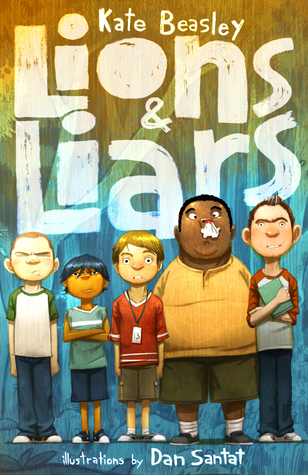
35791906Beasley, Kate. Lions and Liars
June 5th 2018 by Farrar Straus Giroux
E ARC from Edelweiss Plus

Frederick Frederickson is angry with his parents because they are canceling the family vacation cruise because of an impending hurricane. The upside is that he gets to go to his friend Joel's birthday party. The downside is that he is in a boat that gets caught in a storm, washes away overnight, and ends up at a camp for troubled boys. Everyone there assumes he is a camper named Dashiell, and he doesn't insist on setting them straight, so falls right into camp life with the other boys, all of whom have different issues. He manages to make friends, so when the hurrican hits camp, the boys all work together, and eventually Frederick gets back to his family.
9462760Strengths: This has a great cover by Dan Santat (and Yoo's The Detention Club (2011) still circulates really well!), and is a solid, funny camp story.
Weaknesses: I could not get past the fact that Frederick was a missing child and no effort was made to get him back to his family. I'm not sure why this bothered me so much.
What I really think: This is a more of a fifth grade/elementary book so I don't think I'll be purchasing; I'd like to see more middle grade books set in summer camp.

Thursday, May 31, 2018

Just Under the Clouds

31294252Sarno, Melissa. Just Under the Clouds
June 5th 2018 by Knopf Books for Young Readers
E ARC from Netgalley

Cora's mother has struggled to keep a roof over Cora and her sister Adare's head ever since the death of their father six years ago. This can be a challenge in New York City, even though the mother has given up her artwork and is working in a store. Cora does fairly well in school, although has been moved around so much that she struggles to make friends. Adare had a lack of oxygen at birth and has a host of unspecified challenges, mainly characterized by not focusing on the present, and occasionally holding her breath. When their last shelter is broken into, the family moves in with Willa, who is from the same town in Texas as their mother, but doesn't exactly approve of her choices. Cora finds the nice apartment, and taking the subway, to be interesting, and she is open to making some friends. Sabina is friendly, and lived near the shelter, so she seems safe. It turns out that her family is also a little unusual, and they live in a boat on the canal. Cora is very interested in trees, since her father worked in the parks and left her a notebook of his sketches and information about trees. When she finds the particular "tree of heaven" that he was studying, she wants to climb it to feel closer to him. Things with Adare get out of hand, however, and when she goes missing, Cora must come to terms with her past and present and find a way forward.
Strengths: The author MUST be drawing comparisons with A Tree Grows in Brooklyn, with the poverty and instability, the beloved father, and the "tree of heaven". There need to be more books about students who are not comfortably middle class, so that readers can either see themselves or understand others a bit more. This has lots of details about Cora's life that my students will find interesting. Cora's experiences are realistically and sympathetically done, and the book is short and moves quickly, which is never a bad thing in a middle grade novel!
Weaknesses: It seemed odd that Adare, at age ten, would not have been identified with a particular condition, even with the family's instability. Also, the grieving for the father takes up more of the book than I would like.
What I really think: There is a delicate balance of things my readers like in a sad book. They like lots of descriptions of what life is like, but they are not as fond of the character's introspection about their situation, if that makes sense. (I spend a large part of my day involved in the nuances of what students want in a book!) This is a little slower than my students usually want, but I will probably purchase it, and this is certainly a great book to look at for most collections.

36635794Mahoney, Kristin. Annie's Life in Lists
May 29th 2018 by Alfred A. Knopf BFYR
Copy provided by the publisher

Things are not going well for Annie's family, so they move from Brooklyn to a very small town. Her mother's job is transferable, and her father has some new opportunities. Neither Annie (Andromeda!) nor her high school aged brother are happy about leaving their old neighborhood and schools, especially for a small town. Annie does manage to make some new friends in her school, but things don't always go smoothly, like the time underwear is stuck in her pants leg from laundry day and she kicks it out during a kick ball game! Clover Gap's attractions are somewhat lacking as well, and Annie's not fond of antiquing or leaf peeping with her parents. As the year progresses, Annie gets help from Zora to put together a "not too scary" Halloween costume for school, has family visit for Thanksgiving, since her family has a bigger house, gets used to the cold weather in her new town, exchanges Valentines, falls in a giant hole, finds out more about why her family moved, and finishes up the school year, prepared to come back the following year.
Strengths: This is told in Annie's lists, with some page decorations. Annie is an endearing character with a supportive family, and her concerns are solidly middle grade. Not earthshaking, perhaps, but certainly the sorts of concerns that my students have about family, friends, and place in the world. Weaknesses: I was not a fan of the format, but some of my students will find it appealing.
What I really think: Even with the format, nothing terribly fresh. It will circulate well because of the cover, and the description is correct that fans of Anastasia Krupnik and Ramona Quimby will pick this up, but Annie (perhaps because of the list format) doesn't seem to have the strong, really engaging personality of those other heroines.

Wednesday, May 30, 2018

How We Roll, Jasmine Toguchi

35791915Friend, Natasha. How We Roll
June 5th 2018 by Farrar Straus Giroux
E ARC from Edelweiss Plus

Quinn's family has moved from Denver to near Boston so that her brother, Julius, who is on the autism spectrum, can attend the Cove school. Quinn is glad to move, since she is suffering from alopecia, and can start her new school with a wig so that no one will suspect. She also had some bad occurrences with her friends in Denver at the end of 8th grade, and is glad to be starting over. She is accepted right away by a small group of girls who seem nice enough, but she is intrigued by one of the girl's former boyfriends, Nick. Nick was involved in a ski mobile accident and lost both of his legs, so is in a wheelchair while he is learning to use prosthetic legs. Nick's brother, Tommy, was responsible for the accident (he was driving drunk), but is still considered very cute by the other high school girls. Nick is bitter, because he was an up and coming football player. As Quinn makes friends with him, she finds out that he enjoys drawing more than football, but his father thought that artistic endeavors took away from sports activities, so didn't encourage him. Quinn is afraid to tell her new friends about her alopecia, but after Nick and Tommy help her get Julius off the roof of her house, her wig falls off, and they know. She eventually tells her friends, who are more understanding than she thinks they will be, and also makes some peace with her parents, who are often more concerned with Julius than they are with her.
Strengths: Friend's work is always concerned with issues students today face, and she treats these issues with frankness and compassion. My daughter was a huge fan of her Perfect, Lush, and Bounce. Quinn's experiences with being touched inappropriately and with a boy hinting that she participated in a sexual activity are handled in a very helpful, middle grade appropriate way. Quinn knows she should tell someone, but doesn't, and does not feel right until she is able to process the experience with her mother, who is very understanding. This is a great lesson for middle grade readers. While it seemed a little unlikely that Nick and Quinn would hit it off so quickly, this was also realistically done; Quinn, as a new student with her own secrets, was able to connect with Nick in an honest way that classmates who knew him before the accident weren't able to pull off. The description of dealing with alopecia also was instructive and sensitive, and one I haven't really seen since Haddix's Because of Anya (2002). While we are seeing a lot of books about children with siblings on the autism spectrum, Julius' difficulties make sense in this book. You'd think there are too many issues, but somehow Friend pulls it off. Love this one!
Weaknesses: Having had many friends who got PhDs in Classics and were never able to find a job, I found it hard to believe that the father would leave a job in Colorado AND found one in Boston. AND spoke in Latin to his daughter. Cute, but I am the only one who isn't buying it!
What I really think: Definitely purchasing, although I wish the publisher had kept the cover style of  Perfect, Lush, and Bounce.

34495933
Florence, Debbi Michiko. Jasmine Toguchi, Drummer Girl
April 3rd 2018 by Farrar Straus Giroux
Public library copy

Jasmine's school announces that there will be a talent show on the coming Saturday, but she's not sure what talent she can demonstrate. Most of her talents, like mochi pounding or collage making, are good for showing to people. All of her friends seem to dance or take music lessons, so they automatically have things to do. When Jasmine mentions this to her mother, they go to visit a college friend of her mother's who plays taiko, Japanese drums. Jasmine takes to them right away, but is disappointed that she still needs to practice, even though she has a talent for them, With less than a week to prepare, it's a close call, but with some help from her mother and sister, Jasmine is ready for the show, even if the practice doesn't go the way she thinks it should.
Strengths: Books about children who do things and have interests are fantastic, and the fact that Jasmine discovers an activity that is also connected to her cultural identity is particularly fun. I love her supportive family, her struggles to identify what she likes, and the difficulties she faces when learning something new. This is a great length for beginning readers, and has a feel of B is for Betsy for the new Millenium.
Weaknesses: Less than a week for a talent show? And Jasmine premiers a talent she has just learned? Seemed unlikely, but made for a good story.
What I really think: I'm going to wait and see if my students this coming year are still reading books that seem young for 6th grade. These are an essential purchase for elementary school, and I would have adored them in first grade, but I'm a little leery of purchasing them for middle school.
Ms. Yingling

Tuesday, May 29, 2018

Float

Martin, Laura. Float
May 29th 2018 by HarperCollins
E ARC from Edleweiss Plus

Emerson has a category five RISK rating, but not because he is a threat to others. He can float, and without his weighted vest and shoes, could end up floating away from earth and being in grave danger. His single mother is very stressed at the thought of having him monitored over the summer, so is very excited to send him to Camp Outlier, where children at RISK can be supervised and have a more typical summer experience. Emerson is less than thrilled, and when he gets to camp, he finds that most of his bunk mates feel the same way. Hank, who has inconvenient invisibility, is somewhat more exuberant than the others, and encourages Hank to throw away his heavy shoes and "live life" for a change. The Red Maple cabin (whose inhabitants include a boy with a skunk as a therapy animal, one who occasionally bursts into flame, and one who sticks to things and must wear special gloves) tries there best at all of the competitions, tries to connect with the girls their age in another cabin (one of whom occasionally turns into a cocker spaniel!) and helps one of the boys (who travels through time and doesn't see himself in the future) work through his bucket list. Luckily, their efforts are generally successful, and Emerson has a great summer.
Strengths: The author's notes at the back of the book, describing the tales her father told about summer camp, added a nice touch of nostalgia to this. Emerson and his camp mates are all sympathetically portrayed, and the time travel is a particularly interesting idea. The writing of actual letters makes sense here, since camps still don't let children have access to technology.
Weaknesses: The boys being hazed by an older cabin and made to wear dresses rubbed me the wrong way, somehow. I can't imagine it would be allowed at all, as badly as many hazing episodes go. I also could have used more explanation for the RISK occurrences.
What I really think: This author's The Ark Plan was a great dystopia with dinosaurs, but it hasn't circulated as well as I'd hoped. I need more summer camp stories, and I personally thought the inclusion of the fantasy elements gave a fresh twist to this.

I've been looking for summer camp books because I think summer camps are harder and harder to find-- my own children had to go to church camp, because everything else on offer was so specialized and expensive. It didn't end well. When I was growing up, back when dinosaurs roamed the earth, there were scout camps, YMCA camps, and many of my friends went every year, sometimes for a month or two. I don't think that is the case any more, at least in Ohio. (Wow. Brief search shows that a one week camp for three hours a day is $235. That seems wickedly expensive!)
Ms. Yingling

Monday, May 28, 2018

MMGM- Postcards from Venice


It's Marvelous Middle Grade Monday at Always in the Middle and #IMWAYR day at Teach Mentor Texts and Unleashing Readers. It's also Nonfiction Monday.


36373439Romito, Dee. Postcards from Venice
May 29th 2018 by Aladdin
E ARC provided by Edelweiss Plus

Skyler has always wanted to go to Venice, and she gets her wish when her workaholic mother gets assigned to spend the summer in the Venice office of the food company for which she works... and may get to stay on for the whole year! Since her dad is staying behind in New York, Skyler  needs something to do, so her mother arranges for an internship. At first, Skyler almost ends up in accounting, but when she meets cute Austalian boy Logan, he suggests she work on the social media internship with him. Skyler must critically assess her experiences in her new city, take pictures, and write pieces for the company blog. This is not really Skyler's forte, but she does her best, even when fellow intern Zara (whose parents travel a lot, so Zara speaks multiple languages and is more world savvy... and weary!) sabotages her efforts and routinely gets her in trouble. While it's fun to hang out with Marissa, who is overseeing the interns, and with Logan, who is a lot of fun, Skyler wishes her mother didn't have to work such long hours. There are all sorts of adventures to be hand in Venice, and Skyler makes the best of them, although she also spends a lot of time working on her writing. Marissa makes a lot of good suggestions, and Skyler improves a lot, but in the end, the work is very stressful. If she and her mother end up staying for the year, will Skyler even want to continue on with the company?
Strengths: I have read a LOT of travel books, and the best thing about this was that Skyler really WANTS to be in Venice. All too many books concentrate on home homesick the character is or how much they don't like being in some fabulous, far away place, so that was really refreshing! She had a good background knowledge and enthusiasm for being where she was. It was also nice that her mother was around but busy... I think this happens much more in the real world than dead parents do. I was also very pleased that Skyler was writing even though it wasn't easy for her, and she tried really hard. The drama with Zara and slight romance/friendship with Logan were both great.
Weaknesses: I'm a great believer in handing all books to all children, but let's look at this realistically-- if Logan and Skyler were shown on the cover with notebooks and cameras in hand, walking around Venice, this would be a whole lot easier to hand to boys. It's one thing to be idealistic and tweet about how books don't have gender, but that is not going to change the way that actual boys and girls look at actual books.
What I really think: Love, love, love this story and will definitely purchase, but it will circulate predominately to girls, no matter how hard I try. Interestingly, few of the books about traveling have boys as the main characters. Hmmm.


36025290
Killion, Ann. Champions of Women's Soccer
May 1st 2018 by Philomel Books
Copy provided by publisher

Killion, Ann. Champions of Men's Soccer
May 1st 2018 by Philomel Books
Copy provided by publisher

36025289When it comes to biographies, my rule of thumb (instituted after weeding a 1986 biography of Michael Jackson shortly before his death) is that the subject needs to have passed away or be past his or her floruit. While the subjects in these corporate biographies are living, some are no longer playing soccer, so they seem like a good investment.

Both of these books give a good overview of the history of modern soccer, and cover the players who were most popular. Starting with Mia Hamm (born 1972) for the women and Pele (born 1940) for the men, these books cover soccer luminaries, many of whom even I have heard! I thought these went in chronological order of the careers, but they do so only roughly, Most of the biographies give a date of birth, but not all, and talk a little about the subjects introduction to soccer, a brief description of family life, career progression and highlights, and information about what else the person has done.

At the end of the books, there are a few interesting compilations, such as the Top Ten Events , Top Ten Biggest Upsets, and brief bios of rising stars. There are also black and white pictures of a few notable moments, and a well done index.

The thing that I liked most about these books was the format. The book is the size of an average middle grade novel, the covers are bright and full of action, and the print is a comfortable reading size. This is huge, especially for readers who would rather be out playing soccer rather than reading about it! The short entries make this easy to browse or skim, but also lend themselves to rereading about favorite players.

All in all, well done volumes that will see a lot of circulation for a longer than usual time period, given the emphasis on the history and development of the game. An essential purchase for middle school libraries with a student population interested in soccer.

Sunday, May 27, 2018

Two Dogs in a Trench Coat Go to School

34451595Falatko, Julie and Jack, Colin. Two Dogs in a Trench Coat Go to School
May 29th 2018 by Scholastic
E ARC from Edelweiss Plus

Waldo and Sassy are hard working dogs who scour the floor for meatballs and keep their humans' house safe from squirrels every day, even when the humans give them the Breakfast of Distraction and escape every day. They worry about their boy, Stewart, who seems very sad to go to school, so they work out a plan to get into the building and check out Stewart's evil overlords. Luckily, Waldo can speak human, so when he shows up at school wearing a trench coat and blaming all of his quirks on the fact that he is from Liver, Ohio, the teachers and students all believe that he is the new student, Salty. The biggest problem that Stewart is facing is that he hasn't done any work on his big project, and has even lost the Information Sheet about it, which spells certain doom. Once Waldo and Sassy get accustomed to the school routine (piles of meat for lunch!), they try to help Stewart with his project. They decide that squirrels are a great topic, and manage to put together a project that saves the day. There is a sequel in the works!
Strengths: Even though this book would be easy enough for strong first grade readers to enjoy, it has a ton of funny jokes that will amuse adults as well. I love finding books like Stick Dog that incorporate both elements-- it's like whole wheat, organic toaster pastries sweetened with stevia. I read huge passages to my daughters, who agreed that Waldo and Sassy's voice sounds exactly like our dog Sylvie's, and we have taken to saying "tiny carrots wrapped in bacon" at every available opportunity. The parents' descriptions of being at work and playing with office supplies were hysterical as well. Plus... squirrels!
Weaknesses: I strongly suspect that this will be a paper-over-boards binding, which will mean getting a copy from Perma-Bound because this is too good a book to let fall apart within a year!
What I really think: Willing to spend a little more money and time on acquiring good bindings on quality notebook novels like Stick Dog, Big Nate and this book. Slightly annoyed at the publishers, but still glad of the books!

Blabey, Aaron. The Bad Guys in Alien vs. Bad Guys
March 27th 2018 by Scholastic Paperbacks
Copy provided by Young Adult Books Central

Dr. Rupert Marmalade, the hamster alien, has been defeated, and the Good Guys Club is celebrating. However, when they find themselves lost in deep space and once again at the will of evil, they are less than happy. Marmalade is now a slimy alien with dozens of tentacles... all of which end in tiny butts! Unless the guys can escape, they are all doomed to die. Legs figures out how to work an escape pod, and they're all set to go-- until an alien nabs Legs. Snake wants to go ahead and leave, abandoning their friend, but the others won't hear of it. At one point, Wolf and Snake have a heart-to-heart about their friendship, but snake leaves anyway. Or does he? Shark has a great plan to disguise himself as a butt-tentacled alien, and his costume is very convincing... until it isn't any more. Things like they are going to come to a grim end, when the day is saved by an unexpected source!

Blabey's illustrations are hysterical, and support the text brilliantly. When Wolf says "OK, if you vote to stop looking for our friends, raise your hands," the next box is just snake, looking VERY unhappy. So much emotion is able to be conveyed by the expressions on the faces, and of course, butts are always funny, especially when they are on alien tentacles!

The Bad Guys have really grown throughout this series, and now are completely devoted to saving the world. Who knew that starting to save kittens from trees (however unwillingly they were saved!) would end with the guys saving the world from complete and utter devastation-- not once, but twice. They have an uncanny knack for figuring out alien space ships, machinery, and weapons that the cast of Star Wars might envy!

The humor and illustrations in the Bad Guys series appeals to readers who giggle at Eaton's Flying Beaver Brothers and Eliopoulos's Cosmic Commandos, but the book has enough serious themes that make is akin to Winnick's Hilo when it comes to adventure and saving the day. While there are plenty of space cats books, this is the only one I know that has a space spider, snake, shark, piranha and wolf!

Saturday, May 26, 2018

Cartoon Saturday- Born to be Good (How to be a Supervillain #2)

Fry, Michael. Born to be Bad Good (How to be a Supervillain #2)
May 1st 2018 by jimmy patterson
ARC provided by Young Adult Books Central

Victor Spoil is back after defeating Dr. Deplorable in How to Be a Supervillian. He's still struggling with wanting to be good even though his parents are supervillains, but now he at least has some friends who understand how he feels. He has gained a lot of information about how to rock spandex and harness his super power, which happens to be tickling people. There is, of course, the irritation of Niles, who is not only attractive and perfect, but gives Victor a hard time. Victor has come to the conclusion that he's not a fan of the job description of "supervillain" and informs his parents that he has decided instead to pursue a career as a librarian! However, when all of the parents go missing, the children (including Moldy Dave, Javy, Norman and Octavia) must go looking for them. They find them, stuck in action poses, being collected by the Commodore. In order to prevent himself from being taken into the collection, Victor claims that there is a crucial piece of the collection missing-- the amazing Captain Chaos. The Commodore doesn't quite believe him, but wants the captain, so an elaborate ruse is put in place with The Smear and an animatronic Captain Chaos to try to win back the parents and save the world.

Fry's artwork in this notebook novel still reminds me of Berkeley Breathed's Bloom County, with Victor looking a lot like Milo, wild hair and all. Since young readers have no idea about this piece of "ancient" artwork, they will just enjoy the goofy, pop eyed characters in their saggy spandex briefs and capes.

The writing is filled with all manner of odd, anecdotal bits that don't have much to do with plot development, but everything to do with getting a laugh. Butt lasers, sparkle bombs, Nilixian Rootbeer and mind readers who have dyslexia. It doesn't hurt the nine-year-old knee slapping factor at all that many of these items (Spleen Island!) are accompanied by pictures.

Patterson has quite a collection of books he has written with others under the "jimmy" imprint, so as Middle School: The Worst Years of My Life and Treasure Hunters, but it is good that he is letting other authors have full credit in his new line of James Patterson Presents Books. Even the most reluctant reader won't be too disappointed to find these books wrapped up as gifts!

Ms. Yingling

Friday, May 25, 2018

Most Valuable Players

35791912Bildner, Phil and Probert, Tim. Most Valuable Players
May 29th 2018 by Farrar, Straus and Giroux (BYR)
E ARC from Edelweiss Plus

Rip and Red are sad that 5th grade is ending, and more than a little apprehensive about what middle school will bring, but looking forward to the big celebration that will take place. Not only is there a graduation, but there is a school fund raiser that will include the Hoops Machine, an humorous exhibition team. Rip has been selected to go on the court with him and is very excited. However, when required tests are scheduled to be administered during the last week of school, the students start to rebel. They have enjoyed their quirky teacher, Mr. Acevedo, and feel that the tests are not a true test of what they have learned in fifth grade. Unfortunately, the school board decides that the entire fifth grade will be kept from participating in the fundraiser (and the Hoops Machine game) since they refused to take the test. Can the parents prevail one final time at the boys' school?
Strengths: Anything involving basketball is great, and the ensemble cast is full of appealing characters. Mr. Bildner works in a lot of fun activities and school events for the characters, and they all seem to have supportive (and diverse) family structures. Circumstances are portrayed realistically, and there are consequences for actions.
Weaknesses: Testing is here to stay. It always has been around, and polemics against are largely futile. This was the one part of the book that struck me as unrealistic-- we have had any number of students opt out of testing, and there are never any negative consequences for the students. I don't think we are allowed by law to assign any. There are, of course, negative consequences for teachers and the school when students who are doing well in school don't take the state tests, but it doesn't really help students to belabor that point.
What I really think: I was hoping this series would circulate more, but it hasn't. Perhaps the cover illustrations are more appealing to elementary school students? I think I will pass on purchase unless circulation picks up on the other books.
Ms. Yingling

Thursday, May 24, 2018

Sandapalooza Shake-Up (Welcome to Wonderland #3)

36082854Grabenstein, Chris. Sandapalooza Shake-Up (Welcome to Wonderland #3)
May 22nd 2018 by Random House
Copy provided by the publisher

P.T. and Gloria have saved the Wonderland Motel, and now because of the celebrity tie-in with the Surf Monkey movie, the family of the Marquess of Hereferrshire is staying with them while they visit Disney World to loan the Twittleham Tiara to the theme park to display in the castle. The family, especially the young daughter, Lady Lilly, are all fairly snooty, but P.T. is so busy with the new motel restaurant and a sand castle competition that he doesn't give her much thought. The motel has sponsored a sand sculpting team consisting of Travis and Darryl to give the motel good advertising, and they do a great job. When the Twittleham Tiara is stolen, however, the reliable business of the motel starts to falter. The royals move out, and the Conch resort starts an ugly smear campaign saying that the Wonderland is not a safe place to stay. Blame falls on several employees, including a housekeeper and the cook in the new restaurant. With a reduced staff, everyone must kick in, which leads to less time to investigate the crime. P.T. and Gloria are on the case, and P.T. is also investigating whether Travis might be his father. In the end, they manage to figure out the theft, which has deeper roots than one might expect.
Strengths: Grabenstein really understands how to write interesting and well-developed mysteries that are amusing and not overly complicated. Are the books great literature? No. Are they fun to read? Yes. I love the Florida motel setting, the mother and grandfather are especially great, and there is goofiness aplenty. Great series for summer reading!
Weaknesses: Paper over board cover wear horribly, and the evil characters are a bit over the top. Conch's moves in this book were overly criminal, which was a bit jarring given the general goofiness of the story. This might be something that strikes me more as an older reader and might not matter as much to younger ones.
What I really think: Definitely purchasing. The bright, cheerful covers alone are worth the price!

Wednesday, May 23, 2018

Rereading after inventory

SHOULD I keep my old favorites? Clearly, if a book doesn't bring me any joy AND it's not circulating well, it goes. I get about 1,000 new books every year, and if I didn't weed aggressively, it would quickly become a problem. Occasionally, I look critically at older titles just to see how they hold up. Of course, I was almost in tears when I realized I had gotten rid of Eleanor Cameron's The Court of the Stone Children, especially since there doesn't seem to be a copy in the entire Ohio library system. If I recall correctly, however, I reread that one and wasn't enthralled as I had been. I never had a library copy of A Room Made of Windows, and I would probably want to slap Julia anyway.

Here are some titles that I loved as a child and have kept in the library. Will I keep them forever? Depends on my students. I must continuously tell myself  "This is not an archive"! Would that it were.

377889Boston, L.M. The Children of Green Knowe
1954, School Library Copy

Toseland is sent to live with his great grandmother because his parents are in Burma and he's tired of having to stay with teachers at boarding schools. When he arrives at the house in the country, the whole area is surrounded by water, and he is picked up in a boat! He loves the old house, but finds it a bit eerie and magical. He is intrigued by a picture on the wall showing other children who lived in the house-- in the 1600s! Mysterious things keep happening, and his Granny is understanding when they do. Tolly, as his Granny calls him, gets to know about the heritage of his family and the house in a particularly interesting way.
Strengths: Tolly is a great character, full of adventure and optimism. Granny is also just what he needs in order to finally feel he has a home. The house is fantastic, and the idea of connecting with other children from that long ago is intriguing.
Weaknesses: I felt like I need to read the rest of the books to get to the meat of the story.
What I really think: I remember this as having a lot more time travel, but the connection with the past wasn't very concrete. This was also a lot slower than I remembered.
Stay or Go?: Stays, but I feel children might benefit from being told it is an older title.

2958889Bellairs, John. The House with a Clock in Its Walls (Lewis Barnavelt #1)
1973, School Library Copy

In 1948, after Lewis' parents both die in a car accident, he is sent to a town in Michigan to live with his Uncle Jonathan, who is well-to-do but doesn't seem to have a job. He lives in a huge old house that used to belong to an evil magician, and both he and his friend and neighbor, Mrs. Zimmerman, practice a little bit of magic themselves. There is a clock hidden deep within the walls of the house that can be heard in every room, but the uncle doesn't know how to make it stop. Lewis settles into his new school and eventually makes friends with a popular boy named Tarby, which is unusual for him because he is overweight (trigger warning: the word "fat" is used frequently, and in a perjorative sense a lot in this book) and bad at sports. In order to keep Tarby hanging around with him, he plays up his uncle's magical abilities and manages to raise the magician's wife from the dead, causing all manner of problems but ultimately solving the problem of the clock.
Strengths: In terms of pacing and excitement, this holds up well in comparison to modern titles. Nicely creepy, and I adored Uncle Jonathan and Mrs. Zimmerman!
Weaknesses: Clearly, the taunting use of the term "fat" by several characters is problematic today. I did some research on Mr. Bellairs, who died in 1991 when he was about my age, and it looks like he might have been rather overweight himself, so these scenes might, sadly, be based on his own experiences.
What I really think: I am so very glad I held on to ALL of the Bellairs books and want to get them back into students' hands!
Stay or Go: Stays, especially with the movie coming out in the fall. Wonder if the paperback reprints will be changed at all?

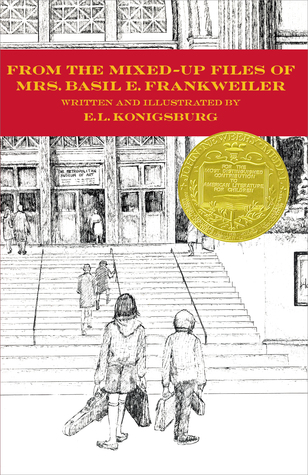
1462487Konigsberg, E.L. From the Mixed-Up Files of Mrs. Basil E. Frankweiler
1967, School Library Copy

Claudia is just fed up with her family and the way they treat her, so she decides to run away. She decides to take her 9-year-old brother Jamie with her because he's the least annoying of her three brothers and has more savings to fund the venture. They make pretty solid plans to get to the city, packing their clothes in their instrument cases, and decide to live in the Metropolitan Museum of Art. They scope out good places to hide, sneak out to get food, and even bathe in an indoor fountain. When the museum is abuzz with the purchase of a new statue that may have been created by Michaelangelo, Claudia decides to solve the mystery before returning home. This involves traveling to meet the previous owner of the statue, and looking through her files to find clues.
Strengths: The details about running away and staying in the library are extraordinary! It makes it seem completely reasonable that the two could live in the museum for a week. I found myself not caring about the mystery of the statue quite as much, but admired Claudia's persistence in finding a reason to have been away from home. I thought the level of worry about her parents was realistic, and there is an article in the paper about the two being missing.
Weaknesses: I wasn't very convinced about WHY Claudia felt a need to run away, but what tween doesn't want to run away from time to time? Transistor radio. Wow. No cell phones. That is really the only in-your-face stuff that dates this. Plus maybe  museum security.
What I really think: I can see why this one is a perennial favorite for teachers and students alike.
Stay or go?: Definitely stays. This holds up really pretty well in terms of pacing, technology, and everything else!

Listen to Your Heart

36127456West, Kasie. Listen to Your Heart
May 29th 2018 by Point
E ARC from Edelweiss Plus

Kate would rather be out on the lake on her family's Wave Runner than do anything else, but when school starts, she has to resume family responsibilities and buckle down for her junior year. Her best friend Alana has encouraged her to enroll in a pod casting class, although Kate doesn't think this is a good idea. The class has to come up with a theme for the year, and when Kate's is chosen, she finds out that she will also have to be a co-host all year, along with the self-assured Victoria. Alana also has Kate checking out Diego, on whom Alana has a crush, and when Kate finds that he works at the tutoring center where she takes her cousin every week, she spends a lot of time with him, talking up her friend. Add to this mix Frank, whose family owns a lot of property around the lake and would like to buy Kate's family's business, and things get complicated. Kate goes out with Frank, who ends up liking Alana, but Kate can never figure out if Diego likes HER. When the podcast must go live at a community festival, everything comes to an amusing conclusion.
Strengths: Like this author's Lucky in Love, this is a fun, light romance set in high school that is also appropriate for middle school readers. I loved that Kate had her own passion (the lake) but was investigating things out of her comfort zone (pod casting). She wasn't desperate to have a romance, and spent a lot of time becoming friends with Diego, thinking he was interested in Alana. Her family was around (cousins and aunts and uncles lived next door) but not intrusive. Very sweet, with added bonus points for a strong sense of place.
Weaknesses: I like that characters were from different cultural backgrounds, but it wasn't completely convincing at times. (Would someone from Hawaii be described as Polynesian? I honestly don't know whether or not this is the case.)
What I really think: I need to read more Kasie West books. I didn't have a lot of readers this year who asked for more high school-type romances, but when I get readers who do like those, they will often go through several a week, and having fresh titles helps. (Remember Simon Pulse Romantic comedies? They are now as old as some of my students. Sigh.)
Ms. Yingling

Tuesday, May 22, 2018

A Warp in Time (Horizon #3)

Watson, Jude. A Warp in Time (Horizon #3)
January 30th 2018 by Scholastic Inc.
Copy provided by Young Adult Books Central

The children in the Killbots whose plane went down have suffered from having friends die, being stuck in all sorts of treacherous situations, and losing their confidence in their survival. Just when they are faint with hunger and about to give up, they hear the voices of other humans. They meet another group of children, the CubTones, who were traveling home from the Macy's Thanksgiving Day parade when they were ripped out of their plane in a similar fashion. They managed to save more things from the plane, including china, seats, and other things to make their camp more comfortable. They seem to be settling in for the long haul, which makes Molly worried. It gets worse as they talk more to the members of the band and realize that they make a lot of references to daily life that the Killbots don't understand. Molly is worried that the bite she has gotten from the bird will begin to affect her, especially since she meets Calvin, who has a similar bite and is kept in a separate quarters by the CubTones because all manner of things irritate him. He talks nonsensically, but the more that they listen to him, the more it is clear that he is trying to tell everyone more about surviving in this weird wilderness and maybe, someday, being able to return home.

There are a lot of characters in these books, and they remain true to how they are portrayed in previous volumes. Yoshi is still trying to prove himself, because he feels his parents don't want him. Molly is a good leader, but worries that her skills will decrease all too soon. The Japanese sisters are learning a bit more English, and able to communicate with the group through Yoshi. Javi really steps up and tries to help Molly. Hank is a good leader for the CubTones, and Kim, Crash and Pammy are all very separate entities. Calvin, of course, is difficult to read, but Molly does try to figure out the mystery.

There is an online gaming component to these books, so many of the children's adventures have a disctinct video game feel-- they travel around, have to fight monsters, and find gadgets that help them with what they are attempting to do. The first book in the series is by Scott Westerfeld, and the second by Jennifer Nielsen, but Jude Watson is able to maintain the same feeling and writing style that made these books quick reads.

Children who love science fiction series like Voyagers! Or Todd Strickland Mars: Year One will find plenty of action and adventure in the Horizon series, and the mystery will appeal to those who have finished The Thirty-Nine Clues or Infinity Ring series.

606639
DuBois, William P. The Twenty-One Balloons
September 14th 1947 by Viking Books for Young Readers
School library copy

I was waxing nostalgic about books with my elder daughter over the weekend, and this title came up, along with Morley's Parnassus on Wheels and Roberts' I am the Great Horse. Clearly, this child picked up my eclectic reading tastes. Since I'm about to run out of ARCs and summer is quickly approaching, I treated myself to a reread of this book, which is still on my library shelves.

William Waterman Sherman has taught math to students for 40 years in San Francisco, and we catch up with him in 1883 after he has sailed a balloon far away, in order to escape the cares of the world. Unfortunately, his balloon (which was brilliantly equipped with wicker furniture and a silk mattress filled with gas) is attacked by birds, and he crashes onto the island of Krakatoa. There, he is met with Mr. F, who is garbed in a full morning suit, and is shown the wonders of an island with such an enormous diamond mine that it can support 20 families in amazing style. Because of the necessary secrecy surrounding this vast wealth, Sherman is told he can't leave, but as long as he doesn't have to teach the 40 children on the island, he is okay with that. The residents have a restaurant form of government, and each family provides one meal a month, based on the letter of the alphabet assigned to their family, and the corresponding culture they have appropriated for the food as well as the architecture of the home. Sherman isn't wild about the Chinese food provided by the Cs, but looks forward to the Italian food as the month progresses. There are lots of details about how the people get money for the diamonds without ruining the market, and also about the details of mechanical beds that drop the occupants right into the bath! The book moves quickly, however, and soon Krakatoa is due to explode. The residents are prepared, and take off in a balloon powered platform, leaving Sherman to crash land in the ocean. He tells the Explorers Club about his adventures.

There are problematic passages, such as an incident with a Native American tribe having the top of the Explorers Club building land on their reservation, a mention of Negroes, and the general cultural appropriation of the restaurant culture and the vaguely disapproving feel that had.

I got rid of The Cricket in Times Square because of the lengthy, unflattering description of a Chinese man, but I'm a little conflicted about this. The book is completely typical of its time, and not purposefully mean spirited. The idea is such a fun one. Should it stay, or go?

This is why it is good to occasionally revisit older titles. Tonight's reading may include The Children of Green Knowe and The House with a Clock in Its Walls, since it's going to be a movie in the fall.

Monday, May 21, 2018

MMGM-Front Desk


It's Marvelous Middle Grade Monday at Always in the Middle and #IMWAYR day at Teach Mentor Texts and Unleashing Readers. It's also Nonfiction Monday.

31247008Yang, Kelly. Front Desk.
May 29th 2018 by Scholastic/Arthur A. Levine
ARC provided by the publisher

It's the early 1990s, and Mia and her parents have moved to California from China in search of more freedom and opportunities. Unfortunately, they are not able to get the same sort of professional jobs they had in China, and work at a Chinese restaurant until Mia's help turns disastrous! They eventually find a hotel in Anaheim in need of managers, and are happy that they won't have to pay all of their salary for rent. The owner, Mr. Yao, promises them a certain rate per customer, but ends up not treating them very fairly. This makes things even harder for Mia. Not only is she helping to run the front desk while her parents spend a lot of time cleaning, she has to be in class with Jason Yao. Mia struggles a bit in school, although her English is very good. She has some trouble getting along with the other students, who are not very kind about the clothes she wears or her immigrant status, but she does find a friend in Lupe, whose father comes to repair something at the hotel. Both girls have told some white lies about their lives, knowing that other students might not understand how difficult their lives can be. Word gets out that Mia's parents occasionally will put up other Chinese immigrants at the hotel for free, so there is a steady stream of people in need of a helping hand. Mia also gets to know the "weekly" residents, including Hank. When a car is stolen from the hotel, the police look suspiciously at Hank, who is black, and when Hank later runs down criminals who beat up Mia's mother, he ends up in jail. Mia doesn't think this is fair at all, and uses her writing skills to try to improve his situation. She also uses these skills to try to win a hotel in Vermont in an essay contest. She even manages to gather a lot of money to enter, although her mother's hospital visit after being beat up threatens to be very expensive. Mia learns that while her hard work doesn't always pay off, it gets her and her family much closer to their goals of being comfortable US citizens, and also helps those around her.
Strengths: This had a lot of very well placed elements going for it. First, it is an #ownvoices book, and Yang has drawn on her own experiences. She mentions in a forward that her early days in the US were very difficult, and she wanted to share this with her son without writing a depressing book. She succeeded admirably. While the difficulties on Mia's life are very apparent, Mia, her parents, and the other people with whom Mia interacts all try very hard to do their best and to help others who need it. This makes the book realistic but upbeat. Young readers who do not understand the difficulties of immigrant life will definitely understand them after reading this book, but because Mia is such a likable character, they will hopefully use this understanding to be nicer to people in their own lives. The incident with Mia having to wear flowered stretch pants instead of jeans was heart breaking to read as an adult, and I hope that it will help readers be more aware of the difficulties their own classmates may face.
Weaknesses: As an adult, my heart broke for Mia again and again.
What I really think:  This is an essential purchase for elementary and middle schools alike, and will be enjoyed by readers who may not understand how powerful the book is. I do think it will help readers to be empathetic, and we certainly need more of that!

This is a great book to read along with Sonnenblick's The Secret Sheriff of Sixth Grade, because of the kindness it teaches. The school principal in that book has a quote up on his wall: "Be kind, for everyone you meet is fighting a hard battle." Too bad that even adults have trouble with this concept.