Sunday, February 13, 2022

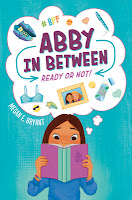
Abby in Between: Ready or Not

Bryant, Megan. Abby in Between: Ready or Not
February 15th 2022 by Penguin Workshop
E ARC provided by Edelweiss Plus

Abby's best friend is her cousin Zoe, whose family is moving from North Carolina to California for the father's new job. She has given Zoe stationery to match some that she has, with flamingos on it (an inside joke), but Zoe is given her own phone to keep in touch with friends, and at nine, Abby's mother says she is too young and has to wait until 8th grade. With fourth grade just starting, this seems like forever! Abby doesn't have the teacher that she wanted, and there are more changes at home. Her mother is going back to work as a paralegal because Abby's father has lost his job. Money will be tight, and Abby has been enrolled in an after school running club. Since she hates to run, she begs to be allowed to go with her father on his part time, gig economy jobs, but is shot down. Running makes her sweat, and she is keenly aware that she now smells. She's been given deodorant, and is also worried about her developing breasts, since she had an aunt who had a concern about cancerous lumps. Her mother takes her to the doctor for reassurrance. Zoe doesn't answer her letters, her mother is often busy with work, and she struggles with making friends, although there is one girl in the running club with whom she gets along. After breaking her toe and ending up in a walking boot, Abby is allowed to design the t shirt for the club's upcoming 5K race, and she throws herself into fundraising for it, especially since it's raising money for a tiny house community. When she is able to run, she realizes that it's not so bad. The book ends on a happy note, with Abby coming to terms with the changes in her life. 

Deodorant was nifty in the '70s. 
Strengths
: If you believe the diary I kept in fourth grade, I was mesmerized with the idea of deodorant and shaving my legs (which Abby does not mention), so Abby's concerns are very realistic. I especially loved the fact that she felt she HAD to wear a certain sweater on the first day of school even though it was 90 degrees; I did the same thing in 6th grade! Her relationship with her young brother is also well portrayed; he annoys her, but she cares about him and tries to be nice. The running club is why I picked this up. Having worked with Girls on the Run, I'm all for encouraging younger students to try running, and was glad to see that Abby came to appreciate the sport. Her cousins absence, and Abby's longing to get a letter from her, will resonate with readers who have had a friend move away. This was a great novel for elementary students that I would have enjoyed a lot when I was in elementary school. 
Weaknesses: There were parts of this book that made it feel like it was written longer ago. Abby's mother going back to work was a big deal; I went back to work 20 years ago, and my children didn't blink. It seemed odd to take a child to the doctor just for questions about puberty, and Abby's mother talked about "getting measured" for a bra. I don't remember that ever happening (except for my grandmother's corsets-- yes, corsets!) forty five years ago when I was Abby's age. I just bought my own daughters sports bras and put them in with their laundry when I thought the need was arising soon, so there was a lot less drama! That could just be a family difference. 
What I really think: If this involved a 12-14 year old, and the concerns were just slightly different (I'm thinking more friend drama, and possibly some romantic drama), I would definitely buy it. It's just slightly too young for my students, but would be a great choice for elementary libraries, where younger and younger girls have questions and concerns about puberty. 

Ms. Yingling

Saturday, February 12, 2022

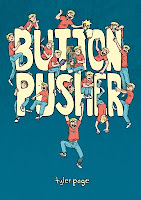
Saturday Morning Cartoons- Button Pusher

Page, Tyler. Button Pusher
March 15th 2022 by First Second
E ARC provided by Edelweiss Plus

In this graphic novel memoir, Tyler often gets in trouble at school and at home for his impulsive behavior. He can't sit still in class, is often excessively goofy, and makes a lot of poor choices. His father is very volatile and often explodes in anger, but his mother tries to help Tyler  manage his school work. She eventually takes him to be assessed, and the doctor diagnoses him with Attention Deficit Disorder. Family counseling is recommended, and that helps a tiny bit, but Tyler is eventually put on the drug Ritalin. This seems to work, and is most noticeable when he doesn't take his medication. While things improve at school and Tyler is able to do better at his school work, make friends, and pursue some interests, his father's own ADD makes his relationship with the family fraught. The mother thinks about leaving him and moving back to her own family, but she can not bring herself to do this. After eight years on the medicine, Tyler decides that he doesn't need it any more, and is able to function in high school and college without it. 
Strengths: Tyler's experiences with attention deficit disorder and hyperactivity are explained in a very clear way. We see how hard it is for him to sit still in class, pay attention, and remember to do his work. His father's adult ADHD is also interesting, and there is mention of the father recieving medical treatment for it as well, although he isn't keen on it. The mother's involvement with the school and therapists is well done, and the notes from the doctors offer a good overview of how things are progressing. There are good historical details about the 1980s, and it's clear that we are not talking about modern methods for dealing with ADHD. Side bar graphics, in blue and white, offer some explanations of the medical terms (like executive fuction disorder) and treatments, which is very useful. 
Weaknesses: There are a lot of cultural references (video games, clothing styles), but it would have been helpful (since this is a memoir) for there to be a specific date. The author was born about 1977 and was put on Ritalin in 1985, so this takes place in the late 1980s. Since medications have changed, this would have been helpful information to have right up front. It is unfortunately common to not clearly state dates in graphic novel memoirs, perhaps to make the experience seem more timeless and universal? (Greene's A-Okay, Mericle's Bad Sister, Alexander's Other Boys)
What I really think: The inclusion of some medical explanations are helpful, even if the note says they are informational and shouldn't be used for diagnosis or treatment! There are always a number of students who take medication for ADHD, and this will speak more to those readers than Edwards' A Tale as Tall as Jacob: Misadventures with My Brother, since that was from the sister's point of view. Like Gerber's Focused, this is a helpful look at a condition that many middle grade readers experience, either for themselves, or through dealing with classmates who struggle with it. 

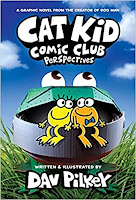
Cat Kid Comic Club: Perspectives

Pilkey, Dav. Cat Kid Comic Club: Perspectives (Cat Kid Comic Club #2) 
November 30th 2021 by Graphix
Copy bought for the Blendon Library by the wonderful Mr. Woodruff

Cat Kid is back, helping Flippy to teach his cantakerous children some art techniques. This is somewhat difficult since Melvin and Naomi insist on bringing all of their negative sibling energy to the class, bickering, tattling, hitting, and generally causing a ruckus. Flippy threatens to send them to time out or home, but relents, so the low level chaos continues. Cat Kid does manage to teach a couple of lessons on perspective, showing the tadpoles how to draw 3D bubble letters and buildings with windows, but that's about all the art tips we get. The other students do continue to churn out their own comics in a variety of formats on a range of subjects, from a very George and Harold Skelopup to a nicely photoillustrated Haiku reflection. Melvin is punished by having to write a comic about Naomi, and he is inspired by an instance where Naomi has to work harder to be rewarded because she is a girl, so we get a nice but slightly odd message about gender equity, and the siblings, after Naomi engages in quite a bit of  obnoxious "I'm not touching you" behavior, seem to get along a little better. 
Strengths: There aren't a lot of books that deal with siblings fighting; I think there were more in the 1980s. I suspect that children still fight, although my own personal children usually got along better than my brother and I did. Certainly Naomi and Melvin's interactions seemed very familiar to me! The art techniques were interesting, and the range of student products gives a lot of inspiration to Cat Kid readers who might be interested in writing their own stories. 
Weaknesses: Were I Flippy, I would have come down a lot harder on the bratty behavior a lot sooner. Also, this didn't have quite as much of a plot or a clever message as the first book, and seemed to ramble a bit more to me. The readers who like Pilkey are not necessarily going to care. 
What I really think: I'm glad that my long time supported and volunteer bought this book for the library, because it will be in high demand, but it wasn't quite as clever as the first book in the series, Cat Kid Comics Club, which was quite delightful and subversive. 
 

Ms. Yingling

Friday, February 11, 2022

Has Anybody Here Seen Frenchie?

Connor, Leslie. Has Anybody Here Seen Frenchie?
February 15th 2022 by Katherine Tegen Books
ARC provided by Young Adult Books Central

Aurora lives with her parents and toddler brother, Cedar, in a small town in Maine. They are neighbors with classmate Frenchie and his mother Gracia, and Aurora and Frenchie have a devoted but unusual friendship. Both are on the Autism spectrum, but while Frenchie is nonvocal (an important distinction) and methodical, Aurora is overly talkative and struggles with impluse control. She understands his quirks, knows why he is so attached to the needlepoint purse he carries pictures of birds in, and advocates for him in school. She is alarmed when the two are not assigned to the same class, although Frenchie does now have an aide, Mr. Menkis, to help him navigate the new school year. Aurora tries to make some new friends (other than Darlene, who is also quirky and frequently thrust into Aurora's sphere, but whom she dislikes), but also tries to include Frenchie. It's an awkward balance, and when Gracia and Aurora's writer mother go to a spa in order to do an article, the daily routine is undone. Aurora is distracted going into the building, and Frenchie, who was right behind her, doesn't show up to class. The school goes into lock down, Aurora is questioned by the police, and the search begins. The book is told from the view point of Aurora, Frenchie, and many others in the town who come into contact with Frenchie at various times. The entire town gets drawn in to the search in the wooded surrounding areas, and Aurora tries to put herself into her friend's shoes to try to understand where he might be. Will Frenchie be located before he comes to grief?

Like Connor's The Truth as Told by Mason Buttle (2018), Has Anybody Here Seen Frenchie? offers a bit of a mystery set in a particular landscape, concerning neurodivergent characters. Aurora's outbursts and Frenchie's wordless contemplation are both sides of the Autism spectrum I have seen in students in our unit classroom, and both are treated sympathetically. Like those in Martin's Rain Reign (2014) or Baskin's Anything But Typical, these representations offer a window into another way of seeing the world that is valuable to neurotypical students who might be trying to understand classmates who see the world differently than they do. 

The sense of community is also fantastic, and we see everyone from a neighbor who coaches baseball to a thrift store owner, to teachers and others in Aurora and Frenchie's circle. The methodical description of how to search for someone who is missing was oddly compelling, and the fact that the community rallied together was great to see. 

Throughout the story, a piebald deer appears as an almost mythical character, which goes along well with Connor's lyrical writing. I felt like there was much deeper symbolism to this animal, as well as with Frenchie's interest in birds, that I didn't take the time to sort out, but would make for interesting group discussions.
 
Connor is a strong writer who always puts an interesting twist on stories, from the parental neglect in Waiting for Normal (2008) to a world wide gas shortage in Crunch (2010) to a tween living with an incarcerated parent in  All Rise for the Honorable Perry T. Cook (2016), and Anybody Here Seen Frenchie? is also a nuanced examination of children living with and working through sometimes challenging experiences.

Thursday, February 10, 2022

The Inheritance Games

Sometimes, I miss things. Thought I'd read this one, but when a student suggested it to me, I realized that I was conflating this book with de la Cruz' Never After: The Thirteenth Fairy, which is NOTHING like this book. They just have a sort of similar cover. Thank you, Ali, for recommending this one!

Barnes, Jennifer Lynn. The Inheritance Games
September 1st 2020 by Little, Brown Books for Young Readers
Public Library Copy

Avery Grambs doesn't have a great home life; she's being raised by an slightly older half sister, Libby, after the death of her mother. The girls' father isn't too interested in them. Out of the blue, Avery gets a letter that she has been named as a beneficiary in the will of billionaire Tobias Hawthorne and must attend the reading. She and Libby are flown to Texas, and soon find out that Avery gets a whole lot of money as long as certain requirements are met. She has to live in the house for a year, and put up with the other relatives who didn't get very much. These include four boys who are about her age. She is enrolled in their private school, but this doesn't shield her from all of the public speculation over her new found wealth and the reasons for it. Thea, who is vaguely related, tries to help her through school, and Avery works on the various mysteries that Tobias has left with the boys. Tobias liked to play games with the boys, so they are all aware of his type of clues, although some of them find them more interesting than others. There is also the mystery of family friend and school mate, Emily, who died on the estate. There are a variety of threats, including Libby's former boyfriend, Drake, disinherited and unhappy relatives, and the press and paparazzi. Will Avery be able to figure out why she was named in the will, and will she be able to survive?
Strengths: Don't all middle grade and young adult readers secretly wish they would come into a ton of money? Live in a mansion? Go to a private school? Add a mystery on top of it, and this is just perfect. Avery is an appealing character who is loyal to her half sister and trying desperately to make a success of her life. She's also intrigued by the mystery and willing to sort through all of the clues to figure it out. The Hawthorne's are privileged and a tiny bit evil, but not overly so, and the reaction that Avery gets seems realistic. There are plenty of details about her new posh life, and the end of the book certainly had me reserving the second book in the series! My favorite thing might have been that this was a great Young Adult title, but also middle grade appropriate. Fifteen years ago, these were a lot easier to find. I also had more readers that wanted them. Sigh. 
Weaknesses: I could not for the life of me keep the four boys straight. This might be more a function of my attention to detail than their depiction, because they all were a bit different. Just could not focus on what set them apart. Should have, since one of them kisses her.
What I really think: I've been a fan of Barnes' work since Raised by Wolves (2010) and Tattoo (2007) (remember the cover trend of low rise jeans and torso-only pictures?), and her The Lovely and the Lost  (2019) and The Fixer (2015) do really well in my school with readers who like more Young Adult books. I adored the fake swearing (fox-faxing elf!) and appreciated that Barnes was sensitive to young readers but also very creative! Definitely purchasing the series and can't wait until the third book comes out in August 2022.

Ms. Yingling

Wednesday, February 09, 2022

When the World Turned Upside Down

Ibura, K. When the World Turned Upside Down
February 1st 2022 by Scholastic Press
E ARC provided by Edelweiss Plus

It's March 2020, and Shayla, who is Black, is conflicted about her school being shut down. It means that she doesn't have to deal with Ai, her sort of best friend, but it means that she has to be at home with her father, who is struggling since his job as a fashion designer slows down considerably. Ai lives in her apartment building, and has struggles of her own. Her mother has taken to her bed, and Ai is left to cook for her family, since her older sister Kartika is trying to study for senior year exams. Ben and Liam also live in the building, and the four have been friends ever since Liam's mother used to babysit them all. Liam suffers frequent panic attacks, so the virus has him very distracted, but he tries to cope so that he can deal with his young sisters. The Quartet realize that they have to stick together, since they don't see anyone else from school. They do online lessons, but are soon trying to find ways to occupy their time.  When a neighbor gets sick, they bring food for her dog, and let parents know so that the woman can get help. She has COVID, and the parents are angry at the children for exposing themselves to the virus, but no one gets sick. They do take care of the woman's dog. They also help the building superintendent wipe down surfaces, and run errands for elderly neighbors who might not be able to get out as easily. Shayla's father provides them with masks, and they try to maintain social distance and practice good hygiene; the only other person to get COVID is Ai's sister, who is okay. As 2020 progresses, they also have to process their feelings about the George Floyd murder and the Black Lives Matters Protests, which occur close to home. The children have to decide how involved they can be while still remaining safe, and how they should continue to try to make the world a better place. 
Strengths: I liked the inclusion of Shayla and Ai's friendship problems, which were treated in a very realistic way. If you have other options for friends, you can let some go, but when you're locked down, even friends you're a little tired of can look good. There are a variety of experiences, and parents with different situations. There was even a pandemic puppy, which was good to see! There were some good details about masking, social distancing, and other things that SOMEDAY will need to be explained to readers who have no memory of them. This is a good purchase for elementary libraries so that students who will be in, say, fourth grade, will be able to see what the world was like when they were just starting school. 
Weaknesses: This comes to a somewhat abrupt end. It might have been interesting to take this a bit further, with the children going back to in person learning, but the author's time line of how the book was written shows that this wasn't really possible, given the way publishing works. Like Walter's Don't Stand So Close To Me, it had to end when it had to end!
What I really think: This certainly showed a different experience of the pandemic than I had-- the children didn't seem to do much with school, and I was so nervous about not being in person that I was hyper aware of constantly checking in and being available. They also saw a LOT of people. It's good to see different experiences, but I had trouble getting my mind around it. The children all seemed a bit young. I'm debating. On the one hand, it's a great historical novel, but on the other hand, the last thing my students want to read about right now is lockdown! 

Tuesday, February 08, 2022

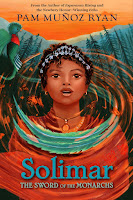
Solimar: The Sword of the Monarchs

Ryan, Pam Muñoz. Solimar: The Sword of the Monarchs
February 1st 2022 by Disney-Hyperion
E ARC provided by Edelweiss Plus

Solimar is approaching fifteen, and when she has her Quinceañera, she'll officially be a princess of San Gregorio. Her brother, known as Campeón, is the reluctant heir apparent, which is unfair, but the way Solimar's world works. Her father, King Sebastian, and her mother, Queen Rosalinda, have some problems; King Aveno is trying to buy some of their land. Unfortunately, it is the land that monarch butterflies visit every year, and the kingdom is known far and wide for them. When the monarchs are due to return, Solimar travels into the oyamel forest (which has a cool, moist environment) to see the monarchs. She crosses the river to get a better look even though it is forbidden, and is rewarded by having the butterflies settle on her. This, however, has a strange effect; afterwards, her rebozo (a scarflike shawl) glistens and seems to grant Solimar the power to see into the near future if she wears it in the sun. She keeps this ability secret from most people, but tells her abuela. Her abuela takes her to the local "witch" with whom she studied, Doña Flora, who tells her the rebozo now is helping the weaker monarchs to survive, and she must be their steward. When her father and brother are due to take goods to the big market in Puerto Rivera, her brother confides in her that he intends to run away and join the crew of a ship, leaving the possibility of ruling in her lap. He begs her to keep this a secret, and she's willing to... until King Aveno takes advantage of her father's absence and descends upon the palace, taking her mother and other residents of the castle hostage. Luckily, Solimar isn't in the room, but hears the commotion, and uses a secret passage to escape and take consel with Doña Flora. She is advised to go to Puerto Rivera to get her father and brother, and to travel down the Rio Diablo to make good time. Luckily, she meets Berto, who studies the river and travels it, and he agrees to help her. With the additional help of her pet bird, Lazaro, and an enchanted doll, Zarita, Solimar undertakes the difficult journey to get help to save her kingdom. Will she be able to get help in time to save not only her family, but the butterflies? 
Strengths: Solimar was a very engaging character who bristled a bit at her upbringing but in general was up for embracing any adventure that came her way, which I appreciated. Her family, while fairly traditional, was also open to change and didn't try to change her too much, although they did want her to make more of an effort to be a princess, such as not wearing her boots with her Quinceañera dress. I was a nice change to not have them be mean about it! The magic and herbal healing was a nice touch, and I would gladly read a whole book about a young abuela being trained by Doña Flora! Berto was very helpful, and the two got along well on their adventure. This was a fast paced, pleasant read, and I loved the inclusion of information about the importance of monarch butterflies and what can be done to save them. (I have a bee and butterfly garden in my yard, so it's always good to see conservation efforts promoted in literature.)
Weaknesses: Solimar's adventure was fairly standard. I did like this much more than this author's Echo, and this would be a great choice for fans of Sarah Beth Durst's work. 
What I really think: This had an old school, fantasy adventure feel to it, similar to Banks' The Farthest Away Mountain, Levine's The Two Princesses of Bamarre, or Tamora Pierce's work, but with a Mexican setting and cultural connections. There was a bit more princess power and deconstruction of gender norms, which actually, gave this a strong John Flanagan Royal Ranger vibe. If this remains a stand alone, I might buy it, but I already have so many fantasy series, and relatively few readers for them. 

Haddix, Margaret Peterson. The School for Whatnots
February 8th 2022 by Katherine Tegen Books 
E ARC provided by Edelweiss Plus

It's hard to write a review of this one, since there are a lot of twists and turns in the plot. A somewhat omniscient narrator walks us through these, and sometimes even the narrator claims surprise. 

Max's wealthy parents want to protect him from ever feeling loved only for his money, so they enroll him in a school populated by android students; "whatnots". They are supposed to be examples of perfect behavior and support his social and emotional development. However, one of the students is a real person. Josie's family lives in poverty, so in exchange for her pretending to be an android (to the point of being raised by an android nanny she never sees and having to sleep in a charging bed every night!), she gets a better education. Whatnots are phased out when children graduate from 5th grade, so when Josie leaves Max a note saying that he should always remember she is real, he is very worried when he is told he will never see her again. This triggers a deep dive into many societal secrets. 

Excellent reviewer and former colleague Mark Buxton has a great review of this over at Young Adult Books Central. I'm kerflummoxed as to what I even think about this book. My daughter Picky Reader was a HUGE fan of Haddix's work. When asked why, she said "I never know what is going to happen in her books, and it's always something I don't expect." This book certainly exemplifies this!

Monday, February 07, 2022

MMGM- Speak Up, Speak Out! and Wayward Creatures

It's
Marvelous Middle Grade Monday
 at 
and #IMWAYR day 
at 
and 

Bolden, Tonya. Speak Up, Speak Out! The Extraordinary Life of "Fighting Shirley Chisholm" 
January 4th 2022 by National Geographic Kids
Copy provided by Media Masters Publicity and Young Adult Books Central

If you work with middle school students, you NEED this 132 page biography (page count is important!) of the spirited and influential Chisholm. I'm surprised that this has no reviews on Goodreads and that I haven't seen it all over social media. With the combination of Bolden's fantastic writing, a forward from Stacy Abrams, the timely topic of Blacks in the political landscape and the start of Black History Month, eveyrone should know about this new book!

While I'm not usually a fan of books that start with maps, the map of Modern Day Brooklyn was very instructional for me. While I've read a lot of books set in New York City, so many of the Brooklyn neighborhoods sounded familiar, I wasn't quite aware that... they were all in Brooklyn? This was just a great way to introduce me to the world that Chisolm represented, and being able to see the geography (so much coastline!), proximity to Manhattan, and different places where Chisholm lived was very helpful. 

Chisholm's family background, and her parent's immigration story, sets the stage for the environment in which she was raised. Born in 1924, and set to spend time with a grandmother in Barbados in 1928, Chisholm's life was shaped by the events of her times. However, she had a strong drive that propelled her to seek experiences outside of what was expected of women at that time. She attended college (although wasn't able to go as far as Oberlin or Vassar), started off pursuing a degree in education, but early on got interestested in politics. For a young Black woman in 1944 to get interested in politics? Wow. I can't imagine how many difficulties she would have faced. 

By the late 1950s, she was the director of a day care center and heavily involved in local politics. With her background, she knew that to make changes and to get the people of her community things that they needed, she would have to "make a lot of noise". She eventually became vice president of the Central Brooklyn Coordinating Council, and became the first Black woman elected to the New York State Assembly in 1964. She fought tremendous societal and personal challenges to become the first Black woman to win a congressional seat in 1968.

What stood out to me was how invested in the welfare of her constituents Chisholm won. It seems like many elected officials are involved in politics to forward their own agenda, but Chisholm really wanted to make positive changes for the people in her community. This is a great message for young readers today. If more politicians had this motivation, the world would certainly be a better place. 

Chisholm's story is an inspiring one. Bolden's concise and fast-paced writing, enlivened by a style that captures some of Chisholm's no nonsense rhetoric, brings to life a political figure everyone should know. There are pictures in the center of the book, although I wish that this had been a photobiography like National Geographic's Onward: A Photobiography of African-American Polar Explorer Matthew Henson by Dolores Johnson. Chisholm was a colorful character, and it's a shame that so few color pictures of her exist! This book is a must purchase for any middle school or public library. 

Lorentz, Dayna. Wayward Creatures
18 January 2022 by Clarion Books
E ARC provided by Edelweiss Plus

Gabe's family is struggling since his father lost his job and his mother went back to work full time. Gabe and his sister have to pick up some of the household chores and do more for themselves, often making mornings hectic. On top of that, middle school isn't going well, with Gabe's friends playing expensive elite soccer. When his friend Owen wants to hang out with new kid Taylor, Gabe is irritated, especially when Taylor calls attention to himself with bike tricks. The group stops at a convenience store before heading to a nearby park to ride bikes, and Gabe has an idea. He steals some fireworks, knowing that will bring him attention. Sadly, when he shoots some at Taylor, dry grass catches fire and the park quickly goes up in flames. Owen is nabbed by the police, and luckily no one is hurt. The park, however, is destroyed. Instead of a court, Gabe is bound over to a restorative justice program, which relieves his parents. The committee decides that Gabe has to pay for the fireworks and spend 40 hours of community service restoring the park. At first, Gabe feels this is unfair, since he didn't MEAN to do so much damage. He doesn't talk to his parents, eats in his room, and steers clear of everyone at school, especially Owen. In alternating chapters, we also see a young coyote, Rill, who is fed up with her parents and runs away. She is injured in the fire and hides in a cave. Gabe finds her while working to restore the park, and brings her food and water every day. Rill also meets Teeth, a possum, who promises to find her family in exchange for some of Gabe's food.  Gabe collects cans to earn money to pay for the fireworks, helps a man who lost a chicken coop in the fire build a new one, and builds some to earn more money. He enjoys helping clear brush and repair the park, and even brings maple saplings from home to replant. When Rill is eventually discovered, Gabe fights to have her healed and returned to the wild instead of being euthanized for being a nuisance animal. Will he be able to repair his home life and his relationship with his friends in the same way he is restoring the park?
Strengths: The only other book that I've seen feature restorative justice is Mikaelsen's Touching Spirit Bear (2001), which is a bit outdated. I liked how the idea was explained and then shown, with members of the community talking about how the fire affected them. Gabe's family struggles were interesting, and the one chaotic morning reminded me why I stand in the hallway every morning and greet students pleasantly-- you never know what their morning was like before they got to school. Friend drama with people pursuing different activities is also prevalent in the middle school setting, and I liked that Owen was sympathetically portrayed. The work on the park had a lot of nice STEM touches that could be used in science classes, and Rill's plight was described well. The cover of this is very appealing. 
Weaknesses: The parts of the book with Gabe's journey are so powerful that having to switch to Rill's character wasn't my favorite thing. I wish we had seen more of Gabe's experiences with people in school rather than his battle to save Rill. I don't think he could have spent the whole day in a stairwell avoiding people-- if a student like Gabe went missing at our school, we would have the police in, and absolutely tear the place up trying to find him! 
What I really think: Lorentz has written a variety of different types of books. Storm Dogs is still my favorite, but this is probably my second favorite. I will purchase, and see if teachers who studied Touching Spirit Bear in the past would want to change out that book for this one. 

Sunday, February 06, 2022

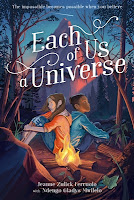
Each of Us a Universe

Ferrulo, Jeanne Zulick. Each of Us a Universe
February 1st 2022 by Farrar, Straus and Giroux
E ARC provided by Edelweiss Plus

Calliope Scott's world is filled with problems; her father is in jail, her mother is fighting cancer, and her arm has been in a cast ever since the day that everything went badly wrong. The other girls at school in her small town make fun of her for her father's situation, and for her solitary manner and her worn out clothes. She does have some supportive adults in her life, including her science teacher, Mr. Lopez, who was part of her father's rock climbing community and still visits her dad and asks about him,  and the Demskys, an older couple who run a small grocery store. The Demskys also watch out for Rosine and Mali, sisters who have come to the US from the Democratic Republic of Congo by way of Burundi, and have had a very difficult life. Rosine befriends Cal, who is understandably a bit prickly. One thing that makes Cal feel better is hiking in the mountains near her town of Bleakersville, and she becomes obsessed with finding the "magic" left a number of years ago by a meteorite. There are stories about scientists studying this, but all of the information is vague enough that Cal creates a strong mythology in her own head and is determined that if she can climb the highest point on these mountains, the Spire, she can find a cure for her mother's cancer. Rosine decides to join her, and the girls, along with a stray cat Cal calls Wildcat, try to scale this daunting height. Will Cal find the magic that she seeks, or will the adventure be enough to help her come to terms with the reality of her family's situation. 
Strengths: Cal had a lot of difficult problems in her life, but she dealt with them in a fairly constructive manner. It was good to see the Demskys watching out for her. The father is in jail due to a drunk driving offense, and this is a situation which has affected several of my students and yet is rarely portrayed in middle grade literature. Ferrulo has a note at the end of the book about children dealing with parents with cancer, and this is another fairly common difficulty that also lacks representation. I very much enjoyed Rosine's character, since I taught with a woman who came to the US from the DRC, and Ferrulo consulted a woman with a similar background to make sure the details were correct. Cal's ourdoor adventure wasn't as badly planned as others I have read. 
Weaknesses: Cal's belief that she would find a cure for her mother's illness if she climbed the mountain made this read more like a book for elementary school students. This was a little bit like Rauf's The Star Outside My Window in this respect. 
What I really think: This reminded me a bit of Gemeinhart's The Honest Truth (2015) or Wallace's The Wilder Boys (2015), with the adventure undertaken because of issues at home. This author's A Galaxy of Sea Stars (2020) does well in my library, but Ruby in the Sky (2019) has been a hard sell. Debating.

Saturday, February 05, 2022

Saturday Morning Cartoons-- Spy School: The Graphic Novel

Gibbs, Stuart and Sarkar, Anjan (illus.) Spy School: The Graphic Novel
February 1st 2022 by Simon Schuster Books for Young Readers
ARC provided by Young Adult Books Central

This graphic novel adaptation of Gibbs' title from a decade ago is very true to the original. Ben is surprised when he is recruited by the CIA to go to their Academy of Espionage, which is cleverly disguised as a geeky science academy because aside from some cryptography skills, he's not that smart. Turns out that he has been brought in as bait-- the word is put out that he invented a special code, and people start coming after him. The daughter of the man who recruited him, Erica, tells him that all is not as it seems at the school, and there is a mole that must be found. Of course, if Ben can find the mole, he might be able to stay in the school. There is a lot of personal peril-- bombs under the building, people kidnapping and drugging him... but Erica is always saving him. Is the mole a fellow student who just appears to be stupid? Is the principal as stupid as he looks? And what's up with Erica's father? Once Erica tries her own plan to flush out the mole (emailing from the principal's account that Ben has developed Jackhammer, a super code hacker program), will everything work out?

First of all, I like that the style of the original covers was maintained, with the addition of the comic style panels in the back ground. Very clever. My hope with graphic novel versions of chapter books is that young readers will eventually pick up the novel as well, so this tie in is important. 

The illustration style is a little different than some I have seen; a little bit more like a comic book, but not entirely. The font is in all caps, but a very readable san serif font that is not as small as some books. The color pallette is heavy on grays, brown, and greens, befitting the sometimes militaristic aspect of the plot, but does have some pops of color when the mood is being lightened. 

Ben and Erica certainly have the most time on page, and their relationship is noteworthy, but in this version there were a couple of characters that really popped a bit for me; the doddering Professor Crandall who is just pretending to not understand what is going on, Erica's father, who is shown in a sharp suit, and Ben's friend Mike, who hovers on the periphery, trying to understand what is going on with his friend. 

This alternates pages intense with word bubbles with pages that are mainly action, so is well paced and easy to get through. There's still a lot of text, so best for fans of wordier graphic novels. This is not quite as believable as Alex Rider or the Gallagher Girl books, since it walked right along the edge of goofy, but seeing the pictures somehow adds to the believability.

I'm a huge fan of Gibbs' series-- Fun Jungle, Moon Base Alpha, and Charlie Thorne, so it makes sense that his works would get a graphic novel treatment, and what better book to start on than Spy School?


Escabasse, Sophie. What the Hex? (Witches of Brooklyn #2)
September 7th 2021 by Random House Graphic
Public library copy

Effie, having settled in with her aunts in Witches of Brooklyn, finally gets to meet their large group of friends... all other witches. She is also dealing with some friend drama, since Berrit has made a new friend over winter break. Garance has moved to the US from France, and Effie feels left out. While she's grappling with that, there is a street corner where two competing statues are fighting magically, causing horrible weather in a very small area. When Effie finds out a secret about Garance, the two bond. They solve some problems, and Effie feels like the three girls can work together and be friends. 
Strengths: It's hard to escape friend drama even if you have magical powers, so this was a good combination. No one is actively mean to each other, and Effie even tries to have patience with her friend, but there are still hurt feelings everywhere. The magical problems aren't huge, but it's nice that the girls are able to solve them. Lion was a fun character when he shape shifted. The house is a very fun place, the witches are quirky, and Aunt Ma was a fun surprise. A very pleasant magical graphic novel.
Weaknesses: I feel like I missed something-- the aunts seem rather old to be stepsisters of Effie's mother. Maybe it was a witch thing, since they live so long? Also missed why Lion was bright pink.
What I really think: The first book, along with The Okay Witch, circulates well with my students, so I should buy this. 

Friday, February 04, 2022

Roosevelt Banks and the Attic of Doom, Snow Struck

Calkhoven, Laurie. Roosevelt Banks and the Attic of Doom 
February 1st 2022 by Red Chair Press, One Elm Books
Copy provided by the publisher

In this sequel to Roosevelt Banks, Good Kid in Training, we find Roosevelt excited about the upcoming SUMMER OF DAD after his fourth grade year. His parents are both college professors, but while his mother is teaching summer school, his younger sister Kennedy will be in day care, and he will have his father all to himself. Of course, these plans fall through when his parents announce that there is another baby on the way, and the father will be renovating the attic for a room for Roosevelt. This is a bad thing, because the attic is haunted, so Roosevelt and his friends have a number of plans to change the course of this home improvement. Josh is busy with sports, and Tommy has a part in a play, but Eddie is around to help Roosevelt take care of Mrs. C's rabbits... and get into trouble. Tommy's older twin brothers also have some ideas for making sure that the attic bedroom doesn't happen. Will Roosevelt be able to spend some time with his father,  make his peace with the upcoming sibling, and manage to NOT cause as many problems and get in as much trouble as he did in the first book? 
Strengths: I really enjoy Calkhoven's work, and her Boys of War and G.I. Dogs series have been hugely popular in my library. She has an excellent feel for what details young readers enjoy. There are lots of realistic summer plans, but also some fun ones that don't seem very likely. It's important that details about how elementary students are cared for over the summer are realistic-- I'm actually surprised we don't see more books set in summer child care programs.  The concern about the new baby, and Roosevelt's struggle with being a big brother are good to see. Bonus points for having two upbeat, patient, and functioning parents! The illustrations and large text will definitely draw readers in. 
Weaknesses: Would fourth graders really be worried about ghosts? That's not my regular demographic.
What I really think: This fills a gap in realistic fiction series about well meaning but misguided young people, and would be great to hand to fans of like McDonalds's Stink Moody, Look's Alvin Ho, Khan's Zayd Saleem, Harley's Charlie Bumpers or the Cleary classic Henry Huggins. It's just a bit young for my students, who would never openly believe that their attic was haunted, so I will send this over to an elementary school, where I'm sure it will see a lot of use. 


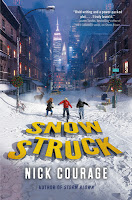
Courage, Nick. Snow Struck. 
January 25th 2022 by Delacorte Press
E ARC provided by Edelweiss Plus

Elizabeth and Matty have had a hard time of it; their house was badly damaged by a storm, and their family has been living in a hotel while it is beign repaired. For a Christmas treat, they are sent to spend time with their cousin Ashley in New York City. Ashley's parents are divorcing, but still live near each other, but it's still a difficult dynamic. Elizabeth is looking forward to snow, but when the children arrive in New York, it's 80 degrees. Matty, who has been extra anxious ever since the storm at home, is worried about the weather. When a cold front rapidly approaches the city, he warns his sister that they should stay put, but his worries are ignored. We also see a couple of other perspectives-- a fishing boat in Eternity Fjord, Greenland that is experiencing the effects of climate change, and Joy, who works in emergency response for the National Climatic Research Center in Washington, D.C., and would like to get back to visit family in NYC. The children are at an art gallery with Ashley's dad over forty blocks from the aunt's apartment when the storm hits, and it's a strenuous journey to get back across the rapidly snow covered city. They face another challenge once they are safely home-- there's a blackout, although they still have a gas stove that works, and Ashley's dog, Fang, has slipped his harness and is out in the horrible weather. The children go out on various occasions to try to find him, and get to experience a New York that few ever get to see, complete with rats and deer on the move outside of their usual environs. At the same time, the ship is heading towards New York, as is Joy, and all of these different threads mange to be woven together during a crucial moment in the process of finding Fang. (Spoiler: Fang is okay in the end! Whew!)
Strengths: Elizabeth and Matty are not used to snow, but I loved that Matty, being anxious, was super prepared in his choice of gear, and Elizabeth regretted some of her choices. Those choices can be a matter of life and death in a winter survival situation. I liked that there were a lot of details about the snow, ice, traffic conditions, and what the subways and buildings were like. This reminded me a little of Moskin's 1978 The Day of the Blizzard, which also involved winter survival in a city. I was a little sad when the trio returned home from the art gallery, but going back out after Fang was a good adventure, and taking a short breather was good. The information about tracking storms and the National Climatic Research Center from Joy's point of view gave a larger perspective on the weather event, and the scenes with the research ship in the Arctic were important background for the climate change themes. This was fast-paced, had a good message along with the adventure, and (most importantly), Fang was found and was okay. It's always important that dogs survive, especially the cute, fluffy ones!
Weaknesses: It took me a bit to get into the story, since it started with an arctic fox, but I really have to admire how Courage brought together all of the plots. 
What I really think: Storm Blown hasn't circulated as well as I would have liked, but part of that might be due to the fact that I got a copy of this book right before the pandemic started in 2020. Winter survival is generally more popular than hurricane stories, so I will definitely purchase. And NOT just because I'm a sucker for a good snowstorm book ever since Haywood's Snowboand with Betsy! I have two copies of Northrops' Trapped that are in tatters because they've been read so much... and they're over ten years old. Wow. Seems like just yesterday that I read that one!

Ms. Yingling

Thursday, February 03, 2022

The Visitors

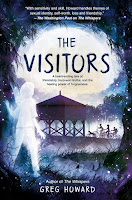
Howard, Greg. The Visitors
February 1st 2022 by G.P. Putnam's Sons Books for Young
E ARC provided by Edelweiss 

The Hollow Pines plantation in Georgetown County, South Carolina, has been abandoned for years. It's filled with ghosts, who all have troubled pasts and reasons for staying. One of these, a boy, doesn't quite know why he is there or who he is, but he's been roaming the area since Walter Cronkite was a news personality in the early 1970s. When three tweens from the present day, Thomas, Maya, and Mateo, show up at the derelict house, he overhears something that awakens a memory. Thomas is taping a podcast called "Finding Will" about a boy, Will Perkins, who disappeared in 1971 and whose body was never found. There are other names that sound familiar as well; Ronnie and Frankie, and we see them interact with Will in flashbacks. Will (who was born in 1959) was gay, and had a crush on his best friend Ronnie, who reacted badly when he found this out and told Frankie, who was a bully. Our ghost thinks he might be one of these boys, but the other ghosts at the plantation who represent a variety of time periods dating back to when the plantation had slaves, won't tell him anything. When Thomas and the twins enter the house, the ghost decides to show himself and help them with their cold case investigation. Thomas and his own best friend, Maya, have had some rough patches ever since Maya transitioned from being Marco. Maya's mother is supportive but her father is not, and she and Thomas have never addressed the tension between them. As more clues come to light, the ghost has a better idea of who he might be. Unfortunately, Mr. Culpepper, the former plantation owner, also haunts the house, and is determined to steal the souls of the children. With the help of the other ghosts, the children and their dog Goldie manage to survive, but will they be able to shed more light on what happened to Will Perkins, and on who the ghost really is?

Trigger warning: Suicide.
Strengths: This had plenty of spooky, almost Gothic Southern moments, and the cover certainly invites readers in to be scared! The use of cultural reference points, especially Walter Cronkite, whom younger readers will not know, is enough to make readers wonder about Will's age, and we are later given a definitive time frame, which I appreciated. The inclusion of ghosts of enslaved people allows the history of the plantation and the treatment of people during the time of slavery to be explored in an interesting way, and I appreciated the author's note about why he included this information. Will's treatment by Ronnie and Frankie, and especially by his own father, is horrible but absolutely true to life. Again, the author's note about his own experiences was very helpful. Maya's similar experience fifty years later makes for an interesting "compare and contrast" moment. Culpepper is a vicious killer ghost, which is the kind my students like best, and there are some truly frightening moments. This is an interesting departure from Mr. Howard's Middle School's a Drag, You Better Work and closer in style to The Whispers, and shows a good grasp of the horror genre. 
Weaknesses: There is a lot going on in the story, and it might take a strong middle grade reader to keep all of the plot threads straight. The historical references are all very solid, but unless Will had a younger sibling, I don't think he would have watched enough Sesame Street, at the age of ten, to make up a story involving Hooper's store. (When my own childhood shows up in historical fiction, I become super picky. I was the target demographic for Sesame Street when it first aired, but would never have watched it past the age of seven.)
What I really think: This might take a bit of handselling to find just the right reader; it's a bit long, but I appreciated the mix of horror, LGBTQ+ issues, and history. Fans of Luckoff's Too Bright to See, King's Me and Marvin Gardens or Haydu's One Jar of Magic will definitely enjoy this one. 

Ogle, Rex. The Supernatural Society.
February 1st 2022 by Inkyard Press
E ARC provided by Edelweiss Plus

Will is half-Latinx, and his mother has left his father and moved the two of them from Brooklyn to the small town of East Emerson. From the very beginning, Will notices weird things happening in his new neighborhood. At first, he thinks it is because it is Halloween, but he soon realizes that he can see monsters who walk among the ordinary inhabitants of the town. Luckily, neighbor Ivy (who is Korean American) sees them as well, and helps him acclimate. Her brother, Linus (who is Black; the two are adopted), is a very cerebral character who has a very rarified way of speaking. (E.G., from the E ARC “I luxuriate in resolving inquiries,” Linus said. He pushed the glasses up his nose. Luxuriate means taking self-indulgent delight in something.”) While not everyone seems to notice, there are other clues, like Will’s school schedule, which says that he is not invisible. When his beloved dog goes missing at an abandoned amusement park, and then other pets go missing as well, Will has to try to solve the mystery of why this is happening in order to get his dog back.
Strengths: I’m glad that Mr. Ogle wrote a book that he wanted to read when he was young, and that he broke this down carefully and came up with his format. It’s also good to see Latinx representation, and a less traumatic version of his own troubled upbringing. There are not too many books featuring monsters, although we are seeing a bit more.
Weaknesses: It’s just interesting to me that when tweens move, their houses are apt to be haunted. (Oh’s Spirit Hunters, Corrigan’s Creep, Hahn’s Closed for the Season.) Wouldn’t it be scarier if the home you had lived in all of your life was suddenly haunted? The cover is not terribly appealing.
What I really think: Twenty years ago, I would have bought a copy for Lemony Snicket fans, but this is a bit young for my current readers, who aren’t fond of the “Dear Reader” tone. Fans of Lubar’s Monsterrific Tales, Stine’s Goosebumps books, Gilman’s Lovecraft Middle School, and Kent’s Scary School will enjoy this, and it’s great for readers who are allowed to watch Stranger Things but aren’t quite ready for Condie’s Darkdeep. Perhaps the kinds of books that students want to read have changed a bit since Ogle was young.

Wednesday, February 02, 2022

Maizy Chen's Last Chance and Omar Rising

Yee, Lisa. Maizy Chen's Last Chance 
February 1st 2022 by Random House
E ARC provided by Netgalley

Maizy and her mother live in California, where her never-married mother works as a well-known food stylist. Maizy has only met her Oma and Opa once, when her mother's parents came to visit, but immediately left. When Opa becomes ill, Maizy and her mother decide to spend the summer in Last Chance, Minnesota, where her grandparents run a Chinese restaurant. It's certainly a different sort of life, and while she misses her best friend, Maizy settles in to small town life. She meets Logan, who is nice, and some mean girls, who seem to be making fun of her. She spends a lot of time in the restaurant, where she gets to know Daisy, the only staff member, and some of the regulars. She is also tasked with keeping Opa company, and the two spend a lot of time watching a food television show. When she learns that Werner, who runs a bratwurst stand, used to be her grandfather's best friend, but they had a falling out, she trades food from the Golden Palace for sausage sandwiches, hoping to get Opa to eat more. Eventually, Werner comes to spend time with his old friend, although they watch television rather than talk. Her mother seems to be reconnecting with a high school flame, who is now the school principal. When Maizy experiences some racial tension, since her family is the only Asian-American one in town, her grandfather starts to tell her about some family history. Going back into the mid 1800s, we find out about Lucky Chen, who left China to come work in California and fled when he was wrongly accused of stealing from his employers. He got a ticket as far as Minnesota, and got a job as a cook at the Golden Grille. Throughout the book, we see Lucky and his descendants' stories of discrimination contrasted with what is going on in Last Chance now, which includes racial slurs painted on the restaurant and the stealing of a stuffed bear mascot. Maizy learns a lot about the history of her family, her grandparents, and how the struggles that Chinese-Americans have experienced through history are still continuing today. 
Strengths: Maizy was a great character who wasn't too thrilled to be away from home for the summer but who made the best of her experiences. She was glad to get to know her grandparents, to hang out in a different place, and to learn about her family history. So many middle grade characters approach new experiences with negativity, so this was great to see. I'm usually not a fan of the story-within-a-story, but Opa's tale about Lucky and the Golden Palace worked extremely well, and I was looking forward to the next installment as much as Maizy was. The secondary characters, like Principal Holmes, Daisy, and Werner help to give a good feel for the dynamics of the town; Principal Holmes is married to a man, and lives in a nearby city because he's not sure how this will go over with residents, Daisy has some learning challenges but thrives when given a chance by Oma to work, and Werner's family highlights the German residents who first came to Last Chance. I have relatives in a much smaller Iowa community, and the details about a small town Midwest community are spot on. Now, we just need some newer historical novels about Paper Sons and Chinese workers in the 1800s, and if they are written in such an engaging style, they'd see a lot of circulation. 
Weaknesses: The subplot with the mayor felt a bit forced, and Maizy's interplay with the local mean girls didn't quite gel as much as it could have. 
What I really think: This was a perfect balance between a fun setting and characters, and more serious issues and history. It had a lot of similarities to Johnson's The Parker Inheritance, with the blend of modern and historical problems, or Luz Alegre's Dream Weavers, with the family business. I'm always a fan of characters who get to know their grandparents and who get to experience other places in the world, and Maizy makes the most of her opportunities. Definitely glad to add this to my selection of summer adventures for my readers. 

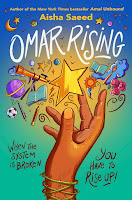
Saeed, Aisha. Omar Rising (sequel to Amal Unbound)
E ARC provided by Edelweiss Plus
1 February 2022, Nancy Paulsen Books

Omar is very pleased that he managed to get into the prestigious Ghalib Academy for Boys, but he is also nervous about it. It means leaving his mother and boarding at the school, and not coming home again until December. He's excited about learning about the planets, and looking forward to reacquainting himself with boys he met at the summer program at the school. He's sad about leaving his friends, especially Amal, who is back home after her horrible year in Amal Unbound. Ghalib is a great school, with a terrific library, new science labs, and a kind and supportive art teacher. Omar has good friends in Kareem, whose father works at the school, Naveed, and even older Faisal. Aiden, however, is cold and rude, and thinks the school is not very nice, since his father is very wealthy. Headmaster Moiz has put all of the Scholarship Boys into an English language class that he teachers, and Omar feels that he doesn't like him very much. The Scholarship boys also have to do five hours of service at the school, from folding laundry to cleaning to helping out in the kitchen, and are not allowed to be in any clubs. Most of the other students don't seem to look down at them for this, but the requirements of the scholarship don't allow much time for anything but studying. Omar does take a few breaks, and talks to his mother on the phone, but he is very concerned about his grades, especially since they aren't good in Moiz's class. He starts an interesting art project, and when he returns home in December, Amal tells him that he doesn't have to suffer through everything alone. He asks Moiz for help with English and starts to do better in class. His art project goes well, and he even starts to understand and befriend Aiden. When the end of the year rolls around, Omar and Naveed's grades aren't good for them to receive a scholarship the next year. They feel that the requirements are unfair, and rally the other students around this injustice. Will it be enough for them to be able to return? 
Strengths: Amal Unbound has been a very popular book; it's being used by a seventh grade teacher for a class unit, and I'm sure that my readers will be very happy to see more about life in Pakistan. Any story that shows my students how lucky they are to be able to come to school every day is one that I enjoy, and Omar's struggles to do well in class are quite admirable. My students are interested in boarding school stories, so movie nights, sneaking into the kitchen, and playing sports with friends will appeal to them. Omar's family situation is very interesting, and it was good to see Amal's family again. 
Weaknesses: This did not have as many details about daily life as Amal's story did, and I would have liked to see more descriptions of the classrooms and activities, and also more adventures outside the school, but it's hard to fit everything into the book. There was a decided paucity of descriptions of food, although there are a few. 
What I really think: I'm definitely purchasing this one, but it did have me scratching my head a bit. Omar's scholarship comes with very specific criteria, but then, I think most scholarships do. My own college scholarship required me to maintain an A average, major in a particular field, and only work certain university jobs. My graduate scholarship wasn't renewed even though I had the grades; the committee just didn't renew it. I wasn't even given any reasons. Is this a broken system, or just a system that didn't work to my advantage? I don't know what the finances of Ghalib Academy were, and how many scholarship students they could afford. Is this injustice? I just never thought of it that way. 

Ms. Yingling

Tuesday, February 01, 2022

Cameron Battle and City Spies

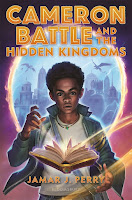
Perry, Jamar J. Cameron Battle and the Hidden Kingdoms
February 1st 2022 by Bloomsbury Children's Books
E ARC provided by Edelweiss Plus

Cameron, who is being raised by his grandmother after his parents' deaths, has always taken comfort in a family heirloom book. The Book of Chidani is based on Igbo legends, but his grandmother has banished the book to the attic and forbidden Cameron from reading it because it brings up so many memories for her. Cameron used to read the book with his best friend, Zion, and when bad weather in Atlanta has the two stuck inside with another friend, Aliyah, they read the book against the grandmother's wishes. They manage to get sucked into the book and travel to Chidani, a secret country in Nigeria where the queen, Ramala, has been replaced by her sister, Amina, who does not have the best interest of the people of Chidani OR the people in Cameron's realm at heart. Cameron suspects that his parents' death has something to do with the book, especially when he is hailed as the hero who can save Chidani because he is a descendant of the founders. Ramala has sent for the children to get help in defeating her sister and reclaiming the throne so that both worlds remain protected. In order to do that, Cameron and his friends have three moons to find three gifts that imbue leaders with power: a crown, a ring, and a scepter. The trio receive training on how to fight and also fly, and have help from Halifa, Bakari, and Makai, who are in service to Ramala. They travel throughout the kingdom in order to find the gifts. It's a hard task, and even though Cameron unearths new powers and ties to the Book of Chidani, he has only found two of the gifts by the end of book one. After a brief return to our world, will Cameron be able to find the ring and save Chidani in book two?
Strengths: My favorite part of this was the slight tension between Cameron and Zion over including Aliyah in their adventure. Friendships are so difficult in middle school, and these tensions don't make it into middle grade literature often enough. This was a solid middle grade fantasy that was well-paced and easy for me to follow. Chidani is very well described, from the clothing to the style of fighting, and Queen Ramala is a beleaguered but capable leader who has good reasons for needing Cameron to help her. Cameron's family dynamic compels him more convincingly to undergo the travail of the quest even when he would rather not. Zion and Aliyah are helpful friends, but also are not always on the same page as Cameron, which is a great source of friend drama, which is always a good choice in middle grade literature. I love the cover!
Weaknesses: This is labeled as LGBTQ+, but I don't remember what the representation was and didn't make any notes about it as I read. In a way, that's good, because we need more books with LGBTQ+ characters where that is just one facet of their personalities. I should not have waited almost a week to write the review, even with notes.
What I really think: This is a solid fantasy adventure, and bringing Igbo and Nigerian culture into a fantasy book made this very interesting. While the plot doesn't break any new ground, it's much less confusing for casual fantasy readers, since the unfamiliar mythology is layered over a typical fantasy quest. It's a great read for anyone wanting an action-packed hero's journey, but will be especially nice for some of my students with African ancestry who have read a ton of Anglo-Germanic fantasy books and can finally see themselves represented in a mythical world. Hand to fans who like the Rick Riordan Presents series, aficionados of magical book tales, and especially to readers who enjoyed Mbalia's and Makonnen's Last Gate of the Emperor or Okarafor's Ikenga.

Ponti, James. Forbidden City (City Spies #3) 
February 1st 2022 by Aladdin
E ARC provided by Edelweiss Plus

Now that we know that characters in City Spies and Golden Gate, it's fun to see them involved in more adventures with Mother. In this third installment, we find Brooklyn having to stay in Scotland to take summer school classes at Kinloch Abbey to catch up with everyone else academically, even though she does make friends with Charlotte, who quit the City Spies program. This is hard when Paris and Kat are sent to a birthday party for a young socialite in London, Tabitha Banks. While they are their, they find that Tabitha's father, Sir Reg, is most likely involved with Umbra, but they aren't quite sure what he's up to. When it is clearer that he is probably after North Korean scientist Park Jin-sun, Paris is recruited to go undercover to play chess against the scientist's son, Dae-jung. The mission unfolds as Paris has to win four chess tournaments to qualify for a larger competition in Russia, and Kat gets a job reporting for a website, All Roads Lead to Audrey, so she can befriend Tabitha Banks. Monty is working with Sydney, who is trying very hard to crack a code that involves Instagram shots of different landmarks, some with just slight color changes, that leads them to Nicholas Sorokin. To make matters more complicated, his twin sisters hang around Tabitha Banks. While the fate of Park and Dae-jung hangs in the balance, there is also a larger issue concerning nuclear missles that are going missing. Will the City Spies be able to complete all parts of their mission and be able to make it back for another school year living at the FARM?
Strengths: Ponti, like Stuart Gibbs, has a writing style that is just so easy to read and enjoyable that I just want to let the books wash over me in a wave of brilliant plot twists and character experiences, and not write a review. I can't imagine the flow charts and notes keepign track of the intricately woven plot! The characters are also easy to follow, and have distinct personalities and mannerisms. The theme of families that you choose is great, and Mother is a fantastic fictional father. We don't see a lot of the school or FARM in this book, but the glimpses that we have are quite fun. Traveling to both Russia and China is a treat, and my favorite part (aside from two amusing Easter Eggs-- look for mentions of a writer's child and the childhood home of a famous singer) was how the City Spies are able to save the day by giving information about a more pressing problem to someone who was right on their heels. A fantastic third book in this series that leaves room for more. 
Weaknesses: I'm not sure how I should feel about Charlotte, and I feel like I have missed a whole bunch about her. 
What I really think: Mr. Ponti must be doing some mad traveling to research these books, or else is able to derive a heck of a lot of details from travel brochures. Little did I know, when I went to Mt. Vernon to see him for the launch of Framed! that he would become such a force in the world of middle grade mystery books! If you haven't looked at this series, you definitely need to. Just the ticket for die hard fans of Anthony Horowitz's Stormbreaker of Gibbs' Spy School series. 

Ms. Yingling

Monday, January 31, 2022

February Releases


Okay. A lot of people do very lovely posts on upcoming books, but I... have no patience. 

Here are all of the books that I either read or plan to read that are being published in February. This list is pulled from and links to Goodreads.

MMGM- Wreck at Ada's Reef and Wangari Maathai

It's
Marvelous Middle Grade Monday
 at 
and #IMWAYR day 
at 
and 
Beil, Michael J. The Wreck at Ada's Reef (Swallowtail Legacy #1)
February 1st 2022 by Pixel+ink
E ARC provided by Edelweiss Plus

Lark and her younger sister Pip have had a hard go of it. Their father died when they were very young, and their ornithology professor mother married Thomas, whose wife also died. They had a Brady Bunch style family going with his three boys until Lark's mother died of cancer. For the summer, the family is visiting Swallowtail Island in Lake Erie near Sandusky, Ohio, where their mother owned a house that has been passed down to the girls. Thomas has a job restoring some pictures at the island museum, so the children are signed up for soccer camps and other activities. A friend of their mother's, news reported Nadine, is around as well. Nadine is trying to figure out a 75 year old mystery about the death of her grandfather in a boating accident. The local leading family, the Cheevers, own much of the land, and intend to develop it with condos and other less peaceful uses, at the expense of 93-year-old Dinah Purdy, who has been allowed to live on the land because her ancestors worked with the Cheevers. Nadine feels that there's something not quite right about the accident, and feels there might be a missing will. She hires Lark to help her with research. Lark also plays soccer with Owen Cheever, whom she feels is kind of a jerk, and he becomes the object of her wrath. Clearly, her mother's death is hitting her hard, and she doesn't have quite the support she needs. Pip is obsessed with horses, so is glad when Nadine loans her a horse for the summer. As Lark gets further and further into the research, all manner of enticing clues emerge, such as a beautiful glass bird nestled in the cut out pages of an old book and a painting of a much younger Dinah that Thomas is restoring. As she closes in on some important clues, Lark and her siblings, slong with Owen, get drawn into a harrowing chase during a storm that involves jumping from balconies, a frantic horse ride, and a perilous journey on the ferry, followed closely by adults who don't want secrets to come to light. Can Lark still save the day?
Strengths: Lark is a nuanced and interesting character. She's not dealing with the death of her mother particularly well, but she is definitely trying to figure out how to proceed with her life in order to help out her younger sister. Swallowtail Island is a fascinating (fictional) setting, and the maps (which I normally don't like) were really helpful. The history is incorporated well, and the older characters in the book like Dinah, Vietnam vet and active boater Les Finlay, and Dinah's contemporary Simon Standford. Thomas' struggles to keep tabs on all five children while remaining employed are very realistic. The highlight, of course, is Lark's ability to solve mysteries by attention to details and asking the right questions of the right people. Will she be solving more mysteries on the island?
Weaknesses: There are lots of clues to follow, and even a transcript of an inquest, so readers who enjoy following along with Lark and trying to figure out the mystery will love this. I find that my attention wavers; I'm perfectly happy to just be told the solution at the end. Also, did we have to kill off THREE parents?
What I really think: I'd forgotten what a great, well-developed mystery Beil writes, since The Red Blazer Girls came out in 2009 and Summer at Forsaken Lake in 2012. I'm also a huge fan of how he incorporates Ohio and Lake Erie settings in his work. I'll be looking forward to a second in this series. 

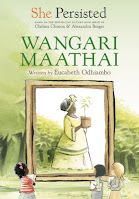
Odhiambo, Eucabeth and Flint, Gillian (illus.) She Persisted: Wangari Maathai 
February 1st 2022 by Philomel Books
E ARC provided by Edelweiss Plus

Born in Kenya in 1940, Maathai enjoyed living in her small town, but soon had to move to the city so that her family could make a living. She excelled at school, and was very interested in science. Even though girls were not usually encouraged to be educated, her family supported her, and she won a scholarship to study in the US, where she earned two degrees in biology. She returned to Kenya in 1966 and realized that too many trees were being cut down, which impacted the quality of life for Kenyans. She taught at the University College of Nairobi, where she found her career was negatively impacted by the fact that she was female, but she resisted the gender discrimination of the time and fought for her rights. She also started the Green Belt Movement to encourage people to protect trees and to plant them rather than cut them down. She was married and divorced, and faced more discrimination, but persisted with her teaching and environmental activism. She was awarded a Nobel Peace Prize in 2004, and, sadly, passed away in 2011. 
Strengths: I am always looking for biographies of people who have positively impacted the world, and for people who are not from the US. Environmental activism isn't new, but my students think it is. I love handing them books about Rachel Carson, Dian Fossey, John Muir, and others who were trying to protect the planet before things became so critical. Maathi is a very interesting person, and I love that this series gets authors who share cultural backgrounds with their subjects to write the stories. Tips on how to persist and help the world in the same way Maathai did  are included at the end, along with a bibliography.
Weaknesses: This is for readers in grades 1-4, so I will be looking for a slightly longer book for my library. My students also like to see photographs of biographical subjects when available, although the illustrations are very nice. 
What I really think: The She Persisted series is an essential purchase for public and elementary school libraries and would make fantastic presents for young readers. I was a huge fan of the Childhood of Famous Americans series, and would have absolutely adored these books as a child.