I got excited when I saw a new book by the great John Wilson, but wish I had known that this was book #3 in the series. It would have made more sense!(Digital book checked out from public library.)
James Doolan is taken to Chihuahua, Mexico as a prisoner with a group of Apache women and children who will be enslaved. Since he is an American, he is freed when he runs into an old friend, Santiago. The two catch up with all of the things that Jim has been doing since they last met.
The West in 1880 was a rough-and tumble place with a lot of fighting over territory and property. Victorio and his band of Apaches are supposed to go to a reservation, which would stop the fighting, but the removal of the army would also hurt the local economy. This isn't too much of a concern because Victorio continues to raid farms in the area. Doolan tells of previous conflicts during which he ran into Victorio-- when the leader took his forces into Mexico and were followed by the Buffalo Soldiers even though it was illegal. When the Mexicans were not happy with Victorio, he took his troops back to the states where they continued to get into trouble. For a while, Doolan was captured by Wellington, who fought with Victorio and considered Doolan to be a replacement for his son. Victorio's forces try to stay alive and have lots of fights with authorities, but eventually get trapped, surrender, and move to the reservation. Strengths: Wilson's books always have LOTS of fighting, action and adventure. There are few newer books on the Old West, and I think that this series might be a good place for students who have not previously been interested in the time period to start their reading. Then they can move on to some Zane Gray! Weaknesses: Obviously, starting with the third book put me at a disadvantage. The flashbacks made me even more confused. The series is published by Orca, so is available only in e book and paperback formats, but I might spring for prebind copies.
Babbitt, Natalie. The Moon Over High Street. In the 1960s, orphaned Joe is living with his grandmother. She is determined to keep him in contact with the rest of his meager family, so intends to go visit "Aunt" Myra for the summer, but falls and breaks her hip. Joe goes alone, and finds himself quite at home in Midville. He likes Myra and is comfortable with her, and especially likes the girl next door, Beatrice, with whom he explores the town. After Beatrice's dog runs off, they run into the rich Mr. Boulderwall at his home on High Street, and he is so impressed with Joe that he eventually decides to adopt him so that he can leave his business (which makes the swervit, a device indispensable on cars) to someone who will run it the way he does. Joe, however, would rather be a scientist studying the moon and not a businessman. Should he choose his pleasant but challenging life with his family, or the life of private schools and financial security? That is the choice... the moon, or High Street. Strengths: This is a pleasant tale about family and opportunity by a well-regarded author. It is also set in Ohio. Weaknesses: Very little happens in this book, and I fear that middle school students will not connect with Joe, since many of them would probably go for the easy life offered by Mr. Boulderwall. This struck me as a book teachers would like more than students.
Marvelous Middle Grade Monday was started by Shannon Whitney Messenger over at Ramblings of a Wannabe Scribe. Head on over there to see a list of Middle Grade Reviews by a variety of awesome bloggers (who are organized enough to remember to send in their links, unlike some people...)
Clark, Catherine. How Not To Run For President. Aidan is playing in the middle school marching band when presidental hopeful Bettina Brandon comes to his Ohio town to campaign. He is interviewed, since his mother has just been laid off from local company FreezeStar, and manages to push Ms. Brandon out of the way of a falling sign. Both to thank him and to add some interest to her campaign, Aidan is asked to go on the trail with Ms. Brandon and her daughter, Emma, who is not only Aidan’s age but very bratty. For a while, Aidan’s heroism and his family’s plight (illustrative of the type of family situation Brandon is trying to rememdy with her campaign) gain supporters, but after a while, typical mudslinging starts to occur. Aidan’s dog is purebred rather than a mutt. His mother was fired, not laid off. Having gained a glimpse into the political world, Aidan returns home disillusioned but also more realistic in his understanding of people and situations.
Strengths: I liked that the candidate was a woman AND an independent. I thought that the Ohio settings were true to life. Good cover, and a rare funny, realistic book for boys. Weaknesses: Never really felt connected to Aidan, and there wasn’t as much plot or action as I would have liked for this target audience.
There have been a fair number of "presidential" books for boys-- combine the books below with a selection of presidential biographies, and there's a ready made display. Just be careful if you have Joanna Hurwitz's Class President-- check out the Awful Library Books web site for the reason why (and a good laugh)! And, yes, that is Blendon Middle School's own copy of Sharon Draper's Sassy mentioned. I'm not quite sure how to fix it!
Barber, Ronde and Tiki. Goal Line. Primarily written, as pointed out by Mr. Winchell in comments, by Paul Mantell, who should be allowed to write books under his own name!
Twins Ronde and Tiki are starting 8th grade and are very excited to start playing football again, but Ronde is disconcerted to find that his identical twin is 3 inches and many pounds heavier than he is. Suddenly, the team is not rooting for “the Barber twins” but just Tiki. Tiki also writes an essay for a contest and wins, forcing him to read the essay at an assembly. He is approached by the school newspaper to write an advice column, and keeping up with football, class work, and the column prove stressful. Another set of twin players from Haiti help the team, but make the Barbers worry about their worth. The Eagles have a chance to have an undefeated season with the return of Coach Wheeler, and might have a chance to go to the playoffs again, but not unless Tiki can get his priorites in order. Strengths: I wish there were more sports series for boys. These are the perfect length and have just the right mix of sports and school problems. They do need a little more romance, though!Weaknesses: For some reason, even though these are based off the Barbers’ real lives, there’s always something I can’t quite believe. In this one, it is Tiki having to read his essay at assembly, and the sudden popularity of his advice column. Are there any middle school that even have school newspapers?
Tunis, John. All American. (Nota Bene: Published in 1942) E ARC from Netgalley.com from Open Road Media.
Ronald is a student at a the private Academy and a star on the football team when an attempt to stop Meyer Goldman from making a touchdown results in Goldman being in the hospital with severe back injuries. Wracked by guilt, and increasingly irritated by the attitudes of the students and staff at Academy, Ronald transfers to Abraham Lincoln High School. The transition is tough-- people call him a “pretty boy” and cause him problems until he gets in a fist fight with the nasty Stacey and ends up in the hospital himself. After this, everyone is nicer and Ron plays on both the baseball and football teams. When the football team is invited to an intersectional game in the South, one of the players will not be able to go because the school does not allow Negroes to play. Ronald wants the team to refuse to go, and he has the support of his fellow players, but local businesmen who will lose money if the team does not go put pressure on his father and the fathers of the other players to encourage the team to play. In the end, the team does not bow to this pressure, but end up being uninvited in the South but invited to an intersectional in the North, so everyone is happy. Strengths: Tunis (1889-1975) always does excellent sports descriptions, and we get football and baseball in this one. The cover alone makes the book worth buying. This is also a good historical description of the plight of African-Americans during this time period. It was fun to read about the fathers talking about the “big game of ‘16” and about Ronald’s lunch: scrambled eggs, potato chips, a piece of pie, bottle of milk and bread and butter, all for 27 cents. Probably considered well balanced, too! Weaknesses: It was jarring to read “Negro” again and again, and I worry that this will offend readers who don’t know the historical background. Also, since this is from Open Road Media, it is only available as an E Book.
It's funny how small print is an indicator that a book is meant for older audiences. I looked at Caludia Gray's new Fateful, and just couldn't get into it because the print was too small AND it was about werewolves on the Titanic. Lots of people out there need two copies for their libraries, but I don't have the audience for this book this year. Will get this author's Balthazar, however, which comes out March 6. Another one was Hautman's What Boys Really Want, which is usually the kind of realistic fiction I adore, but again, small font (along with more mature subject matter) doomed it.
Another one I really wanted to like was House and Vaswani's Same Sun Here. From the Publisher: " A twelve-year-old Indian immigrant in New York City and a Kentucky coal miner's son become pen pals, and eventually best friends, through a series of revealing letters exploring such topics as environmental activism, immigration, and racism." Again, libraries where Naylor's Faith, Hope and Ivy June is popular will want to have this, but the letter format seemed anachronistic, and I see this being a hard sell at my library. Marjoleine Book Blog and Middle Grade Reads both adored this.
For the past week, I've been longing to reread books. Cleary's Fifteen. Edwards' Mandy. Most recently, Paige Dixon's May I Cross Your Golden River (1975). Someone mentioned it, I remember reading it, and there is not a copy to be found anywhere. This made me think about all of the books I have in my library that are rather aged-- the copy of Mandy (1974) that I have is a first edition. How long will it last? When will all of my copies of Stormbreaker fall to pieces and be irreplacable? I need to teach for 25 more years, so I will not be able to recommend the same books forever.
Second morning this week that gently sobbing seems required.
Whew! February is going to be a busy month here! The most important event is the Third Annual Boys Read Pink month! This year, Charlie Joe Jackson, of Charlie Joe Jackson's Guide to Not Reading, is joining us because of his declaration on page 123: " If you have to read, read about girls. It helps you understand them better." This was my point when I set out to challenge boys to read books with girls on the covers. Most of the time, when I hand boys books with girls on the cover, they wrinkle their noses, but when I tell them that EVERYONE is reading them, they are okay with it. Even before the month has started, I've had about 15 boys check out "girl" books. Of course, Charlie Joe himself is so popular that I just ordered three more copies!
Berk, Josh. Guy Langman, Crime Scene Procrastinator. E ARC from Netgalley. Publication March 2012
When Guy's father dies and his best friend Anoop tries to get him to join the school Forensics Squad, he thinks "Why not?", especially when he realizes that Raquel, whom he rather likes, is joining. The teacher in charge, Mr. Zant, is not always amused by Guy's tomfoolery, but is very excited about forensic science, and the group learns about fingerprinting and lots of other ways to evaluate crimes scenes. This comes in handy when someone breaks into Guy's attic and steals valuable coins, and later, when the Forensics Squad finds an actual dead body on the golf course where they are having a competition with another school. Guy has recently found that he has a half brother whom he has never met, and gets it into his head that this is the person who stole the coins (he knew their value) and killed the teenager (who looks vaguely like Guy). Tracking his brother down in the city, Guy realizes that he was not the person responsible for either crime, and using his fingerprinting skills, he locates the perpetrator of the theft, even after the "murder" turns out to be a suicide. Along the way, Guy realizes that Raquel is not nearly as intriguing as Maureen, that his father was an interesting if flawed man, and that the world is a complicated but ultimately enjoyable place.
Strengths: Funny, funny writing! Berk has the same sort of knack that Jordan Sonnenblick has for taking an essentially sad story and making me laugh. My favorite line: "Nuttier than a squirrel turd."
Weaknesses: F-bomb on page 211. *Sigh* This was coming very close to the high school line with the sexual innuendo and general language, but it was a good murder mystery AND was funny, so I have to think about this one.
Sutherland, Adam. Police Forensics. E ARC from Netgalley. Lerner Publications, 2012.
Forensic science is discussed in very short, almost Twitter-like snippets in this well illustrated nonfiction title. The books starts with a variety of forensic terms, then talks about gear, different types of tests investigators use, famous crimes, and has interviews with forensic scientists. This is a good book for browsing in order to get a few interesting facts, but might be difficult to use to do, say, a research project describing the job of a forensic investigator. This is certainly a topic of interest to my students, and the bright colors and brief information will make this a popular book.
The Guys Read Pink suggestions for today: Both Alane Ferguson's The Christopher Killer and Walter Sorrell's Fake ID have girls on the cover.
My three children all ran middle school cross country for two years each. My older daughter also ran for three years in high school. That's 9 years of cross country running. How many pictures do I have of them?
Two.
I don't have any of my younger daughter, mainly because it's hard to juggle a clipboard and stopwatch AND camera while running back and forth across fields to yell times at 20 runners per race. I intend, at some point, to get some pictures from other parents. The good parents.
The larger point of this, aside from my many deficiencies as a parent, is that I don't really care about pictures. Graphic novels annoy me because I have to ferret the text out from the drawings. Have to turn more pages. It's more efficient to skip the pesky pictures and put more text on each page.
The students, especially the boys, don't feel this way. They LOVE pictures. Guinness World Record books. Lunch Lady graphic novels. Books about cars and sports and World War II, as long as they have pictures.
My only reservation about this is that I am not entirely sure that boys read the words in these books. There's a lot of page flipping that indicates the information presented is not being absorbed. I believe strongly that all middle school students need to read 30 minutes a day in order to strengthen their reading skills. That way, when they are forced to read East of Eden or The Canterbury Tales in high school, they can at least get through them. If they actually read the story in Magic Pickle books, great. If they only look at the pictures, will this help them?
I always tell students that my job is to make their reading as enjoyable as possible by picking out books about things that interest them. But they have to do the actual reading. This year, I seem to have more students than ever who don't want to read ANYTHING.
The point of this? What do you hand to the hard core reluctant readers? Are there graphic novels or books with pictures that you think students actually read?
Opine. Obviously, today it doesn't have to make a lot of sense!
(And have to laugh; immediately after posting I had to help my daughter find a quote by Robert Browning, and came up with this as well: "There, that is our secret: go to sleep! You will wake, and remember, and understand.")
Salisbury, Graham. Calvin Coconut: Hero of Hawaii Nominated for the Cybils by Deb Nance
Calvin is helping to prepare for his sister Darci's birthday party, which involves a huge water slide, but the weather is not cooperating. Soon, there is a major tropical storm causing the drainage canal right near Calvin's house to rise alarmingly. When Calvin and his friend Willy are out in the storm, Willy falls into the canal and gets swept out to sea, leading to a very suspenseful rescue. Book five in this series. Strengths: I can see younger students really enjoying Calvin's family and his adventures. The Hawaiian setting is exotic for those of us living in Ohio, and the details about life there are interesting. Weaknesses: For my collection, this is too young. The cartoonish cover and odd character name make it a less attractive choice for an easy read than Shredderman or Hank Zipzer. This author's Eyes of the Emperor is hugely popular in my school, though-- Salisbury does such good books for older students that I just wished this one would be a bit older.
Klise, Kate. Grounded. Nominated for the Cybils by Bigfoot.
Daralynn's father, brother and sister are all killed when her father's airplane crashes; the only reason Daralynn was not on the plane was because she had been grounded. Life is difficult for Daralynn and her mother, but slowly improves. Her mother gets a job at a local funeral home doing the hair of the deceased, but when a new crematorium opens up, Daralynn is afraid that fewer people will need her mother's services. With the help of the funeral home, Daralynn tries to start a trend for "living funerals". Daralynn's grandmother starts to slide into senility. Her quirky aunt, who runs a sort of rest home for elderly men, gets involved with the man trying to get the crematorium started, and soon problems emerge that affect the entire town. Strengths: Imaginative and well-written. Can't think of other books about funeral homes, and students might be interested in the gross details about the crematorium. Weaknesses: This is set in the early 70s, and it would have helped a lot if a specific date had been mentioned. Instead, there are passing references to an uncle who came home from Vietnam 6 years before, haircuts costing a dollar, Dippity-do, etc. While I could place this in time, students might be confused by these details, because most of the story seems modern.
Vernick, Audrey. Water Balloon. Nominated for the Cybils by Sally Gee.
Marley's mother and father are separated, and she will be spending the summer with her school teacher father. This was not her plan-- she would much rather hang out with her friends Jane and Leah. Instead, she is babysitting twin girls every day and has no computer at her father's. After a disastrous water balloon prank that Leah and Jane do not find amusing at all, Marley starts to doubt that her summer can be anything but horrible. When she meets the boy next door, Jack, things get a little better, until she realizes that her father is dating the woman for whom she is babysitting. Marley begins to realize that her life is going to change a lot: her parents are going to divorce, her friendship with Leah and Jane is not going to be the same, and boys like Jack are going to become more than friends. Strengths: Love that her father is supportive but also gives her room to be on her own. There is a wonderful scene where Jack and Marley have to get home from New York City on the train. It's that whole orphans-in-middle-grade-fiction thing; there are so many orphans because middle grade children are often annoyed with their parents! There aren't as many books where kids are annoyed by their parents even though they love them. I also liked Marley's struggles with lack of technology; it is a hard balance to strike in fiction today. Weaknesses: I didn't like Marley at the beginning of the book, although I did warm up to her later. She was too whiny.
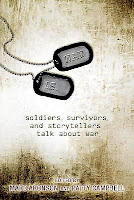
Aronson, Marc and Patty Campbell. War Is...Soldiers, Survivors, and Storytellers Talk About War. (2008)
This collection of writing about various facets of war has an introduction by Marc Aronson that finally makes sense of why so many of my boy readers want to read about war. Aronson posits that "People like war." Why?
There is a certain rush of Adrenalin that the war experience provides. People who have been in wars, despite the horrific experience, are drawn closer to those with whom they fight; they feel more alive. This is a very complete collection showing things from how army recruiters are not entirely honest, to women who experiences harassment while serving, to an interview with a chaplain. The stand out, for me, were several essays by World War II correspondent Ernie Pyle. I had heard of him, but never read his work. Why his "The Horrible Waste of War" recounting what the Normandy Beach looked like after the fighting is not required reading in every high school, I don't know. It is powerful stuff, and beautifully written. I will definitely look up the collection of his columns, entitled Brave Men, and will definitely purchase War Is... for my library. Don't know how I missed it.
Sciezka, Jon. Guys Read: Thriller.
Release date 20 September 2011. E-ARC received from NetGalley.
From the publisher: "A body on the tracks. A teenage terrorist. A mysterious wish-granting machine.The world’s worst private detective. The second volume in the Guys Read Library of Great Reading is chock-full of mystery, intrigue, and nefarious activity. Featuring some of the best writers around, and compiled by certified guy Jon Scieszka,Guys Read: Thriller is a pulse-pounding collection of brand-new short stories, each one guaranteed to keep you riveted until the final page."
Again, that Adrenaline rush. Scary stories, suspense. The Guys Read: Funny Business has been very popular: there's something to be said for a book that says specifically on the front cover "This is for boys to read." I would give more description, but it is so hard to page back through an E-ARC to look at the short stories again. They were all good.
I liked Vampire Rising so much that I nominated it for the Cybils Awards.The second book is a textbook example of how to write for the Adrenaline rush: Alex is chased by two cars, has blood sucking leeches thrown at him by Elle, is attacked by the leeches again in his dorm room, and then the dorm catches on fire. That's just the first two chapters! The boys from Glenarvon have to move in with the girls at LaLaurie school until repairs are made. Shades of Cross My Heart and Hope to Spy!) From there, we find out that the vampires are still trying to take out Alex, so Elle makes several more attempts on his life, and a character named Ultravox is brought in. He's trying to brainwash the LaLaurie girls to carry out an evil plan, using Alex's friend Sid's short stories to do it! This is an absolutely essential purchase if your library's Darren Shan books are in tatters. Still not enough of Ale'x sister, but I think there will be a sequel, and I can live in hope.
Adrenaline. Why things need to explode in the very first chapter of a book for some boys to find it intriguing! That said, adrenaline literally makes me sick to my stomach! I don't like scary books or movies, I don't sky dive, and quite frankly, making left turns in heavy traffic is as daredevilish as I care to get. That's why it's important for me to separate what I want to read from what my students want. If I had my way, we'd have a collection based off of the blogging of The Paris Hat!Ah, rec rooms and saddle shoes. A little more in my comfort zone.
Golio, Gary and Marc Burckhardt. When Bob Met Woody: The Story of the Young Bob Dylan.
This picture book caught my eye at the library. It gives a brief overview of Bob Dylan's early life (as much as is known; he apparently likes to make up things about his life!) and chronicles how he went to New York City to visit Woody Guthrie, who at the time was dying of Huntington's disease. In meeting Guthrie, Dylan gained entry into Folk circles and started his long and illustrious career. Afterword and resources are included.
Strengths: Nice overview of Dylan's life. The pictures are interesting. Would be a good book for elementary schools where they study music. Might encourage students to pick up longer biographies on both artists.
Weaknesses: Not sure of how many elementary schools need these books. I have such a bad feel for elementary audiences!
This nicely illustrated and formatted book unflinchingly discusses the difficulties in Guthrie's early life in a way that students can understand. His mother, suffering also from Huntington's, had erratic behavior that resulted in more house fires than any one family should have. Guthrie's path to a career in music is discussed, and the other singers and historical figures with whom he came in contact are also described. His marital difficulties and multiple children are mentioned without judgement. His eventual demise to to the same disease that ravaged his mother ends the book.
Strengths: The tone of this was very well-done, given the difficulties of Guthrie's life. The historical background is more of a reason to get this book than Guthrie himself; it gives such a vivid picture of the Dust Bowl and all of the social issues in the first part of the last century.
Weaknesses: Students who choose this for a school project will want to select their information carefully. This could make for one depressing Wax Museum feature!
Roberts, Jeremy. Bob Dylan: Voice of a Generation.
neration. (Lerner, 2005)
As with the Guthrie book, the inclusion of vast amounts of historical information as a background for Dylan's life is what makes this book a valuable addition to a collection. As mentioned earlier, Dylan is less than truthful about his own background, but the author gathers what evidence there is to outline the story of Dylan's life. Plentiful illustrations and pages devoted to different historical topics (The Counterculture of the 1960s, The Music of Joan Baez) help to round out the picture of a colorful character.
Strengths: This would be good for a high school collection where they study the 1960s or the Beat poets.
Weaknesses: So little has been done with biographies in recent years that I can't really justify purchasing any more titles. I love biographies, but it is difficult to get students to read them. At least we can always have them sent over from the public library.
Most readers would like a weekly feature on books for boys. Sorry, though--no snacks on this blog, nor am I willing to title the feature Dinosaur Monday! Lists of books for boys got a lot of votes. While unwieldy to post, I'll do it anyway; if you would like a version in Microsoft Word, e mail me.
I also got this very good response; the author can certainly send me a name or link!:
"Displays aimed at boys are a good thing. I found a site that had a display of the Guys Read booklist "At Least One Explosion." So I made a display, and besides our awards display, it is our most popular display so far.
Also, I think we shouldn't be condescending to boys and their interests. If they ask for hunting books, don’t get them something that is trying to dissuade them from hunting (there isn’t a lot out there, but The Trap by John Smelcer is very popular with boys.)
I think it is always best to listen to what they want to, and spend the time to search based on their interests. If I have to put in 2 hours' work to find one book for one boy, and that boy really enjoys that book, then that isn't time wasted. We are here for readers.
Just a note: I'm a librarian, in case that wasn't clear."
One thing that I have found boys ask for is books about war. They don't want books set on the home front; they want books about battles. These can be difficult to find; for example, Hobbs' Sonny's War was too much from a teen girl's point of view.
Certainly nonfiction books are good, too. I have gotten several good series lately, including Capstone'sBloodiest Battles, which has been hugely popular, and selected title from the We The People series. This companies The Terrible, Awful Civil War was quite good, replete with facts about clothing, food and sleeping conditions. 24/7 Goes to War was another good series. The problem with all of these, though, is that they are very short.
While not all of the books on this list have a lot of fighting, they have all been popular with my boys.
Books about War
Ancient Times
Ford, Michael. Fire of Ares. (Series of 3)
When slaves rebel in ancient Sparta, Lysander is caught between the Spartan ruling class, with whom he has been training as a warrior since his noble heritage was revealed, and those among whom he was recently laboring as a slave.
Rubalcaba, Jill. The Wadget Eye.
After his mother dies, Damon, a young medical student living in Alexandria, Egypt, in 45 B.C., makes a perilous journey to Spain to locate his father who is serving in the Roman army led by Julius Caesar.
Stone, Jeff. Tiger (Series of 7—Ancient Orient)
Five young warrior-monk brothers survive an insurrection and must use the ancient arts to avenge their Grandmaster.
Sutcliff, Rosemary. Black Ships Before Troy.
Retells the story of the Trojan War, from the quarrel for the golden apple, and the flight of Helen with Paris, to the destruction of Troy.
Dougherty, Terri. 300 Heroes : The Battle of Thermopylae (Series: Bloodiest Battles)
Describes events before, during, and after the battle of Thermopylae, including key players, weapons, and battle tactics.
Crusades, Medieval
Alexander, Lloyd. Westmark. (Series of 3)
A boy fleeing from criminal charges travels about the kingdom of Westmark, and ultimately arrives at the palace where the king is grieving over the loss of his daughter. (Not really historical, but lots of fighting.)
Cadnum, Michael. Book of the Lion. (Series of 3)
In twelfth-century England, after his master is brutally punished for alleged cheating, seventeen-year-old Edmund finds himself traveling to the Holy Land as squire to a knight crusader on his way to join the forces of Richard Lionheart.
Jinks, Catherine. Pagan’s Crusade. (Series of 4)
In twelfth-century Jerusalem, orphaned Pagan is assigned to work for Lord Roland, a Templar knight, as Saladin's armies close in on the HolyCity.
Flanagan, John. The Ruins of Gorlan. (Series of 7 and counting)
When Will is rejected by battle school, he becomes the reluctant apprentice to the mysterious Ranger Halt, and winds up protecting the kingdom from danger. (Not really historical, but lots of fighting.)
Spradlin, Michael. Keeper of the Grail
In 1191, Tristan becomes a Templar Knight's squire during the Third Crusade and soon finds himself on a mission to bring the Holy Grail to safety.
Revolutionary War
Avi, Fighting Ground
Thirteen-year-old Jonathan goes off to fight in the Revolutionary War and discovers the real war is being fought within himself.
Barry Denenberg. The journal of William Thomas Emerson : A Revolutionary War Patriot
William writes of his experiences in pre-Revolutionary War Boston where he joins the cause of the patriots who are opposed to the British rule.
Elizabeth Alder. Crossing the Panther's Path
Billy, son of a British soldier and a Mohawk woman, joins Tecumseh in his efforts to prevent the Americans from taking more land from the Indians in the Northwest Territory.
Civil War
Abnett, Dan. The Battle of Gettysburg (Graphic Battles of the Civil War)
Presents a brief depiction of the Civil War battle at Gettysburg, Pennsylvania in July, 1863; and describes major Union and Confederate generals as well as details of the fight.
Avi. Iron Thunder.
At Tom’s job at the local ironworks he helps build an iron ship for the Union army, and his loyalty come into question when he is approached by Confederate spies to sell secrets about the ship to the South.
Beatty, Patricia. Charley Skedaddle
During the Civil War, a boy joins the Union Army as a drummer, deserts during a battle in Virginia, and encounters a hostile old mountain woman.
Collier, James Lincoln and Christopher Collier. With Every Drop of Blood.
While trying to transport food to Richmond, Virginia, during the Civil War, Johnny is captured by a African American Union soldier.
Fleischman, Paul. Bull Run.
An assortment of characters describe the glory, the horror, the thrill, and the disillusionment of the first battle of the Civil War.
Paulsen, Gary
Soldier’s Heart— Eager to enlist, Charley has a change of heart after experiencing both the physical horrors and mental anguish of Civil War combat.
Severance, John B. Braving the Fire.
Jem joins the Union Army but is not sure of his motives or what he hopes to accomplish, particularly since the Civil War has divided his family and caused much violence and confusion in his life.
Sid Hite. The Journal of Rufus Rowe : a Witness to the Battle of Fredericksburg
In 1862, Rufus runs away from home and settles in Fredericksburg, Virginia, where he documents in his journal the battle he watches unfold there.
John Wilson. The Flags of War
Two cousins, Nate in South Carolina and Walt in Canada, know nothing of each other until they are united by the Civil War and a runaway slave from Nate's plantation.
World War I
Erich Maria Remarque ; All Quiet on the Western Front
Depicts the experiences of a group of young German soldiers fighting and suffering during the last days of World War I.
Murphy, Jim. Truce.
Tells the story of the December 25, 1914 truce between German and British soldiers as they laid down their weapons and met in No Man's Land to celebrate Christmas.
Wilson, John. And in the Morning.
Canadian Jim Hay joins the army in World War I and is sent to France where he meets a tragic end.
Spilbeen, Geert. Kipling’s Choice.
In 1915, mortally wounded in Loos, France, John Kipling, son of writer Rudyard Kipling, remembers his boyhood and the events leading to what is to be his first and last World War I battle.
World War II
Bruchac, Joseph. Code Talker.
After being taught in a boarding school run by whites that Navajo is a useless language, Ned and other Navajos are recruited to send messages during World War II.
Cromwell, Sharon. GI Joe in World War II
Examines key events involving U.S. soldiers during World War II that have shaped the course of the nation, while defining the GI's place in history.
DeMallie Howard R. Behind Enemy Lines : A Young Pilot's Story
A young American pilot is forced to bail out over occupied Holland during World War II, helped by the Dutch underground, and imprisoned in a German prisoner of war camp.
Dowswell, Paul. True Stories of the Second World War
A collection of stories about the events during World War II and some of their later results.
Elliot, Laura. Under a War-Torn Sky.
After his plane is shot down by Hitler's Luftwaffe Henry strives to walk across occupied France in hopes of rejoining his unit.
Hughes, Dean. Solider Boys.
Two boys, one German and one American, are eager to join their respective armies during World War II, and their paths cross at the Battle of the Bulge.
Napoli, Donna Jo. Stones in Water.
After being taken by German soldiers, Roberto is forced to work in Germany, escapes into the Ukrainian winter, before desperately trying to make his way back home to Venice.
Walter Dean Myers. The journal of Scott Pendleton Collins : a World War II soldier
A seventeen-year-old soldier from central Virginia records his experiences in a journal as his regiment takes part in the D-Day invasion of Normandy and subsequent battles to liberate France.
World War II
Salisbury, Graham. Eyes of the Emperor.
Following orders from the United States Army, several young Japanese American men train K-9 units to hunt Asians during World War II.
Wilson, John. Flames of a Tiger.
Dieter believes in the policies of Hitler and the Nazis, but as World War II intensifies and he is called upon to fight for his country, Dieter begins to question everything he believed.
Wilson, John. Four Steps to Death
Two bodies, uncovered at a building site, prompt the investigating officer to remember World War II and the circumstances involving their deaths during the Battle of Stalingrad.
Wulffson, Don. Soldier X.
In 1943 sixteen-year-old Erik experiences the horrors of war when he is drafted into the German army and sent to fight on the Russian front.
Vietnam
DiConsiglio, John. Vietnam : The Bloodbath at Hamburger Hill. (24/7 Goes to War)
Explores, through letters and diary entries, the Vietnam War and its effects on the soldiers and the citizens of Vietnam.
Hughes, Dean. Search and Destroy.
Recent high school graduate Rick Ward, undecided about his future and eager to escape his unhappy home life, joins the army and experiences the horrors of the war in Vietnam.
Kadohata. Cynthia. Cracker, The Best Dog in Vietnam.
A young soldier in Vietnam bonds with his bomb-sniffing German shepherd.
Mitchell. A Sniper’s Journey (NF)
Gary Mitchell recounts the experiences he had while serving as a sniper for the United States Army, describing the assassinations he was ordered to carry out.
Myers, Walter Dean. Fallen Angels.
Richie Perry, just out of his Harlem high school, enlists in the Army in the summer of 1967 and spends a devastating year on active duty in Vietnam.
Smith-Llera. Danielle. Vietnam War POWs (We the People)
Examines key events that took place during the Vietnam war, focusing on the mistreatment of our POWs.
White, Ellen Emerson. The journal of Patrick Seamus Flaherty, United States Marine Corps
A Marine records in his journal his experiences in Vietnam during the siege of Khe Sanh, 1967-1968.
Iraq
Myers, Walter Dean. Sunrise Over Fallujah.
Robin Perry, from Harlem, is sent to Iraq in 2003 as a member of the Civilian Affairs Battalion, and his time there profoundly changes him.
McCormick, Patricia. Purple Heart.
While recuperating in a Baghdad hospital from a traumatic brain injury sustained during the Iraq War, Matt struggles to recall what happened to him and how it relates to his friend, Ali.
Bowen, Fred. Hardcourt Comeback. This is the book from Peachtree Publishers that has Blendon's own Mr. McMillan in it (page 26), as a teacher running a history bee at school, no less! The story concerns Brett, who is a star basketball player and all around winner-- until he messes up a shot in a game and starts to have problems with school. He even loses confidence on a rock climbing wall, and is worried that he won't do well at the bee. Not to worry, though-- there is a lot more basketball action than worry, and Brett manages to work through his crises and get back on top of his game. The history Bowen brings in to this title is the "Fab Five" in 1993. I like these titles even more than Matt Christopher's.
Klavan, Andrew. The Last Thing I Remember. Charlie wakes up in a room strapped to a chair, obviously beaten and bruised. How did he get there? Flashing back to the last thing he remembers, he goes through an ordinary day of school but always comes back to the fact that he is being followed and tortured and he doesn't know why. The facts slowly emerge in between Charlie's escapes, and it turns out that the ordinary day was over a year in the past, and he's escaped from jail where he was sentenced for killing his best friend! We don't find out what exactly happened because this is the first book in the Homelanders trilogy(The Long Way Home came out in February). I was really impressed with this one. A lot of nonstop action, but with intriguing clues. This had an older feel to it-- fans of Morgenroth'sJude and Harazin'sBlood Brothers will like this.
Jones, Carrie. Captivate. (**SPOILER ALERT**) This sequel to Need finds Zara still in love with the were Nick, and still fighting an assortment of evil pixies, including her father, the pixie king. To complicate matters, there is another pixie king following her around, and she tends to turn blue when he is in the vicinity. My daughter and I adored the first book but were disappointed by the "Bella Effect" in this installment. Zara luuuurrrrves Nick, and when he is killed and taken to Valhalla, she is distraught and has to decide whether to turn pixie in order to save him. WILL this save him? Will he love her once she is blue and has pointy teeth? Can she kiss the pixie king without being untrue to Nick? I still liked the story, and will avidly read the sequel, but Zara is a more appealing character when she is stronger and does not whine quite so much. Still, I bought two copies of each!
Walker, Kristin. A Match Made in High School. Because of the high rate of divorce, Fiona's high school is instituting a year-long marriage course, during which seniors are paired up and given tasks that include managing money and getting along. Unfortunately, Fiona isn't paired with the boy of her dreams, but rather the obnoxious jerk Todd, who is also the love interest of Fiona's nemesis. The two fight and pull pranks on each other, and most of the students don't take the course nearly as seriously as the principal or guidance counselor. I found this book profoundly embarrassing to read, because it was so similar to my own 8th grade novel, although mine was more computer dating. This is a light, fun romp, and students will be much more interested in it than I was.
Yoo, David. Stop me if you've heard this one before. Mitali Perkins recently posted a list of novels with Asian male protagonists, so I've been working my way through those. Like Yoo's Girls for Breakfast, this strikes me as more of a high school title, not only because of the language but because of the contemplative nature of the story. From the publisher: "Despite his nonexistent social standing at Bern High School, Albert spends the summer working with his crush, Mia--the popular ex-girlfriend of Ryan Stackhouse--but as soon as Albert makes headway in his relationship with Mia, Ryan is diagnosed with cancer and pulls Mia, and her attention, away." The only book I can add that is not on Ms. Perkin's list is Sherry Garland's Shadow of the Dragon (1993).
After yesterday's post, I feel like the pressure is on! I have found a few more blogs for books for boys, and have created a new listing to the right. There are a few blogs done by boys, but they tend not to be updated as often. I do feel a little bad, as a feminist, making this distinction, but as a person who never was a boy trying to help boys find books, I need all the links I can get!
Rhuday-Perkovitch, Olugbemisola. 8th Grade Super Zero. Reginald has all kinds of problems. He's called Pukey by a former friend. His father is out of work. He has a crush on Ruthie and isn't sure what to do about it. Reggie also writes comic books and is a big buddy for a disadvantaged boy. To top it all off, he is volunteering with his church at a homeless shelter and starts to feel that his school isn't doing enough to give back to the community, so instead of helping the shallow Vicky win the election for class president, he decides to run himself.
This book was a refreshing change from inner-city, African American children with problems of drug abuse and gang wars, and the positive role models in Reggie's life, as well as his earnest volunteerism, will be good for students to read. My only problem-- this is long (324 pages) and does verge on the pedantic from time to time. Volunteerism can be portrayed in an interesting way (see Sonnenblick), but Reggie's involvement with the youth group and pastor, as well as his soul-searching, might not appeal to students as much.
Lynch, Chris. Monkey See, Monkey Don't. This sequel to Cyberia has Zane once again in the evil clutches of Dr. Gristle, the veterinarian who is trying to use animals to further his own evil ventures. Zane is the victim of mind control, via a bird who talks to him in his sleep and tries to get him to... I got confused. Monkeys are running amok, Zane develops super powers and runs 170 in one day, to the chagrin of his parents who are monitoring him electrically, and I started to forget why all of this is happening... both times I picked up this short book. I did adore the first one, and Hugo the dog is still very fun, but this was a surprisingly difficult read for me.
Kessler, Cristina. Trouble in Timbuktu. Kessler's time living in Africa lends tremendous detail to the intricacies of daily life for twins Ayisha and Ahmed. The two decide to guide two tourists, who turn out to be an evil archaeologist and his wife who are trying to steal some ancient manuscripts. The twins decide to try to stop them, which forces them into an adventure that involves lots of chases and a sand storm. This is again rather lengthy (350 pages), and while there is some action, the rich language and detail make this more of a cultural book than an adventure. Fans of Staple's Shabanu will like this, but I was hoping for something more along the lines of The Devil's Breath.
Because this blog is aimed at librarians and patrons of school libraries all books reviewed should be available in hard cover from vendors like Follett. I rarely review books that are only available in paperback and never review books that are born digital or published through subsidy publishers. I use E ARCs provided by Netgalley and Edelweiss, and physical ARCs if provided by major publishers, as well as finished books. I do not earn any money from this blog, and any books I receive are donated to my school library or other libraries in my district. All opinions are my own and do not reflect anyone else's.





 Golio, Gary and Marc Burckhardt. When Bob Met Woody: The Story of the Young Bob Dylan.


