Showing posts sorted by relevance for query amal. Sort by date Show all posts

Monday, May 14, 2018

MMGM- Amal Unbound

It's Marvelous Middle Grade Monday at Always in the Middle and #IMWAYR day at Teach Mentor Texts and Unleashing Readers. It's also Nonfiction Monday.

36086513
Saeed, Aisha. Amal Unbound
May 8th 2018 by Nancy Paulsen Books
E ARC from Edelweiss Plus

Amal loves to go to school and help out her teacher, unlike her friend Hafsa who gets miffed when class lets out late. Hafsa and Amal plan to leave their small town near Lahore and go to college some day, and Amal wants to be a teacher. However, when her mother has her fifth daughter, she falls into a depression and even with the help of the family housekeeper, Parvin, there is too much work to be down. Amal must stay home from school to do the laundry and cooking. When she is in the market, enjoying the time away from the house, she buys a pomegranate as a treat for herself. On the way home, she is hit by a car, and instead of apologizing, the occupant takes away her pomegranate! Amal grabs the fruit back and leaves after a few terse words, not realizing that she is crossing Jawad Sahib, who loans money to local families and exacts horrible consequences if not repaid quickly. Since her father owes money to Jawad after some bad years with the family farm, Jawad decides to take Amal to his estate to work as a maid in repayment. Her father assures her that this will only be for a month of so, and Amal is fortunate that she is to work for Jawad's mother, Nasreen Baji, who is kinder than many employers would be. Still, she is given trouble by Nabila, who was Nasreen Baji  maid but was demoted after making mistakes, and she quickly begins to realize that she will not be going home soon. She tries to make the best of the situation, and with the help of the other servants, borrows books from the house library. Because Jawad's father is running for political office, the family has built a literacy center in Amal's town, and the Ministry of Education has staffed it, but no one will go, not wanting to owe the family anything. Amal is forced to attend but is very happy to be taught about computers by the teacher, Asif. When Jawad's evil doings finally catch up with him, Amal is able to give vital clues to the authorities and break the family's hold over her town.
Strengths: We need more books about how young people in other countries live, and I would have adored this as a middle school student. The details of what school and family life are like for Amal are wonderfully depicted, and her close knit, extended family is supportive and caring. Having markets in both the town and in Lahore described is fascinating, and the family wedding and attendant parties adds even more cultural depth. Amal's plight, and her reactions to it, are realistically portrayed, and her impulsive behavior has both good and bad consequences. There are so many wonderful levels of things happening in this book, and there is an overall upbeat feel that will help young readers process the traumatic experiences that Amal has. Notes in an afterword discuss the plight of indentured servants in today's societies.
Weaknesses: It seems a little unrealistic that Amal would be able to bring Jawad to justice, but it does make for a great story!
What I really think: I need books like this set in lots of different countries! Every day life for children 11-14, with details about food, clothing, school, families and so many other things! Reading this type of book, as well as historical fiction, is a great way for young readers to understand that the entire world is not exactly the way their little corner of it is!
Ms. Yingling

Wednesday, February 02, 2022

Maizy Chen's Last Chance and Omar Rising

Yee, Lisa. Maizy Chen's Last Chance 
February 1st 2022 by Random House
E ARC provided by Netgalley

Maizy and her mother live in California, where her never-married mother works as a well-known food stylist. Maizy has only met her Oma and Opa once, when her mother's parents came to visit, but immediately left. When Opa becomes ill, Maizy and her mother decide to spend the summer in Last Chance, Minnesota, where her grandparents run a Chinese restaurant. It's certainly a different sort of life, and while she misses her best friend, Maizy settles in to small town life. She meets Logan, who is nice, and some mean girls, who seem to be making fun of her. She spends a lot of time in the restaurant, where she gets to know Daisy, the only staff member, and some of the regulars. She is also tasked with keeping Opa company, and the two spend a lot of time watching a food television show. When she learns that Werner, who runs a bratwurst stand, used to be her grandfather's best friend, but they had a falling out, she trades food from the Golden Palace for sausage sandwiches, hoping to get Opa to eat more. Eventually, Werner comes to spend time with his old friend, although they watch television rather than talk. Her mother seems to be reconnecting with a high school flame, who is now the school principal. When Maizy experiences some racial tension, since her family is the only Asian-American one in town, her grandfather starts to tell her about some family history. Going back into the mid 1800s, we find out about Lucky Chen, who left China to come work in California and fled when he was wrongly accused of stealing from his employers. He got a ticket as far as Minnesota, and got a job as a cook at the Golden Grille. Throughout the book, we see Lucky and his descendants' stories of discrimination contrasted with what is going on in Last Chance now, which includes racial slurs painted on the restaurant and the stealing of a stuffed bear mascot. Maizy learns a lot about the history of her family, her grandparents, and how the struggles that Chinese-Americans have experienced through history are still continuing today. 
Strengths: Maizy was a great character who wasn't too thrilled to be away from home for the summer but who made the best of her experiences. She was glad to get to know her grandparents, to hang out in a different place, and to learn about her family history. So many middle grade characters approach new experiences with negativity, so this was great to see. I'm usually not a fan of the story-within-a-story, but Opa's tale about Lucky and the Golden Palace worked extremely well, and I was looking forward to the next installment as much as Maizy was. The secondary characters, like Principal Holmes, Daisy, and Werner help to give a good feel for the dynamics of the town; Principal Holmes is married to a man, and lives in a nearby city because he's not sure how this will go over with residents, Daisy has some learning challenges but thrives when given a chance by Oma to work, and Werner's family highlights the German residents who first came to Last Chance. I have relatives in a much smaller Iowa community, and the details about a small town Midwest community are spot on. Now, we just need some newer historical novels about Paper Sons and Chinese workers in the 1800s, and if they are written in such an engaging style, they'd see a lot of circulation. 
Weaknesses: The subplot with the mayor felt a bit forced, and Maizy's interplay with the local mean girls didn't quite gel as much as it could have. 
What I really think: This was a perfect balance between a fun setting and characters, and more serious issues and history. It had a lot of similarities to Johnson's The Parker Inheritance, with the blend of modern and historical problems, or Luz Alegre's Dream Weavers, with the family business. I'm always a fan of characters who get to know their grandparents and who get to experience other places in the world, and Maizy makes the most of her opportunities. Definitely glad to add this to my selection of summer adventures for my readers. 

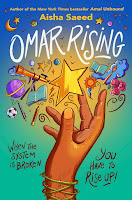
Saeed, Aisha. Omar Rising (sequel to Amal Unbound)
E ARC provided by Edelweiss Plus
1 February 2022, Nancy Paulsen Books

Omar is very pleased that he managed to get into the prestigious Ghalib Academy for Boys, but he is also nervous about it. It means leaving his mother and boarding at the school, and not coming home again until December. He's excited about learning about the planets, and looking forward to reacquainting himself with boys he met at the summer program at the school. He's sad about leaving his friends, especially Amal, who is back home after her horrible year in Amal Unbound. Ghalib is a great school, with a terrific library, new science labs, and a kind and supportive art teacher. Omar has good friends in Kareem, whose father works at the school, Naveed, and even older Faisal. Aiden, however, is cold and rude, and thinks the school is not very nice, since his father is very wealthy. Headmaster Moiz has put all of the Scholarship Boys into an English language class that he teachers, and Omar feels that he doesn't like him very much. The Scholarship boys also have to do five hours of service at the school, from folding laundry to cleaning to helping out in the kitchen, and are not allowed to be in any clubs. Most of the other students don't seem to look down at them for this, but the requirements of the scholarship don't allow much time for anything but studying. Omar does take a few breaks, and talks to his mother on the phone, but he is very concerned about his grades, especially since they aren't good in Moiz's class. He starts an interesting art project, and when he returns home in December, Amal tells him that he doesn't have to suffer through everything alone. He asks Moiz for help with English and starts to do better in class. His art project goes well, and he even starts to understand and befriend Aiden. When the end of the year rolls around, Omar and Naveed's grades aren't good for them to receive a scholarship the next year. They feel that the requirements are unfair, and rally the other students around this injustice. Will it be enough for them to be able to return? 
Strengths: Amal Unbound has been a very popular book; it's being used by a seventh grade teacher for a class unit, and I'm sure that my readers will be very happy to see more about life in Pakistan. Any story that shows my students how lucky they are to be able to come to school every day is one that I enjoy, and Omar's struggles to do well in class are quite admirable. My students are interested in boarding school stories, so movie nights, sneaking into the kitchen, and playing sports with friends will appeal to them. Omar's family situation is very interesting, and it was good to see Amal's family again. 
Weaknesses: This did not have as many details about daily life as Amal's story did, and I would have liked to see more descriptions of the classrooms and activities, and also more adventures outside the school, but it's hard to fit everything into the book. There was a decided paucity of descriptions of food, although there are a few. 
What I really think: I'm definitely purchasing this one, but it did have me scratching my head a bit. Omar's scholarship comes with very specific criteria, but then, I think most scholarships do. My own college scholarship required me to maintain an A average, major in a particular field, and only work certain university jobs. My graduate scholarship wasn't renewed even though I had the grades; the committee just didn't renew it. I wasn't even given any reasons. Is this a broken system, or just a system that didn't work to my advantage? I don't know what the finances of Ghalib Academy were, and how many scholarship students they could afford. Is this injustice? I just never thought of it that way. 

Ms. Yingling

Wednesday, April 01, 2026

Hafsa's Way

Saeed, Aisha. Hafsa's Way
March 10, 2026 by Nancy Paulsen Books
E ARC provided by Edelweiss Plus

In this companion novel to Amal Unbound and Omar Rising, we follow the progress of Amal's best friend, Hafsa. Hafsa's family runs a produce market in their small Pakistani village, and she is very excited to have been accepted into a month long medical studies summer program at the Bukhari school in Lahore. Her father is adamantly against the idea, since he is appalled when she does something as simple as riding a bicycle, because it is somehow unseemly for a girl to do this. When her older sister, Shabnam, visits with her doctor husband, Sohail, the idea comes up for Hafsa to stay with Shabnam while she attends the program, which Sohail offers to pay for. In a surprise move, Hafsa's grandmother jumps with with her agreement to send Hafsa, stopping her son from forbidding it! Hafsa is surprised at how opulent Sohail's family home is, and a bit concerned that Shabnam is helping Sohail's mother with a hospital fund raising gala rather than going to culinary school. Another concern is that the medical camp is being held the next year, and the focus of the current program is climate change. Since it was difficult to attend this year, there is little hope of returning. One teacher lets Hafsa watch the recorded videos from the previous year, so she does get some of the medical information. The program is interesting, and Hafsa takes a particular interest in an elephant, Gulab, at the local zoo, even though other students make fun of her "dancing" with the elephant in a quiet moment. At the zoo, she runs into Tariq, who is also worried that Gulab is not receiving the best care, and the two work to get Gulab's situation more attention. Hafsa talks to Sohail about the fact that Shabnam is working so hard on the gala that she has set aside her dream to open a cupcake bakery, which causes a few family problems, but also opens communication. Hafsa's attempts to get Gulab's case media attention are successful, and the school offers her a scholarship to the camp the following year because of her work. Sohail's mother agrees to hire a team to help with the ever increasing work for the gala, and the book ends on a positive note. 
Strengths: I read this book and Hicks' Inbetweens on the same night, and now I want to go to a summer program! While these tend to be expensive, they are so helpful, and it was interesting to see depictions of programs in both the US and Pakistan. Of course, I would rather send my own children to a medical program, and climate change is every bit as important to study. There's just enough information about climate change and its effects to be interesting, but not so many that the story is bogged down in details. There's a personal face of the issues with Gulab; readers who love animals will want to read this for the details about elephants. The family dynamics are well depicted, and US readers will find it interesting that Shabnam was married relatively young to a man picked out for her by her parents. It was nice to see a glimpse of Amal at the beginning of the story. 
Weaknesses: I would have adored this as a middle school student, but while Amal Unbound remains popular in my library, I've had trouble getting readers to pick up titles like Omar Rising. I'll probably purchase a copy, because I think it's an important story to read. Just don't understand why young people are not curious about the world. 
What I really think: This is a great choice for readers who want to see what every day life is like in countries other than the US and who enjoyed stories like Abbas's Aarzu All Around, Perkins's The Golden Necklace: A Darjeeling Tea Mystery, or Bajaj's Thirst.

I hesitate to mention this book, but since it caught me a bit off guard, it might surprise others as well. Even if librarians and teachers don't read every book they hand to students, they should have a good idea of what the stories contain. This might be exactly what you are looking for in a book; it is just not something I will be purchasing. 

Patel, Khushboo. All That Chandni Knows
March 31, 2026 by G.P. Putnam's Sons Books for Young Readers
E ARC provided by Edelweiss Plus

**Spoilers**

While I very much enjoyed seeing the depiction of daily life in Gujarat in 1999 (and was amazed that there were so many cultural references that are the same in the US!), the exploration of colorism, and Chandni's struggles to get into boarding school, I'm not sure that I want to personally hand middle school readers a story where the father is having an affair with the mother's sister, Diya Masi. Not only that, but Diya Masi lives in the family home, shares a room with Chandni, and while Chandni knows about the affair (and is told that the mother is okay with it), the mother does not and is devastated at the end of the book. There are no details at all about any activity, so my objection doesn't lie there. This is a novel in verse, and I wish there were more support for Chandni throughout, because this would be a devastating secret with which to live.

This was lyrical and heart felt, but perhaps just not the right choice for my readers in grades 6-8. If this is something that appeals to you, by all means take a look. 

Tuesday, August 24, 2010

Invisible Girl

Stone, Mary Hanlon. Invisible Girl.
Stephanie lives in Boston with her alcoholic, abusive mother and her passive, ineffective father. After a particularly brutal beating, Stephanie's mother leaves the family. It is decided that Stephanie should go live with family friends out in California. The difficult part? The family is very wealthy, and the daughter, Annie, who is Stephanie's age hangs out with a group of friends that are right out of The Clique. The arrival of the beautiful and exotic Amal threatens Annie-- the boys like her better, so Annie and her friends feel a need to torture her. Stephanie is also not treated well, so she and Amal become friends. There are some very nice multicultural moments (Amal's family is Egyptian and Muslim), and Stephanie takes great comfort in Amal's mother, who is so different from her own.

This was a very good twist on the novels lately that concentrate on privileged students in private schools, who wear designer clothes. Stephanie's difficulties in fitting in and dealing with her situation are achingly realistic. Picky Reader will love this one, as will many students who are torn between problem novels and books about wealthy families.

Sorry no cover-- I'm on a netbook again because the wiring for the computers in the library is not completely done. Carpet is also supposed to arrive today. Students arrive tomorrow, and I will see all 200 and some 6th graders!

Wednesday, March 25, 2020

Efrén Divided

Cisneros, Ernesto. Efrén Divided
March 31st 2020 by HarperCollins
E ARC provided by Edelweiss Plus

Efrén and his family work very hard, but still struggle to make ends meet. His father works several jobs, and his mother makes sure that Efrén and his twin siblings, Max and Mia, are always cleaned and pressed when she walks them to school before heading to work. Efrén considers his mother "Soperwoman" because she can put food on the table, help out teachers at the school, and make sure he behaves himself in addition to everything else. His best friend, David, seems a little luckier in life, although he lives with his grandmother. When school elections are announced, David thinks he will run for president for the prestige and the chance to change the cafeteria food. David always has the coolest clothes and latest gadgets thanks to his father, but his life isn't easy, either. Efrén agrees to help, although he suspects that classmate Jennifer would do a better job. He has something in common with Jennifer; their parents are in the country without documentation, and both children live in fear of ICE. When his mother is applying for a new job, she gets caught in a raid and deported. Efrén's father immediately starts to make plans to get her back to the United States, but it takes a lot of money, and it's not easy to get across the border even with a coyote. After an unsuccessful attempt, the father decides to take the money to Tijuana, and when Efrén volunteers to go, he reluctantly agrees. Efrén goes across the border by himself, and luckily runs into a sympathetic taxi driver, Lalo, who used to live in the US with his daughter, but was deported after some bad choices. Lalo helps Efrén as much as he can, which is good because there are a lot of dangers. Efrén eventually finds his mother, delivers the money, and returns to his anxious father. It is harder than ever to get by with his father working nonstop, his mother gone, and the kindergarten aged twins needs a lot of care. Will Efrén's mother be able to make it home? And will the treatment of immigrants in the US ever change?
Strengths: It is a delicate balance to portray the difficult realities of Efrén's life so that the story is hopeful to readers who might be in similar circumstances but sympathetic to readers who might not come to the book with positive thoughts about undocumented immigrants. (And unfortunately, there are readers like that, even in middle school.) Cisneros draws on his twenty plus years as a teacher to achieve this balance in a compelling story that will help those unfamiliar with Efrén's way of life understand it. The details about parents working long hours, children taking care of siblings, and students trying to keep up with school work while struggling with basic needs are well done, and the supporting characters reflect a variety of experiences, including a teacher who tries to help Efrén without being too intrusive. (Another delicate balance.) I'd love to see this book used as a core novel or as a reading group choice, along with Weeks and Varadarajan's Save Me a Seat and Gratz's Refugee.
Weaknesses: While Efrén's trip to Tijuana was absolutely fascinating, I have a bad feeling that if a child traveled there alone, there might not be a Lalo to keep him safe. Luckily, in Efrén's story, things work out better than they might in real life.
What I really think: Definitely purchasing, and know that this will be popular with students who enjoyed Yang's Front Desk, Saeed's Amal Unbound, Cruz' Everlasting Nora, and Venkatraman's The Bridge Home. It is also an important addition to a library collection that includes portrayals of a variety of cultural experiences.
Ms. Yingling

Thursday, October 09, 2025

The Golden Necklace: A Darjeeling Tea Mystery and Blackout

Perkins, Mitali. The Golden Necklace: A Darjeeling Tea Mystery
October 7, 2025 by Charlesbridge
E ARC provided by Edelweiss Plus

Sona, a Nepali girl, lives in the mountains near Darjeeling, India. Her father has passed away, and her mother picks tea for the greedy owner of a plantation, Banerji, to support Sona and her troublesome older brother, Samiran. Samiran has taken out loans to set up a food stand, since he is a good cook, but got into trouble. No one will buy from him, and he's finding it hard to get work to repay the loan. Sona is studying for exams so that she can further her education at the Darjeeling International School on a scholarship. Sona occasionally lurks outside the windows of Banerji's house to hear his son being tutored by Sir, and has made friends with Banerji's orphaned Bengali niece, Tara. Tara is older, but enjoys Sona's company. She confides in Sona that her Uncle is arranging a marriage for her, and using the gold jewelry her parents left her as her dowery. While Sona feels that arranged marriages can be good, she wants her friend to be able to make her own choices. When the gold goes missing, Sona works behind the scenes to try to find it for her friend. Her life is hard enough, since she must go every day to a broken pipe to get water, and Banerji is giving the workers a hard time. Getting involved with the local police, and having to sneak around town looking for clues is a tremendous challenge. When the head tea picker, Kaki, is accused of stealing, Sona knows that she must find a way to clear her name. 
Strengths: I'm an enormous fan of Perkins' work, since it often sheds light on the conditions of everyday life in other countries. (Tiger Boy , Bamboo Peopleand Rickshaw Girl.) My students often complain about "having" to go to school, and don't seem to understand how fortunate they are. Seeing Sona work so hard on her studies in order to have the opportunity to get more education is something that is helpful for my students to see, as is her hard work at getting water and caring for her family. The class differences between Sona and Tara are shown, but  it's good to see that they are still friends. The mystery is rather light, so the book is a quick read. There's a very satisfying ending, with Banerji getting his comeupance and a lot of improvements being made to the community that will benefit Sona and her family. 
Weaknesses: It would be helpful to have some more information about the different ethnic groups and why they are in India. We have a small population of Nepali students at my school, but many of my students won't understand why Sona and her family are in India, since they don't keep up with the US news, much less what is going on in other countries. 
What I really think: This is a good choice for Readers who enjoyed Saeed's Amal Unbound or Butterworth's Running on the Roof of the World, and had some similarities to Menon's A Mystery at Lili Villa.  Upper elementary students, as well as middle school students who want an interesting, shorter book, will enjoy this slice-of-life mystery. 

Gibb, Stuart. Blackout (Spy School #13)
October 7, 2025 by Simon & Schuster Books for Young Readers 
E ARC provided by Edelweiss Plus

Ben still just wants a little bit of a time out after having had over 150 near death experiences, so he's glad to be heading to the home of Orion, a hacker who has invited them to stay at one of his many homes, this one in Indonesia. Alexander Hale is flying there on one of Rufus Shang's jets, that he won't need because the group has put him in jail. Everyone is along for the ride- Cyrus and Mary, Alexander (although Catherine is elsewhere), Erica, Trixie, Mike, and Svetlana. When a hacker deploys a "Birthday Cake" maneuver, all of the lights are out, and the jet has to land in a less than optimal way. The group narrowly manages to get to Orion's, where there are back up generators, but Cathering wants them to help solve the problem of who is messing with the world power. What do they want? Unfortunately for Ben, he has to press pause on his idyllic vacation since the group is near the hacker. Cue up near death experiences 160-175 as Ben and his classmates have to save the world YET AGAIN. 

I snorted audibly several times while reading this, and is was a very fun romp. I always enjoys these, and I do buy them for my school library, but we are getting to the point in the series where students aren't necessarily going to be able to finish the entire series in their three years in middle school. Gibbs is a fantastic writer, but I'd love to see him move away from Spy School and Fun Jungle to do some stand alone mysteries so that my students who don't want to commit to 14 books can experience Gibbs' talents. 

Still want a button from SimonKids proclaiming that I have read all of these books! 

Ms. Yingling

Monday, April 08, 2019

MMGM- Orange for the Sunsets

It's Marvelous Middle Grade Monday at Always in the Middle and #IMWAYR day at Teach Mentor Texts and Unleashing Readers. It's also Nonfiction Monday.

Athaide, Tina. Orange for the Sunsets
April 2nd 2019 by Katherine Tegen Books
E ARC from Edelweiss Plus

Asha's family has lived in Uganda for many years. Her father works with the department of tourism, her mother is a nurse, and Asha enjoys going to school in a mainly Indian school.  She is best friends with Yesofu, who is African and whose mother works for Asha's family. As the two get older, Yesofu starts to realize the disparities in the way Indians and Africans are treated; for example, on their soccer team, Yesofu gets little playing time even though he is one of the best players. When Idi Amin comes to power, the social construct comes into question. When Uganda was under British rule in the 1880s, Indian workers were brought in to help build railways. Many stayed, and they ended up being in a social strata below the British, who held power, and the Ugandas, who were shut out of many jobs. Amin doesn't like this, and wants to return "Africa to the Africans". This means that Indians must leave the country. The exact parameters of this changed; at first, Asha's family thinks they can stay because they have protected jobs, but soon even those residents who are citizens are forced out. Not only that, but to "help" the economy, the Indians leaving are not allowed to take most of their money with them, and must sell their properties to the government. Asha doesn't want to leave, and when she sees her father making plans, takes the family's passports and hides them. As the clock ticks down, many of her friends leave, businesses stand empty, and protests and riots against the Indians become more frequent. Yesofu loves Asha, but he also sees that his people have fewer opportunities than hers, and begins to support Dada Amin. When an indiscretion on the part of Asha and Yesofu causes the arrest of Asha's father, Asha and her mother know that they must leave their beloved homeland even though they don't want to.
Strengths: This was an excellent mix of daily life, politics, friendship and suspense. It also covers a point in history of which I was completely ignorant, since I started reading the newspaper in 1974, when Nixon resigned. It managed to realistically portray both Asha's feelings of anger and disbelief at being displaced from her home and also Yesofu's feelings of injustice in equally sympathetic terms. The author left Uganda as a young child, and drew upon conversations with friends and relatives who remembered this event, which makes it all the more impressive that she was able to give Yesofu's concerns voice.
Weaknesses: There were a few moments were it felt like I had heard Asha's complaints before, but that probably bothered me only because I really, really wanted to know what happened next!
What I really think: Definitely purchasing, and glad to have this to add to a collection of riveting novels set around the world, like Amal Unbound, The Night Diary, Everlasting Nora, The Bridge Home, Running on the Roof of the World, and Stand on the Sky.


Washburn, Esme and Calista (Photographs)
20 Recipes Kids Should Know

April 2nd 2019 by Prestel Junior
Copy provided by Media Masters Publicity

My 85-year-old father buys Aunt Jemima scrambled egg breakfasts because his home economics education was so sorely lacking that the only two things he can cook are chili and beef stew. Don't let this happen to the children in your life!

This cookbook starts with basic terms and information that all young cooks need, and I appreciated that the author cited the sources of some of her recipes in the notes. The instructions are very complete, which is suitable to beginning cooks, and the measurements are given in both English and Metric amounts. This is a large format book (9.8 x 0.4 x 11.3 inches), so there are large illustrations of the finished products.

This is broken down nicely into meals, snacks, and sides, and the recipes are in fact good ones for children to know. I might have made a few substitutions-- oatmeal instead of banana bread for breakfast; a different soup other than black bean for lunch; and dinners not quite as heavy on the meat for dinner. The sides of roasted vegetables and mashed potatoes are quite good, and the desserts are also essential-- cake, pie, cookies, and strawberry shortcake. (Which I would probably have replaced by the banana bread!)

I'm a sucker for cookbooks, and if this weren't so appealing and colorful, I would probably give it to my father instead of offering it to students in my library. There's hope for them; for my father, not so much!

Friday, December 13, 2024

Poetry Friday- When the Mapou Sings

Pinede, Nadine. When the Mapou Sings
December 3, 2024 by Candlewick Press
E ARC provided by Edelweiss Plus

In 1935, Lucille is living in a small village in Haiti with her father, who is a woodworker, and her aunt Lila, since her mother passed away shortly after Lucille was born. Lucille can hear the mapou tree sing to her, and feels that her mother communicates with her that way. She attends a convent school run by Belgian nuns with her friend Fifina, for whom she has deep feelings. While the people of the village are happy that the occupation by Americans has ended, the new government is not particularly helpful. When Fifina's father, who runs a newspaper, runs afoul of the section chief, he is beaten, and Fifina is forced to become an "outside wife" to him. Lucille is devastated, and shortly after this, her mapou tree is cut down. She reports the tree as stolen to the police, and even takes them to the section chief's house to see that he has cut down the tree. Of course, this puts Lucille in danger. Her father and aunt arrange with her cousin, Phebus, for Lucille to go to the big city and live with Madame Ovide. She has to deal with the housekeeper, Celestina, but sells carvings and wood polish at the market to earn some money to try to get home. Madame's son, Oreste, is home from attending college in New York City, where he is involved with the NAACP. The two slowly fall in love, and when Celestina finds out, Madame Ovide sends Lucille to work in a house she is renting to an American. This American turns out to be Zora Neal Hurston, who is very sympathetic to Lucille. Through a visitor, Lucille finds out that Fifina might have run away from the section chief and lost a baby.  Eventually, Lucille helps Hurston with some of her research, but later gets embroiled in the political unrest, reconnects with Oreste, and even helps save his mother. 
Strengths: While there are a few books about life in Haiti (Danticant's Eight Days and Behind the Mountains) and books about Haitian immigrants to the US,  (Farrar's A Song for Bijou, Arnold's The Year I Flew Away, Rigaud's A Girl's Guide to Love and Magic), I haven't really seen anything about different historical periods in Haiti. This was a fascinating look at an area of the world that is still having many difficulties. Lucille was an interesting character, and seeing her interact with Zora Neale Hurston was quite interesting. 
Weaknesses: Novels in verse are beautiful to read, but often don't have the backgroud information necessary to understand concepts or background that are unfamiliar to young readers. I'm usually pretty good on world history, but even I struggled with putting this story into historical context. 
What I really think: This is similar to a more Young Adult version of Amal Unbound, when it comes to a young woman having to work in domestic servitude, and had a lot of intersting Haitian history in it, but would be better placed in a high school library than a middle school one. 
 

Ms. Yingling

Wednesday, June 12, 2019

The Village by the Sea

Desai, Anita. The Village by the Sea
April 16th 2019 by NYRB Kids (first published 1982)
E ARC from Edelweiss Plus

Lila and Hari live in a small village in India. Their mother is very ill and never gets out of bed, and their father has had to sell his boat. He now uses the little money they bring in to get drunk on toddy every night. Lila takes care of the house, and Hari tries to earn a little money doing odd jobs. They do manage to send their two younger sisters to school. When a factory is set to be built in their area, Hari at first thinks that it will be a good thing, and provide him with a job, but then starts to wonder. Rich people from Bombat, the deSilvas, often come to stay at their house near the beach and hire Lila and Hari to do small jobs; Mr. deSilva tells Hari that if he is ever in Bombay, he will hire him to be a caretaker. When a group protesting the factory decides to go to Bombay, Hari goes as well. At about this time, the mother has a very high fever, and Lila asks the deSilvas to take her to the hospital. They do, and even kindly offer to pay for the medicine. The mother is severely anemic and generally run down, so an extended stay in the hospital is indicated. The father stays as well, and stops drinking. Hari finds the deSilvas aren't in Bombay, and decides to go home after working in very bad conditions at a restaurant, although he does meet very nice people. Although it looks like the factory will destroy the environment around the town, Hari and Lila try to appreciate their somewhat improved lives and hope for the best for the future.
Strengths: The details of daily life in rural India, and some of the problems faced by people in small villages, are all very well described. The writing is very rich with details, and shows a clear love of the environment, despite its sadness. I love books set in other countries, especially India, and wish there were more to share with my students.
Weaknesses: This was crushingly sad, and when something happened to the children's dog, I just about stopped reading! Because this was first published 37 years ago, I felt there needed to be a note of explanation with it. Is life still like this in India? Have things changed? In towns where factories were built, is life better or worse? Since I don't know the answers to these questions, I can't tell my students whether this should be considered historical fiction, or whether it is still an accurate depiction of life in rural India.
What I really think: This is available only in a paperback version, so I think I'll pass and recommend Padma Venkatraman's The Bridge Home or Saeed's Amal Unbound instead.

Ms. Yingling

Wednesday, April 08, 2026

Seabird

Kadarusman, Michelle. Seabird
September 30, 2025 by Pajama Press
Copy provided by Young Adult Books Central


In 1892, Kartini is attending a Dutch school in Jepara, Java, in the then Dutch East Indies. When she turns 12, however, Mother, her father's second wife, requires that she leaves school and begin a period of isolation that is intended to make her a more desirable wife. She must also learn to act like a lady and turn her attention to embroidery and other quiet pursuits. Kartini misses her best friend, Lesty, who has returned to Amsterdam after her father's position in Java is finished. Kartini's mother, Ma, has been relegated to a smaller home because she was not "Raden Ayu" like Mother, and so lost her position in the household. Kartini would much rather study, and is jealous that her brothers are sent to boarding school and then to high education in the Netherlands, and doesn't understand why she can't have the same experience. She does get permission from her father to correspond with Lesty, so finds out that women in other parts of the world have more opportunities than she is allowed. She also talks to two of the maids her age in the household, Yanti and Uka, and helps them solve a mystery involving an invitation from the South Sea Starling to travel the world with her importing business. Kartini's father is impressed with her writing, and allows her to meet a Dutch journalist, who encourages her writing. When it seems likely that there might be a marriage arranged for her very soon, Kartini musters the courage to ask for more freedom and an education more similar to that which her brothers received. This story is based on the real life Raden Adjeng Kartini who is credited with changing the way that women and girls were treated in Indonesia.

Readers who enjoyed Kadarusman's modern day Music for Tigers or Girl of the Southern Sea will find this look into late 19th century women's history fascinating. My grandmother was born in the US 1893, and didn't get to vote until she was 27, but things were so much different for women of a higher social status in Indonesia. Not being allowed to leave the house or see anyone outside of the family without special permission? Modern readers will be astonished. I loved that Kartini wanted to practice her Dutch, write to her friend, and investigate so many aspects of life outside the walls of her otherwise privileged existence.

Much of this book is in an epistolographic format, but the publisher was smart enough to realize that few people read cursive these days, so both Kartini and Lesty's letters are in different print fonts.

The details of both the weather and environment in Java and the details of daily life are stunning. At the end of the book, there are picture of Kartini and her family, and more information about the Dutch colonization of Indonesia that will probably be new information to most readers.

I love to read about every day life in other time periods and other places in the world, and Seabird will be perfect for readers who enjoyed Saeed's Amal Unbound, Venkatraman's A Bridge Home, or Huang's Singing Yellow Sail: A Memoir of an Only Child in China.

Wednesday, October 11, 2023

I am Kavi

Ponweera, Thushanthi. I am Kavi
September 19, 2023 by Holiday House
E ARC Provided by Edelweiss Plus

In this novel in verse, Kavi lives in a small village in Sri Lanka in the late 1990s. There is a civil war that has been raging since 1983, and her father fought in it. He lost a leg, and later died, leaving Kavi and her mother alone. Against Kavi's wishes, her mother has remarried her father's best friend, Sirapala, who seems lazy to Kavi. She doesn't want to have to stay in the house, and wants better opportunities than farming. She does well in school, and her mother allows her to sit for exams. While she doesn't like the idea of being without her daughter, she finds a school to which Kavi can have a scholarship and also live with her sister, Mala Nanda. Mala Nanda has lived in the big city for a long time, and is a housekeeper for a wealthy family. Her apartment off of the family's garage is bigger than Kavi's entire house, and Kavi is thrilled with amenities such as air conditioning. Going to a new school is hard, especially when she sees the difference in treatment between scholarship students and those who can afford to pay. She decides to make friends with two popular girls, Nethmi and Sulo, and soon gets enticed into their way of life. She is aided in this by Sasha, the daughter of the family for whom Mala Nanda works. Sasha is lonely, and while Kavi tries hard to remember that she is of the servant class, she does enjoy getting hand me downs and discards from the wealthier girl. Sasha even loans her clothes when she is invited to a birthday party. Kavi has told tales about her life, claiming that she and her mother left the village to live with an uncle and aunt, and describes Sasha's life as if it were her own. This comes with some problems. While Nethmi and Sulo are expected to do well in school in order to make their parents happy, Kavi's entire existence at the school depends on her getting good grades. When she gets drawn into Nethmi's plans to do well by cheating, there are disastrous consequences. The civil war is felt all around them, and now Kavi may have ruined her chance to make a better life for herself. Will she be able to stay in school in the city?
Strengths: I love reading books set in other countries, and have to admit that I didn't know much about the Sri Lankan civil war and the unrest between the Tamil and Sinhala people. While Kavi has a good life in her village, the war and the poverty caused by her father's death make her motivated to do whatever she can to ease things for herself and her mother. Going to the big city without her mother is hard, but her experiences with a new way of life are fascinating to read. There's a surprising amount of Western 1990s culture mentioned that will appeal to readers of a certain age (I'm too old to care much about the Spice Girls!). Friend drama is always a popular topic with my readers, and to see the horrible consequences of friend drama when it occurs between people of very different social classes is heartbreaking. There is a lot of honesty about Kavi's experiences; she has to come clean to her aunt, her mother, Sasha, and even her school and her friends. It's all processed in a realistic and hopeful way, and the book offers a very unusual window into a different place and time. 
Weaknesses: Since Kavi's house is so small, there is a brief and delicate discussion of the fact that she is on the other side of a curtain when her mother is "really with" her new husband. This comes up again briefly in the city. Younger readers will probably not understand and not think too hard about it. 
What I really think: Definitely purchasing this title, and will hand it to readers who enjoy Saeed's Amal Unbound or Faruqi's A Thousand Questions or Kadarusman's  Girl of the Southern Sea, or other books set in countries other than the US that offer glimpses into what daily life is like there. 

Wednesday, October 10, 2018

Everlasting Nora

Cruz, Marie Miranda. Everlasting Nora
October 2nd 2018 by Starscape Books
E ARC from Edelweiss Plus

Nora and her mother have been living in her father's family mausoleum after they lost their home, and her father, in an apartment fire. They manage, like many others who live in the cemetery, to eke out an existence. There isn't enough money to buy the uniform and supplies needed for Nora to attend school, so she helps her mother do laundry for one family and also makes and sells garlands of flowers. She has good neighbors in Jo and his grandmother, Lola Mercy, and they are very supportive when her mother does not return one night and men associated with loan sharks break into Nora's home and steal the her father's watch and the money she has been collecting to travel to live with her uncle. Because she does not show up to do laundry, she loses that position, and she starts to panic when her mother is still missing. She goes to the mahjong game her mother regularly attends, and talks to some of her mother's friends. Most of the friends can only say that her mother owes them money, but Rosie has some more information. Eventually, Nora finds her mother, who is very sick. Lola and Jo help her tend to her mother's medical needs, and Nora reaches out to the women who employed them, who helps a little. Because circumstances are so dire, Nora attempts to break into the home of the man who stole her watch to get it back, and she finds that there are some issues that have stood in the way of her mother maintaining contact with her brother. Will Nora be able to get her mother the help she needs?
Strengths: It's so important that students read about what life is like for other children their age in other parts of the world, or children in the US whose lives are very different. If you liked Saaed's Amal Unbound or Yang's Front Desk, this is another great title to offer to students to expand their horizons. I love that Nora is bright and would really like to attend school, and even does some work with a man who has a mobile school that comes to her area. Even though Nora struggles to get food and water, she is upbeat and proactive about her own life and shows a lot of resiliency and skill in survival. For adults who loved Little House on the Prairie for the way Laura had to use her pluck to survive, I believe that books like this are the thing to hand to students now instead! The glossary of Filipino words and phrases is helpful, and the details of every day life are amazing!
Weaknesses: I'm assuming that this takes place in the modern day, but it might help readers who don't know about life in the Philippines to somehow indicate this.
What I really think: As a child, I loved books set in different historical periods that told me details of every day life. If there had been books about children in other parts of the world, I would have loved those as well. It's great to see more #ownvoices accounts of life in different countries! Ms. Yingling

Wednesday, July 10, 2019

Girl of the Southern Sea

Kadarusman, Michelle. Girl of the Southern Sea
May 23rd 2019 by Pajama Press
Public library copy

Nia lives in Jakarta, Indonesia with her father, who runs a fried banana cart, and her brother, Rudi, whose birth led to their mother's death. Her father drinks excessively, often taking the money needed for rent on their shack or for food. Nia no longer goes to school, since the family does not have the fees. She works around the home and helps her father with the banana cart. When she is taking the rent to the landlord, she is involved in a bad bus accident and is the only one who escapes unharmed. A local merchant, Oskar, helps her home, and then spends a lot of time around the cart telling everyone about her miracle of survival. Nia charges more for the bananas and life seems to be looking up, since she has also decided not to let her father have any money at all, lest he spend it on alcohol. However, the people who willingly buy her good luck fritters eventually turn on her for her higher prices, her father leaves and is apparently in another city with another family, and Oskar breaks into the house claiming he is only looking for the dowry Nia's father promised him. Nia is not ready to go down so easily. She confronts Oskar and his mother, and even hunts down her father. She even gets a job as a literacy tutor at her old school, and is able to make a better life for her and Rudi.
Strengths: I love books like Cruz's Everlasting Nora, Saeed's Amal Unbound, or Venkatraman's A Bridge Home; and I don't know that I've ever read anything set in Indonesia! The details of housing, clothing and daily life are all good, and Nia's fight to improve her life is admirable. This is an #ownvoices book, but since the author doesn't currently live in Indonesia, she had a sensitivity writer. I love that attention to detail.
Weaknesses: Not a weakness with this book, but I would like to see books set in other countries where the children are not horribly treated. I don't want my students thinking that everywhere else in the world is a horrible place. They need to know that sometimes it is, but there should be some balance.
What I really think: Definitely purchasing. Canadian writers seem to be putting out books on more cultures than US ones? There have been a lot of great books coming out of Canada, and I'm glad that we get them. (Unlike Carrol's Ultra, Scholastic! I'm still bitter!)
Ms. Yingling

Wednesday, July 23, 2025

Arzu All Around

Abbas, Marzieh. Aarzu All Around
July 29, 2025 by Simon & Schuster Books for Young Readers
E ARC provided by Edelweiss Plus

In this novel in vese, we meet Aarzu Raza who lives in Karachi, Pakistan with her aunt and uncle following the death of her parents in an earthquake. While her cousins Arsal and Irfan are encouraged to play and watch cricket, her uncle has strict ideas about acceptable activities for girls, and cricket isn't one of them. Instead of watching the matches, she's encourage to help in the kitchen. Her young sister, Sukoon, has been suffering from kidney disease for a long time, and the family struggles to pay for her treatment on the uncle's salary as a rickshaw driver. At school, Aarzu's best friend is Nazia, who is much bolder than she is. Trying to earn money to help her sister is hard, and the only thing Aarzu can find to do is sell cooked, sliced onions at the market. When a wealthy man is hiring servants for his family, Aarzu disguises herself as a boy and is hired as a servant to the children's Amma, and calls herself Azlan. She's even chopped off her hair so it will fit under a turban. She makes friend with the daughter, Zoya, and tells her the secret. Zoya is helpful, but lives a completely different kind of life. Aarzu finds it hard to balance all of her responsibilities, but still harbors a deep wish to play cricket. When she hears that there is a tournament with a large cash prize, she wonders if this might be a possibility to help save her sister. In the end, Zoya's family helps out a lot, offering the family a place to live and hire Aarzu's uncle as a driver. Will Aarzu be able to save her sister but also gain more freedom as a girl?
Strengths: Aarzu has many challenges in her life, but she meets them all with resilience and determination. She clearly cares about her sister, loves her cousins, and is grateful to her aunt and uncle even if she doesn't always agree with them. I loved that she tried to earn money to help her sister out. While cricket isn't something that excites students in the US, it has a large following internationally, and fans of basketball or football will understand Aarzu's love of a sport. As with many Southeast Asian books, there are a lof of descriptions of food that made me what to go out to eat! I'd love to see more books written by authors living in other countries, since there are so many differences. US readers will have a hard time understanding Aarzu's uncles opinions about what girls can and can't do; in the US, these sorts of opinions haven't been as strong as this since the 1960s. 
Weaknesses: This starts with a lot of information about cricket, which I enjoyed, but might be a bit of a stretch for US readers who are completely uninformed about the sport. The only book I've come across that mentions cricket at all is Lorenzi's The Long Pitch Home, and that doesn't circulate well, even with the inclusion of baseball. 
What I really think: Ellis' 2009 The Breadwinner first introduced me to the idea of girls pretending to be boys to have more rights; Hashimi's One Half From the East is similar. This is a good choice for readers who thought the differences in experiences between wealthy and poor characters in Faruqi's A Thousand Questions or Saeed's Amal Unbound were thought provoking. 

Wednesday, May 24, 2023

Wild Poppies and Matteo

Saleh, Haya and Qualey, Marcia Lynx (Translator). Wild Popppies
May 23, 2023 by Levine Querido
E ARC provided by Edelweiss Plus

When their father, a teacher, is killed in bombing in their city of Raqqun, Syria, brothers Omar and Sufyan flee to the countryside with their mother and young sister Thoraya to an aunt's house new Al-Nuaman. There are several families staying there, but they all keep to themselves as they struggle to overcome their trauma and provide themselves with daily necessities. Omar, as the oldest, takes his responsibilities seriously, especially since the mother suffers from diabetes and other health concerns. Sufyan, however, acts out. He and his friend Rayan are approached by the Falcons of Truth, a religious extremist organization that gives them money and presents and then kidnaps them and makes them carry out their agenda of "death to infidels". The Falcons of Truth travel around, finding people who they deem to be religiously suspect and putting them to death. Omar's mother speaks up against them and is saved only when an uncle pays for her release. Sufyan's friend, Salma, decides to go with Omar to find Sufyan, and dresses as a boy so she doesn't get into trouble. With war raging all around them and the Falcons of Truth terrorizing young boys and ordinary citizens, will Omar and Sufyan manage to be reunited and to get back to their mother?
Strengths: This book is translated from the Arabic, and I would love to see more books for young readers that were not written by US or British writers! This is a fairly short book that packs quite an emotional punch. I appreciated the difference in the brothers, with Omar feeling responsible, but Sufyan chafing at the lack of food and the situation the family finds themselves in. There are many details about what life is like in a war torn country, and the story moves along quickly. 
Weaknesses: There are many violent moments captured in this book, so I would keep this in mind. There is no description of rape (I think it is phrased that girls are forced to become wives of the violent men), but there are people held at gunpoint and shot point blank, as well as people who are killed in bombings. 
What I really think: I think it is important for my students to understand that the events in the news affect real people, many of them their age, and that we should be grateful for so many things in the US. I wish there had been a little more about the family's life before the father's death to give perspective; at one point, Sufyan considers using his money to buy a video game console, but realizes that since the family can't even afford food, they might be angry at him. That's a real life detail that makes this a valuable look into a horrible experience for privileged readers. Combine this with titles like Rosenblatt's Lost Boys, McKay's Thunder Over Kandahar, or Saeed's Amal Unbound to show US readers how fortunate they are. 

Leali, Michael. Matteo
May 23, 2023 by HarperCollins
E ARC provided by Edelweiss Plus

Eleven-year-old Matteo Lorenzini loves listening on his birthday to the story of how his parents found him at the fire station in Creekside when he was abandoned there as a baby, after they both wished on the big tree in the center of town for a child. He's happy with his family, but feels he is a disappointment to his father because he is small for his age and not a fabulous baseball player. His father played for the Blue Whales team when he was young, and it meant a lot to him because his father left his family about that time. Matteo receives the family baseball bat that was carved from a branch of the tree for his birthday. Even though he has a good friend in Azura, whose father owns the local bakery, Matteo doesn't feel like he can talk to anyone but his pet goldfish, Cricket, about his feelings of failure, or his crush on Omar, who used to be his good friend but doesn't hang out as much ever since Omar made the Blue Whales team and Matteo didn't. This year, Matteo makes the team, but isn't a great player. Not only that, but odd things are starting to happen to him. At first, it's his socks filling up with leaves, and it progresses to bark like scabs on his legs, and then moves on to leaves growing out of his skin. Does this have something to do with the fact that when Cricket died, he buried him near the tree? Finding the name "Kaz" on the tree, and connecting it with Mr. Kowalski, the elderly school librarian, Matteo asks him about what he knows of the history of the town and the tree, but doesn't get a lot of answers. The tree is dying, and the town is thinking of cutting it down, which worries Matteo. There are a lot of secrets in Creekside, and while Matteo and Azura are working on an interview project to celebrate the town's bicentennial, they uncover some of them, but will they be able to find out what family secrets of Matteo's are causing him to turn into a tree?
Strengths: Creekside was an amazing setting, and I loved that Matteo and Azura were interviewing residents about various facets of the town. The civic pride, especially around the tree, was great to see. I especially liked the depiction of Mr. Kowalski's library. The other interesting thing is that Matteo does consult his parents about the fact that he is turning into a tree, and they try to help him figure out what is going on. I don't want to reveal the family secrets, or the surprise ending, but it is all very satisfying. 
Weaknesses: This author's The Civil War of Amos Abernathy has been very popular in my library, but I'm not sure that my fans of this title are going to be as interested in this Pinocchio flavored fantasy. The fact that Matteo's parents are involved does make this seem like a better choice for younger readers. 
What I really think: This is an interesting modern fairy tale for readers who liked Applegate's The Wishtree or Haydu's One Jar of Magic.

Wednesday, February 24, 2021

Treasure of the World

Sullivan, Tara. Treasure of the World
February 23rd 2021 by G.P. Putnam's Sons Books for Young
E ARC provided by Edelweiss Plus

Ana lives with her parents, grandmother, and brother Daniel in Bolivia, near the Cerro Rico metal mine where her father works. Daniel has always been sickly and had trouble with his lungs, issues that were made worse by the altitude in the mountains. Still, the two children have been able to attend school, although it is almost a two hour walk to get there, and Ana has to help  her grandmother and mother after school, searching for small bits of ore in scrap rock. When ore prices rise, Ana's father (who is frequently drunk and abusive) demands that Daniel go to work in the mines with him. After only two days, Daniel is gravely ill, and Ana volunteers to go in his place. Her father has to plead with the supervisor, Don César, since girls are usually considered bad luck to have in the mines. Ana wishes she could continue on with her schooling, since she knows that education is the only way she can avoid a future as the wife of a miner, but she loves her brother and is protective of him. Ana is a good worker, but after a month, Daniel is back in the mines. When a collapse occurs, it impacts Ana's life in several ways. Her father is dead, and her brother is missing. She tries to find Daniel, but gets stuck in the mine. Luckily, she is eventually rescued by Santiago, who takes her into a nearby village so that his sister can help Ana. After she has recuperated a little, Ana goes home, only to find that her brother has been found, but her mother has married. This actually improves their lives quite a bit, but mining life is difficult, and most families are one medical emergency away from disaster. Ana is brave and resilient, and has learned to take chances in order to help her family. Will she be able to find a way out of their current troubles?
Strengths: Like this author's The Bitter Side of Sweet, this is an important book about how children in other parts of the world live. The depiction of the situation of women and girls is explained well, and while part of Ana is resigned to this, the bigger part of her is not, and she does what she can to change her lot. Her grandmother provides a lot of history about the treatment of the Incan people in Bolivia, and of the state of the mining industry and how it affects people. Her friend Victor has several interesting complications in his life that paint a more vivid picture of what life is like. Seeing the wealthy household in the larger town was also informative. I really liked it when the mother got remarried, and for a bit Ana was able to really enjoy her improved life, only to see it threatened. This is definitely a captivating story about a little investigated part of the world. 
Weaknesses: While this is not an #ownvoicesbook, Sullivan lived in Bolivia for a number of years and has clearly done massive amounts of research to adequately portray life in a rural Bolivian mining community. 
What I really think: This had so many good details about life in Bolivia, and a really compelling story about a girl using her initiative to make her life better. It will be popular with readers who like Bow's Stand on the Sky, Saaed's Amal UnboundButterworth's Running on the Roof of the World and Kadarusman's Girl of the Southern Sea.

Monday, July 18, 2022

MMGM- Thirst

It's
Marvelous Middle Grade Monday
 at 
and #IMWAYR day 
at 
and 


Bajaj, Varsha. Thirst 
July 19th 2022 by Nancy Paulsen Books
E ARC provided by Edelweiss Plus

Minni lives with her father, who runs a tea stand, her mother, who cleans house for a well-to-do family, and her older brother Sanjay, who at fifteen has graduated from tenth grade and taken a job doing food prep in a restaurant. Their neighborhood is poor, and the dwellings close together. They don't have running water, but have to haul it from a central location every day. When the children are out one night with a relative who has a new car, Sanjay and his friend Amit get out of the car and see men stealing water from tanks brought in to help alleviate the shortages in communities like theirs. Unfortunately, they are seen by Ravi, and there is concern that Ravi will turn the boys over to his boss and get them into trouble. To avoid this water mafia, the boys are sent to the country to help grandparents on a farm. Minni's mother is ill; she has been ill before, and the doctors said it was from not consistently boiling the water. She has blood tests, and it is decided that she needs to go back to her village, where she can stay with relatives and really get some rest. Minni, who goes to school because Anita Ma'am, the woman for whom her mother works, has generously paid her tuition, is going to take over her mother's job, cleaning and making rotis for Anita and her daughter, Pinky. Pinky is very interested in Minni and wants to be friends, but her grandmother is always finding fault with Minni's work, and it's not worth angering her and losing her job. It's hard to pick up the extra work that her mother is not at home to do, work a job, and keep up with school, even with the help of her best friend, Faiza. There are other helpful people in the community, like Shanti, who lost her own child and helps out with children in the neighborhood, and Priya Didi, an American who is teaching a computer class at a community center that Minni is able to attend because her mother entered her into a lottery. Things don't always go smoothly; Minni is late to school, and gets in trouble when the principal finds out her teacher, Ms. Shah, is covering for her, she has trouble doing the work at Anita Ma'am's, and she is worried about her mother and brother. This makes it hard to study for her tests, which she knows are important for her future. When she has a realization as to the identity of one of the water thieves, she knows she needs to act, but also knows she needs to be careful about how she proceeds. Will Minni be able to get through this rough patch and work to reunite her family?
Strengths: I personally adore books dealing with every day life in other countries. Even if I ever get to travel again, that doesn't necessarily provide a good understanding of what it is like to like in a different society. Minni's family is not quite comfortable, but are very close to acchieving this, and it's great that Minni is able to continue to go to school. The computer classes were quite interesting. Seeing Pinky's much more comfortable life was interesting as well, and it's good to less US readers know that life in other countries can be very much like their own lives in the US. The sub plot with the water thieves is presented in a way that readers who have no concept of people struggling to get water will be able to understand. Minni's friendship with Faiza, and the cast of interesting and supportive characters, gives this an even more hopeful feel. I enjoyed this one very much. 
Weaknesses: For some reason, I thought this was going to be a futuristic dystopian novel (maybe because of the cover?), like Hughes' A Crack in the Sky, so it took me a minute to understand what was going on. We are apparently living in a time of all manner of actual dystopian situations; there are far too many places in the world where running water is still a luxury.
What I really think: This is a fantastic book that gives a good look at different levels of society in Mumbai, and is so hopeful. I want to hand this to all of my students who complain about silly things like not being given a phone! Readers who enjoyed LaValley's The Vine Basket, Venkatraman's The Bridge Home, Saeed's Amal Unbound, and Faruqi's A Thousand Questions will enjoy this tale of grit and resilience. 

Thank you to everyone who joined the #MGReadathon. I went over my 48 hours because I was in the zone, and got 41 books read. It was so nice to be able to just write a couple of sentences for each and not a full review! 

Have an awful book hangover now! Have some errands to run, but since I can sew again (six weeks post wrist surgery) I really should do some projects that have been waiting. I find it really hard to change gears!

This probably also explains why I am already in a mild panic about going back to school even though students don't come back until August 11th.