Wednesday, June 22, 2022

In the Beautiful Country

Kuo, Jane. In the Beautiful Country
June 14th 2022 by Quill Tree Books
E ARC provided by Edelweiss Plus

The Zhangs decide to move to the US in the 1980s because they feel there are more opportunities. The father has a friend who is running a business, and goes ahead of the family to ready things, but the friend no longer wants to share the business. The father finds a fast food restaurant in Duarta, a small town on the outskirts of LA, and Ai Shi (Anna) longs to join him. She and her mother say their goodbyes in Taipei, Taiwan, and are soon on their way to the US with six pieces of luggage. Anna is a bit disappointed in the quiet, dusty town, but has high hopes. School is hard, since her English needs some work. There are some kind students, but there are more unkind ones, and she struggles. The hours at the restaurant are long for her parents, and her mother often feels the brunt of people who are unkind because of her own language barriers. The family does take a bus to a neighboring community to attend a Chinese church; Anna's father had come from China to Taiwan to attend university, but had gotten caught in a political struggle and was never able to make it back. The familes there at least look like the Zhangs, but are more well-to-do, and the parents don't want them to know that their business is struggling. Not only are there few customers, but there are some obnoxious teens who spill salt and ketchup on the tables and are suspected of throwing bricks through the windows. This is a stressful and expensive occurrence, and the police say they are helpless. Luckily, Terry, who works in a nearby grocery, befriends the family and gets her husband to warn the teens off. She also invites Anna to a sleepover and treats her to a visit to Disney with her own daughters, an event which gives Anna a lot of hope. The parents determine to sell the restaurant and go back home, but things start to look up a bit, especially after they incorporate some Taiwanese dishes into their menu, and they decide to stay. 
Strengths: Verse novels have become a bit more popular in my library this year, and Anna's story will resonate with readers who enjoyed Jude's Syria to Cincinnati move in Warga's Other Words for Home. The details about moving to a new country, missing family, setting up a new existance, navigating school, and struggling with a business were all very interesting. The small town was vividly depicted, and while the destructive teens were horrible, it was good to see that Terry and her family were supportive. 
Weaknesses: There are not a lot of 1980s details, so I almost wish it were set today, since immigrant families still have the same kinds of challenges, and I don't want my readers to think this sort of experience is limited only to the distant past.
What I really think: This ended a bit abruptly, but it was a good story. It's still a valuable book, so I will purchase a copy. I just really would have liked to know more about Anna's experiences. Comparisons to Yang's Front Desk are apt due to similar businesses, time period, and Asian origins. It also felt a bit like Amos' new Cookies and Milk. I'd love to hear the stories of some of the other families from church whose parents are doctors or academicians. 

Ms. Yingling

Tuesday, June 21, 2022

Onyeka and the Academy of the Sun

Okogwu, Tọlá. Onyeka and the Academy of the Sun
June 14th 2022 by Margaret K. McElderry Books 
E ARC provided by Edelweiss Plus

Onyeka and her mother left Nigeria because of problems with Onyeka's father that are never discussed. While Onyeka has a good life, and a good friend in Cheyenne, who is also Nigerian, she feels that she doesn't fit in. She feels especially uncomfortable about her hair, which is exuberantly curly and sometimes hard to manage. Her mother is overly protective, so when she and Cheyenne go swimming to celebrate Cheyenne's birthday, Onyeka is worried when things go badly wrong-- Cheyenne almost drowns, and it seems like Onyeka's HAIR saves them both. Her mother finally admits that Onyeka's missing father was a Solari, a person with exceptional powers, and that Onyeka seems to have inherited them. By ignoring this, the mother hoped that her daughter would not have to deal with everything this involves. Now that the powers have surfaced, the two head back to Nigeria to get the help of Dr. Dòyìnbó, the father's mentor and the founder of a school for Solari children. They are just going to visit while the mother searches for the father, but Onyeka is interested in meeting children like herself, even though it is somewhat awkward. She has to room with Adanna, who is quite mean to her, but starts a tentative friendship with Ẹni. The other students fill her in on some of the history of the Solari, who were the unintended result of some scientific experiments, and since their powers often manifest at a young age and can be quite strong, it's important for them to get the help of the school. They also tell her about Nigerian history, including the Council of Unity that stepped in to help heal divisions in Nigerian society and helped the country transition to solar power, which has been very useful and led to a technologically advanced society. Onyeka's power, called Ike, is to be able to move things with her hair; each child has slightly different powers, like mind bending or being a technopath. Using these powers can make her feel ill, and it comes to light that her father was doing research to try to improve the health of the Solari. Onyeka's mother goes missing, but her aunt, Dr. Naomi, arrives at the school to help. The Solari are trained so that they can help Nigeria, but when Onyeka finds out that many of them are dying, she's not sure who she can trust and sets out to find out not only the fate of her father, but the mysteries behind the treatment of the Solari. Not everything is wrapped up at the end of the book, so there is definitely room for a sequel. There is also apparently a Netflix film in development.
Strengths: The Academy of the Sun is one of the more vibrant school settings for children with magical powers, right up there with Black and Clare's Magisterium, Chima's The Havens, and Nimmo's Bloor's Academy. What I really liked was that the "magic" was more technologically oriented, and there were lots of scientific connections. The Nigerian setting made this fresh and added another layer of interest. Onyeka's parents are neatly kept out of the way, and her missing mother gives her impetuus to learn more about her skills in order to save her. The characters are nicely balanced between good and evil, helpful and not, and the children in particular are nuanced and require Onyeka to think critically about her relationships and not just take them on face value. Having her maintain contact with Cheyenne was a great emotional support which she needed badly, and having an unknown but supportive aunt added to the mix also made me slightly less anxious for her. There are plenty of details about academy life, and the uniforms are much more exciting than those in Amari and the Night Brothers. The real draw for young readers might be Onyeka's amazing hair, and it was good to see Adanna working with Onyeka to make it more comfortable to wear and increase its power! At 320 pages, this was a good length for middle grade fantasy, and I can see this being very popular, especially with the media tie in.
Weaknesses: There's a lot of setting up that occurs in this book, so not as much action right away; I suspect subsequent volumes will give Onyeka cause to wield her growing powers in much more exciting ways. Dr. Dòyìnbó's role in the book, and the ways problems surfaced and were resolved at the end of the book weren't my favorite. Younger readers probably won't mind either, but since the rest of the book was fairly strong, I was expecting a fresher take on this. 
What I really think: This seemed to read more quickly than Amari and the Night Brothers, and had more pleasant students than Wildseed Witch, and was also easier to follow. When I have readers who aren't used to reading a lot of fantasy but would like to try some, this is very important. The blurb compares this to "Black Panther meets X-Men", but it felt more to me like L'Engle's Meg Murray attending a tech version of Yolen's Wizard's Hall. Definitely purchasing. 

Monday, June 20, 2022

#MGReadathon!

From 2006-2016, social media for children's literature happened primarily on BLOGS. There were silly awards we could give each other, comment challenges, and perhaps the best event ever created: The MotherReader 48 Hour Book Challenge. It was an excuse to forego personal cleanliness, household chores, and talking to people in person and get a LOT of reading done while also visiting other blogs. Looking up the rules from 2015, I am impressed at how much effort Pam Coughlan put into the event. There were prizes! And charitable donations!

It seems like a good time to bring back a version of this. There are still a number of children's literature blogs, but most connections occur on Twitter. Twitter, to me, is so busy with other things that it's easy to lose track of what is going on in the book world. 

48 Hour #MGReadathon Rules:

  1. Find 48 consecutive hours to read from Friday, 7/15- Sunday, 7/17.
  2. Sign in on the STARTING LINE through Mr. Linky on this blog so we have a list of blogs to visit.
  3. Keep track of your hours. You can include some social media time*.
  4. Keep track of how many books you read. Audio books count as books. 
  5. Sign in at the FINISH LINE of the readathon and COMMENT on this blog with number of hours and books read.
*(I thought it was 15 minnutes during every four hour period, but that just might have been me. You should read more books than blogs.)

There are no prizes, other than the fame and glory of reading the most hours or books. I think my personal best was 38 books, so... gauntlet flung!

Bonus Challenge!

Laurie Hnatiuk (@lhnatiuk) and Kathie MacIsaac (@KathieMacIsaac) of Bit About Books are much more motivated and organized about social media than I am, and have a Summer Reading Challenge of their own going on. It's helpfully arranged in different hiking trails with awesome lists of books for different books, and also includes an Off the Grid path if you've already read most of the titles. The challegen started June 1st and ends August 31st, but pairs perfectly with 48 hours of intensive reading!

You have a month to clear your schedule, stock up on books and snacks, and alert Junior Members of Staff that you will be WORKING that weekend and someone else will have to take them to the pool.  I have been known to walk the dog while reading a book, so Pongo is prepared. I'll post the Mr. Linky starting line on Friday morning, July 15th, so you can start whenever you would like that day. Get ready to clear out your TBR list and READ!

MMGM- Become an App Inventor and Hope Wins

It's
Marvelous Middle Grade Monday
 at 
and #IMWAYR day 
at 
and 

Land, Karen and Tezel, Selim. Become An App Inventor: The Official Guide from MIT App Inventor.
February 8th 2022 by MITeen Press
Copy provided by Young Adult Books Central

I remembers computer punch cards and came of age when people were hooking Tandy TRS-80 Micro Computer systems to their televisions and building their own computers from scratch. I also took coding classes in the '90s and built websites with HTML and Java Script. It amazes me that today's children (the same ones who look at me and say "You're old. How do you know so much about computers?") aren't more interested in coding. This book, which goes along with MIT's App Inventor website (https://appinventor.mit.edu/), is a great step by step way to lure young technophiles into creating their own apps. 

This book starts, in fact, with detailed instructions for going to the web site and getting started, no matter what kind of device you might have. Clear text, plenty of white space (well, cream), and screen shots, accompanied by notes that are clearly labeled, make this very helpful for learners who struggle to flip back and forth between screens. Working with this book alongside a device, and being able to flip back and forth, makes it so much easier to use the website. 

I especially liked how the elements of the design pages were set up and explained. The App Inventor, which admittedly I have not tried to use, seems to be a bit more sophisticated than a typical drag-and-drop system, but still has some of the ease of that format. The coding blocks are broken into categories,and it's possible to add code without memorizing the language, but is a bit more sophisticated when it comes to choosing functions, which I really appreciated. This makes it quicker, but allows more attention to detail, like using the WYSIWYG "compose" function of a platform like Blogger while being able to switch to the HTML format. There's even a "show warning" button, which can be hugely illuminative when things aren't working.

It's easier to learn things by putting concepts into practice, and there are seven different projects to choose from, including "Hello, It's Me!" and a Translation App. I was absolutely tickled to find "My Piano", since I spent much of the winter of 1979 coding my oboe solo in BASIC on the TRS-80 my family got for Christmas! 

App chapters are interspersed with interviews with different kids who code, and it's fascinating to see how children around the world use app creation to address problems that their communities might be facing, like water purity, locating potholes or school buses, and cleaning up vandalized areas. I liked that these biographies addressed the challenges that the coders faced, as well as the successes they had. 

I am a digital immigrant who does not enjoy spending any more time on the computer than I have to, even on social media. I have a smart phone only because I couldn't find a dumb phone with a slide out keyboard, and am supremely unlikely to wade into the bracing waters of app creation. 

This is a great book to hand to young inventors, along with Saujani's Girls Who Code: Learn to Code and Change the WorldYoung Rewired State's 2016 Get Coding!: Learn HTML, CSS & JavaScript to Build a Website, App & Game, or other how-to manuals on coding, or who have been inspired by fiction books like Deutsch's Girls Who Code series, Stone's Click'd, Tashjian's My Life as a Coder (My Life #9)  or Yang's Secret Coders. My only concern about this book is that it will become obsolete if MIT changes its website at all. Still, this is a very helpful instruction manual for starting to create apps. 

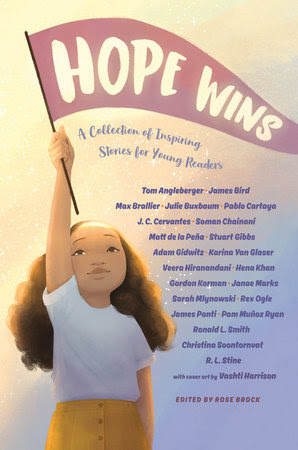
Brock, Rose (ed.). Hope Wins: A Collection of Inspiring Stories for Young Readers
June 7th 2022 by Philomel
Copy provided by the publisher

Brock continues on from Hope Nation with a collection of stories for younger readers, written by a selection of authors she knows on the vague topic of hope. Profits from this book are supporting the North Texas Teen Book Festival.

The stories are all very personal, and align fairly well with the authors' previous works. For example, R.L. Stine cleverly twists the assignment to let him write a story about hoping to see a ghost... until he actually does. Rex Ogle and James Bird tell additional stories about their difficult early years, Matt de la Pena offers a sports story, Karina Yan Glaser and Hena Khan write about their own school experiences and how they formed their personalities, and Sarah Mlyowski writes about her younger sister. Julie Buxbaum, who seems to have written primarily young adult titles but is coming out with a middle grade title in September of 2022, admits to being scared of both slumber parties and going to the movies. There are some interesting backstories of some authors who write books that aren't necessarily realistic fiction; Christina Soontornvat writes about growing up with immigrant parents who ran a restaurant and had to deal with difficult individuals, James Ponti explores his struggle with personal identy, J.C. Cervantes waxes lyrical about her relationship to the written word with a poem, Tom Angleberger writes touchingly abohow his autism spectrum was seen as a "major malfunction" when he was younger, and Max Brallier has interesting and formative experiences with large scale hot dogs. 

Some authors have very specific tales, like Pam Muñoz Ryan's entry about a friend who changed her life, Adam Gidwitz's lifelong struggle with coolness, and Janae Marks' path towards writing, which adheres most closely to the theme of the book. Ronald L. Smith's essay showcases why there are so many more fantasy books for middle grade readers than one might suspect; he's not the only future author who spent most of his class time sneak reading Tolkien! Veera Hiranandani's reminiscence about a photograph that is her favorite captures a particular moment in her middle school life, and it's great to see something else from her since her Save Me a Seat was so powerful. 

Some entries wax more philosophical, like Pablo Cartaya's letter to his daughter, who was was in 8th grade during 2020 and had to struggle with all of the things that the pandemic caused. Stuart Gibbs offers tips on how to deal with grief, which he sadly discovered after the unexpected death of his wife. Sonan Chainani offers a story of victory after defeat. 

The real draw here, and the story that I would love to see become a full length book, is "This Can't Be Happening to Gordon Korman", which explains just how this prolific author came to write his first novel in his 7th grade language arts class, get it published, and continue on in his 40+ year career of writing for young people, which now seems to include two books every year. He's told the world about this start many times, but this deep dive into the experience is the story I didn't even know I needed. Of course, there are lots of us who write entire novels in middle school, and most of us shouldn't be encouraged to continue!

This collection reads like letters from friends, passing the time recounting their past, and will please readers who are familiar with some of the authors, and hopefully introduce some new artists. This is the first year I've had requests for short stories, so this will be a good addition to my growing collection of new tales from diverse authors. 

Any objections to this are purely personal. It doesn't even make sense to say "hope wins". Hope doesn't win. Luck wins, and no, you can't make your own. Knowing people. Being in the right place at the right time. I don't really know what wins, since I have clearly not mastered the concept of winning at life. Hard work certainly does not win, although it's a more productive distraction than whining, Netflix binges, or "self-care". Hope eventually dies, because even without concrete complaints, life is just a succession of missteps and failures interspersed with tragedies. Hope is a scenic, pleasant road to certain, bitter disappointment. 

But it's probably a bad idea to tell middle schoolers that. They'll find out for themselves soon enough, and won't be able to blame us for tarnishing their optimism. 

Sunday, June 19, 2022

Just a Girl: A True Story of World War II

Levi, Lia. Just a Girl: A True Story of World War II
March 22nd 2022 by HarperCollins (first published 1994)
Copy provided by Young Adult Books Central 

 In this memoir for elementary readers, we learn the story of Lia Levi, who was born in 1931. When Mussolini comes to power and starts to exert sanctions against Jewish citizens, her parents start to make plans to keep the family safe. Her father loses his job, Lia has to move to an school for Jewish children, and soon the bombs start to fall. The family, which includes Lia's younger sisters Gabriella and Vera, and a nanny, Maria, soon start moving around the country to stay safe. They go to a grandmother's on the seaside, while Vera stays with another grandmother in Rome, and eventually to Milan and Rome. When the moving becomes more difficult, Lia is enrolled in a Catholic school for her own safety, where she is safer, but occasionally sees bombs dropping.
 
While Lia's experiences are harrowing, they skirt the edge of the war's atrocities and make this a good choice for describing the treatment of Jews during World War II to the youngest of readers. The story is mainly concerned with the daily aspects of life during the war, and also illustrates the sort of circumstances that are currently ongoing in places like Afghanistan and Ukraine. There is an underlying theme of Lia learning to speak up for herself; she starts the book being very shy, but as her experiences test her strength and resolve, she learns to speak up when necessary.
 
Black and white illustrations accompany the text, and there are side bars addressing issues like from Lia's perspective as an older adult, recounting her experiences. The pictures are great for driving home the sorts of clothing that people wore, the buildings and landscape of Italy, and various other historical aspects.
 
There have not been too many books written about the experience of the Italians during World War II.
 Napoli's In a Flash has Italian sisters living in Japan, and her Stones in Water details the experiences of an Italian boy who is catured by the Nazis. There is also Hughes' Hero on a Bicycle (2013) explores the life of a boy who is fighting the Nazis in, and Marsden's Take Me With You (2010), which chronicles the life of a girl whose father is an American GI. Spradlin's Jack Montgomery: World War II: Gallantry at Anzio gives a good nonfiction look at the experiences of the military action in the region.

Saturday, June 18, 2022

Cartoon Saturday- Remarkably Ruby

Libenson, Terry. Remarkably Ruby (Emmie & Friends #6)
May 3rd 2022 by Balzer & Bray/Harperteen
E ARC provided by Young Adult Books Central

Ruby is constantly encouraged by her exuberant, artsy mother to get out and do things other than writing poetry in her journal and watering the family plants, but Ruby has fallen out with friends at school and is so uncomfortable in her body that she tries to stay off everyone's radar. Her anxiety about life has led her to develop Irritable Bowel Syndrome symptoms, and her clumsiness has occasionally landed her on social media in embarrassing ways. Mia, who used to be her friend, is completely embarrassed by Ruby and tries hard to avoid her. Mia is running for class president, and is herself incredibly anxious. She still has two friends, Keya and Gabi, as well as her boyfriend, Trevor, who is very supportive and also fun to kiss. As the campaign starts to heat up, especially when rumors fly that Josh is trying to bribe people to vote for him, Mia starts to alienate her friends by being obsessed with her campaign and not sharing her concerns with those who care about her. Ruby, meanwhile, agrees to join a poetry club that her favorite teacher, Mrs. Winn, is starting, and even helps to recruit members. She's a little uncomfortable, but starts to enjoy herself. She even makes a new friend, Leah, and the two hang out together. During a talent show, Ruby reads a poem that vaguely describes the breakdown of her relationship with Mia, which mortified Mia right before the class election. The two have an altercation, and the principal decides that because of their past history, they can help Mrs. Winn run a poetry program for elementary students instead of serving detention. Will the girl be able to reconnect, and get help with their rampant anxiety?

This hybrid illustrated novel/graphic novel series has been very popular with my students who like Raina Telgemeier and Svetlana Chmakova's middle school titles that also showcase the generational anxiety so many students are currently exhibiting. Like this author's other books (Invisible Emmie, Positively Izzie,  Just Jaime, Becoming Brianna, Truly Tyler), this has a good mix of school, family, and social situations with which the main characters must deal. It's not strictly necessary to read these in order, but it is fun to look back and see where characters like Ruby and Mia appear in the other volumes in smaller roles. I'd love to see Trevor or Josh examined, especially since they don't seem to have the same level of trauma in their lives that Mia, Ruby, Emmie, and Brianna seem to have. 

One of the things I like best about these books is the representation of the parents. Parents are still a huge part of middle schoolers lives, and they determine so many facets of middle school experiences. I loved seeing Mia's father tell her she had to put her phone downstairs, and enjoyed Ruby's mother's overly enthusiastic interest in her daughter's life. Parents can be a source of embarrassment for tweens, but also a good source of support, and it was interesting to see that Ruby's mother eventually has her attend therapy sessions for her emotionally based stomach upsets. 

There's a good mix of artwork, and hand drawn style of text, which greatly appeals to young readers. Mia's chapters are drawn with more traditional, comic book style panels, while Ruby's are a mixture of text blocks and smaller drawings. The color palette tends toward the pastel, with Mia's sections having more pops of color. 

These books will be greatly appreciated by fans of  Scrivan's Nat Enough series, Miller's Click books, and Lloyd's Allergic

Friday, June 17, 2022

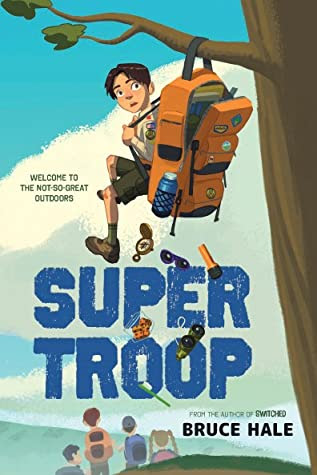
Super Troop

Hale, Bruce. Super Troop
June 7th 2022 by Scholastic Press
E ARC provided by Edelweiss Plus

Cooper and his best friend Nacho are looking forward to a summer of adventure before 7th grade, but because of hijinks they pull on a family trip to a local amusement park, end up with a much different adventure than they had planned. In trouble for getting off a ride and ending up with park security, the two boys are forced to join a local scouting group, the Boy Rangers, to learn some discipline and control their impulsivity. Cooper's mother and father, who are divorced, tell him he doesn't have to go to the thrice weekly troop meetings, but if he doesn't, he will forfeit attending a comic book camp to which he is greatly anticipating. The troop seems unimpressive at first; six boys, who don't seem to work well together and have their own personal quirks, and a leader who doesn't seem invested in his mission. After an unfortunate incident with a fire, the addition of three girls because of a lawsuit, and the replacement of their leader with a former military man, Rocky Pierce, things at least get more interesting. Cooper desperately wants to reunite his parents, who have been divorced for two years, and hopes that if he perseveres with the troop that this will bring them closer together. This will be tough, since his father is living with his girlfriend, whom Cooper calls "Shasta McNasty", and her young twin daughters. This doesn't keep him from trying to arrange meetings between his parents, and when his mother starts to date Mr. Pierce, he and Nacho attempt an ill-conceived prank. This gets them in further trouble, and they have to spend time cleaning up Mr. Pierce's back yard. The troop is preparing to enter a jamboree, and as part of their training, attempt to camp in the wilderness at the end of a seven mile hike. This goes poorly, anad the parents are not happy. Mr. Pierce has a public hearing to determine his fitness to be a troop leader. Will Cooper be able to overcome his personal feelings about his leader in order to help out the troop, which has come to mean more to him than he expected?
Strengths: There should be many more books about camping, like Gebhart's There Will Be Bears and Gansei's The Wild Bunch, and more books about scouting as well. There are not enough humorous books being published, and camping is an experience that not all young readers get to have, so a funny story about the process is most welcome. It was good to see that Nacho's moms and Cooper's parents were determined that their antics at the amusement park had consequences, and followed through even when the boys complained. Seeing Cooper's parents work together from separate households was also helpful. Although Cooper claims not to like Shasta and her girls, he gets along well with them. The inclusion of girls in the troop goes fairly smoothly; Cooper and the other scouts don't complain, and it takes a tiny bit of mental adjustment on Mr. Pierce's part. Since the Campfire organization has been co-ed since 1975, that was good to see. Mr. Pierce is tough, but fair, and when he makes an error of judgment, he readily admits to it and takes steps to better prepare for future endeavors. While characters' ethnicities aren't integral to the story, there is a realistic amount of diversity in the characters. With its humorous cover, Super Troop is a book that middle grade readers will eagerly pick up.
Weaknesses: There are parts of this that seemed oddly dated. From the slovenly, overweight troop leader to a stop at a video game arcade to scouts playing with knives and lighters, this felt in spots like books from the 1980s, like Smith's The War with Grandpa, especially when Cooper and Nacho try to prank Mr. Pierce with a stink bomb. Young readers won't mind, but I was just a little surprised. 
What I really think: I will definitely purchase a copy, since Hale's other books, like Playing with Fire, The Monstertown Mysteries, and Switch are all popular with my students. Hale has moved to the top of my list of authors who should write a novel about boys setting up a babysitting service in their neighborhood (along with Jake Burt and Dan Richards), but I do wish that there had been a few tweaks to some of the wording and situations.
 Ms. Yingling

Thursday, June 16, 2022

Charlie Thorne and the Curse of Cleopatra

Gibbs, Stuart. Charlie Thorne and the Curse of Cleopatra
June 7th 2022 by Simon Schuster Books for Young Readers 
E ARC provided by Edelweiss Plus

Charlie evaded authorities in Charlie Thorne and the Last Equation and Charlie Thorne and the Lost City, and now feels that there are further clues to be found while she's wandering around the world with the Einstein's Pandora code lodged in her photgraphic memory. She's managed to break away even from her half brother Dante and his coworker and love interest Milana, and has crashed a party in order to look at a tablet inscribed in Latin that may have clues from Cleopatra on it. It's owner isn't thrilled to find her in his private quarters, and even less thrilled after she chloroforms him and escapes. This is just the beginning of Charlie's adventures being chased by just about all of the secret service organizations around the world, who all want something from her. Since Charlie has money she has stolen from a company that stole her computer program, money is no object. When she meets up again with Dante and Milana, they follow the clues and find directions and objects that no one else in two thousand years has been able to process or find. These clues take them from Greece to Italy to New York, and Charlie seems to be unstoppable. Will she be able to find clues from all of the brilliant minds that have left them behind?

N.B. I read this on the last day of state testing (which went on for almost a month), so was a little cranky. I usually love this series, and thought this would be particularly great since I've actually visited Greece and Italy, but I found myself being annoyed at Charlie and her methods, especially ditching her brother. Probably just jealous of all of the traveling she got to do!

Strengths: Charlie has all of the qualities that many middle school students want-- autonomy from parents (who aren't dead, just unsupportive), unlimited money, super intelligence, awesome spy skills, and reason to travel the world. This is heavy on exciting chase scene, and the excitement rarely lets up. There are lots of people after Charlie and her knowledge, but she manages to constantly get the best of the bad guys. In this case, I was a fan of the bad guys being somewhat bumbling and definitely evil; while I appreciate a nuanced villain, Charlie is a more straight forward character. Her hunting down a college friend so she could get help from the girl's aunt was an interesting peek into her past. This was definitely a romp equal to or better than the first two books. It's hard to keep up that energy, but Gibbs does a great job.
Weaknesses: There's a lot of really interesting and helpful history of the ancient world, so this would be fantastic for the fifteen high school students still studying Latin in the US (remember, I taught Latin a lifetime ago), but sometimes there were rather large chunks of it that slowed the story down. I also found myself wondering how long it would have taken Cleopatra to get all of her clues in far flung places, given the rate of travel during her time, and whether her children would have been able to figure out the clues AND do all of that traveling!
What I really think: There's definitely at least one more adventure coming up, since Charlie mentions finding Isaac Newton's secrets, but I hope this series wraps up in five books. Any more than that, and it's tough to get readers to invest in longer series, even though the Spy School and Fun Jungle series are still going strong. They are the exceptions that makes the rule. 

Wednesday, June 15, 2022

The Cedarville Shop and the Wheelbarrow Swap

Krone, Bridget. The Cedarville Shop and the Wheelbarrow Swap
June 14th 2022 by Catalyst Press
E ARC provided by Edelweiss Plus

Boipelo lives in Cedarville, a small village in South Africa. Since the local cheese factory shut down, it's hard for people to find work. His father often travels long distances to take jobs in order to support him and his grandmother. Boi is lucky enough to go to school with his best friend, Potso. The two aren't fond of their homes, which are two room structures built in the 1990s by the government. When reading foreign magazines to his grandmother, who struggles with vision issues, Boi gets a glimpse of what like is like in other places, and learns about Kyle McDonald, a Canadian who managed to trade a paperclip for other items that eventually ended up with a new house for him in 20006. Boi wants to try this, but he and Potso have little to thei names. Boi makes a clay cow from river clay and trades it for a two liter bottle of soda at the local store. His trades are sometimes hampered by his desire to help people, and don't always go as well as he would like. When he tries to trade a chicken for a DVD set, his attempts at cooking it fail, so he doesn't have either the chicken or the DVDs to trade. Luckily, he has gotten some media coverage for his attempts to change his circumstances, and while he is working odd jobs to make money to replace the chicken and start trading again, he gets some news that improves life not only for him but for many people in his village. 
Strengths: The details of every day life in a village in South Africa are fascinating. Boi talks very matter-of-factly about the sorts of things he eats (porridge with sour milk), the kinds of activities he and Potso do, and what life is like for the other people in Cedarville. There is a young mother who has to travel long distances to work and has to leave her young daughter at day care, several elderly locals who struggle with health issues, and local business owners who are struggling to hold on. The reasons behind his attempts to trade his cow for various items so he can get a new home are realistically protrayed, and the fact that things didn't quite go to plan but ended up fairly well was heartwarming. There are funny parts to the story, a bit of romance with Boi's crush, Sesi, and a lot of examples of people working together for the good of their community, which was good to see. Even though some of the circumstances seem dire to a Western mindset, they are all portrayed in a neutral light-- this is just the way things are. It's hard to describe; some books paint dire circumstances as overly rosy, and point out that people can persevere even when things are terrible, and others paint them as just endlessly bad, but this lays out the realities of Boi's life, shows how he copes with them, and details his attempts to try to change them. There are no saviors, but there are people who help him along the way, and there are some small steps to imporved living conditions because of Boi's efforts. 
Weaknesses: Ms. Krone is not Black, and it would be great to see stories written by and about Black South Africans. We are starting to see a few such stories coming to the US, like Nwaubani's Nigerian Buried Beneath the Baobab Tree, Ochieng's Kenyan Playing a Dangerous Game and Ghanaian writer Beatie's Crossing the Stream, but there are still not enough. It's difficult to get titles from other parts of the world, so while we are waiting for more Black African writers to be represented, I think that Krone's work is well done and researched. One of our 7th grade language arts teachers does a study of Noah's Born a Crime, so Small Mercies has been a popular title with her students, in order to see more examples of life in South Africa. 
What I really think: This is an interesting look at everyday life in South Africa that will be relevatory to my suburban US readers who often don't know what life is like in other parts of the world. Definitely purchasing, and checking to see if this publisher has other titles I need to know about. 
 Ms. Yingling

Tuesday, June 14, 2022

The Lost Ryū

Cohen, Emi Watanabe. The Lost Ryū
June 7th 2022 by Levine Querido
E ARC provided by Edelweiss Plus

Kohei lives in Japan in the 1960s. The memory of World War II is still fresh, but the large dragons that used to thrive in the area are gone, superseded by smaller dragons that accompany people. Kohei has a dragon, Yuharu, whom he loves, but his grandfather, Ojiisan, is having a miserable old age since he is missing the larger dragons. When new neighbors from the US move in, Kohei isn't thrilled, but gets to know Isolde, who is his age. She is half Japanese and half Russian, and has a Yiddish speaking dragon named Cheshire. She agrees to help him find out about the larger dragons in order to help out his grandfather. His father is gone, but he hopes to find clues in his father's office. Based on what they find, the two decide to take off to the coast by train and to try to get to Ryūgū-jō, a dragon sanctuary off the coast, to hatch an ōyatama (dragon) that will help the grandfather's mood. Their plan is tricky, but they learn a lot about each other's pasts, and even though things don't always go well, Kohei and Isolde benefit from the journey in many ways. 
Strengths: I always love reading books set in other countries, and right now a lot of my students are always very much interested in Japan. Dragons are also extremely popular. The idea of having one's own dragon, a very small one that is super helpful, is such an intriguing possibility. I loved that Kohei was so concerned with his grandfather's well being, even though the two had a somewhat rocky relationship. Isolde is an interesting character, and her feelings of not fitting in no matter where she is will speak to many middle grade readers. The adventure by train to the coast, and the magic they experience with the dragons, is the best part of the book, but I don't want to go into too many details. This was well-paced, moved quickly, and offers just enough details about the dragons. While I appreciated the historical setting, this isn't really a historical fiction novel. (Which can still be a hard sell in my library, although interest has grown over the last few years.)
Weaknesses: My students don't have much historical knowledge. While I could tell this was set several years after WWII, it would be great for younger readers to be told right away an approximate year. Also, I didn't take notes on this and suffered some Fantasy Amnesia, so apologize for abbreviated review. A dragon on the cover would not have hurt my feelings and would have helped get the book into the right students' hands. 
What I really think: Because of the popularity of Tui Sutherland's Wings of Fire series, dragon books are much in demand in my library. It's great to see a story centered on Japanese dragons, and I'll gladly add this to my list of newer dragon books like the Tsang's Dragon Mountain, London's Battle Dragons, Halbrook's Silver Batal series, Pasternack's Anya and the Dragon, Prineas' Dragonfell, Burgis' The Dragon with the Chocolate Heart  Durst's Spark, as well as  older dragon titles

Monday, June 13, 2022

MMGM- Escape and Blather

It's
Marvelous Middle Grade Monday
 at 
and #IMWAYR day 
at 
and 

Alexander, K.R. Escape 
June 7th 2022 by Scholastic Inc.
E ARC provided by Edelweiss Plus

Cody is obsessed with theme parks and virtual reality, so when there is a lottery for the new VR theme park, ESCAPE, he checks his phone constantly to see if his entry was accepted. His friends Laura and Patrick share his interests, but don't care as much about the park. Most of the teens who have been picked are famous social media influencers, but there are a few spaces left for ordinary kids. Cody really, really needs to get away from home and school. His parents aren't abusive, but they are very strict and never let him have any fun, and they also fight a lot. When he gets an e mail on his phone during school, he knows that it is from ESCAPE, but his teacher, who is actually pretty cool most of the time, not only takes away his phone but calls his parents! Cody is grounded, but manages to sneak a look at his phone and finds out that a driver will pick him up at 8:00 the next morning to take him to the park for a week. He packs, sneaks out, and is soon on his adventure. He meets the park's creator, the creepy Mr. Gould, and befriends two famous kids, Inga (on whom he has a little crush) and Jayson. They are very nice to him, and the three become a tight unit when it comes to striking out into the park. Everything is included, so all of the food and rides are free, and no adults are allowed. Jayson and Inga have their own reasons for wanting to escape, and the park seems to pick up on all of the kids' worst fears. Cody starts to suspect things are really wrong when the group visits the Egypt section, and he gets an actual scorpion bite, even through the special suit that the kids have to wear. There are several other thrilling rides, but each seems more dangerous than the last. Add in a competition with the evil Meg-A, and Cody and his friends start to fear for their lives. Will they have to escape ESCAPE?
Strengths: Horror is NOT my favorite genre, but my students love to read it, and we have a lot of conversations about the sort of books that interest them. While I'm not going to provide them with as much gory, human-on-human violence as they would like (still not convinced this is something that is good for eleven-year-olds!), I'm always looking for things that are scary. They also are ridiculously fond of video game books like Tor's Minecraft series, and Escape has a lot of moments that have the feel of video games. The inclusions of a variety of young social media influencers is fantastic, and something I haven't seen a whole lot of, even though many of my students are sure that that's what they will do when they grow up. (After 16 years and a mere 326 blog followers, I'm not going to bet my retirement on this course of action!) I appreciate that Alexander doesn't skimp on the plot or the character development, although the thrill ride of the theme park definitely is center stage. The best part of the story was the uncertainty of what was really going on with the theme park; we have an inkling, thanks to the Scooby-Doo-ish villain Mr. Gould who is practically muttering "You meddling kids!". 
Weaknesses: The ending seemed a bit rushed and forced, but readers are going to pick this up for the National Treasure type action scenes, not the plot development.
What I really think: The creepy cover alone makes this worth buying three copies, but it's a shame that Scholastic won't publish this author in hard cover. If The Collector has sold half a million copies, surely there is a little money to be had in this format. Alexander is absolutely on fire right now, with three new releases coming up, including Darkroom (10/22), Speak for Me (11/22) and Possess Me (12/22)!

Blather: Had to do Real Life over the weekend, going to a friend's wedding, and helping my daughter move on Sunday. My wrist is doing well, but I'm still taking it VERY easy. 

About five of my friends are deep into Cleaning Out Parents' Houses, which is NOT fun! I've been turning a critical eye to my own home and Stuff. As my friend Michael told me this weekend, "LIFE is fatal". I don't collect much, but do have a lot of vintage Pyrex, as well as way too many clothes. The Pyrex is worth a bit these days, and I wear everything I have, so I'm concentrating on cleaning out junk drawers and things that my daughter will never want!

Three book goals this summer: Read a bit, do more challenges, and host a 48 Hour Book Challenge (ala the 2006-2016 MotherReader one) the weekend of July 15-18. I need to work on details, which will be ready (you heard it here!) July 1.

One blog you should really check out is Middle Grade Carousel! I'm going to try their Middle Grade Bingo for June, and they have fun cover challenges and book lists on Twitter at @kindeladies, too. 
(https://elymnifoquent.files.wordpress.com/2022/05/mgcbingo2022-06june.png)

Hope everyone is making progress on whatever needs it!

Sunday, June 12, 2022

Out of Range, Rosie and the Pre-Loved Dress

Lang, Heidi. Out of Range
June 7th 2022 by Margaret K. McElderry Books
E ARC provided by Edelweiss Plus

Ollie, Emma, and Abby are sisters who are close in age, but do not get along well. Abby is the oldest, and in order to fit in after the family has moved has joined the cross country team even though she hates running. What she does like is Dustin, one of the members of the team who takes an interest in her when she says she wants to improve her skills. Because she's spending time trying to get Dustin to be interested in her, she often cancels plans with Emma. Emma struggles with a lot of anxiety, and even though she is a good singer, has had enough trauma surrounding public performance to dissuade her from going out for plays. Ollie is the youngest, and is tired of watching both of her sisters grow away from her. Flipping back and forth between the girls' experience on a disciplinary walk after they pull a prank at the wilderness camp their parents made them attend as punishment for OTHER meanness to each other, we see the girls struggle when they get separated from the counselour, and in between those experiences, see what happened at home to get them sent to camp in the first place. Ollie and Emma try to band together to scare Dustin away from Abby; at one point, they "redecorate" her room with all of their stuffed animals so she looks juvenile, and Abby retaliates by ripping the heads off of the stuffed animals. Abby has a friend at school who pulls a prank on Emma so that her singing gets on the announcements, which doesn't help her anxiety. In the wilderness, the three struggle with typical survival issues like food, cold, and having to cross water, as well as an encounter with both a cougar and a bear. Even after almost losing both sisters, Abby struggles to remain grateful that they are alive, and their survival is compromised by their inability to get along. Will they be able to make some peace with each other and manage to get out of the forest alive?
Strengths: This was a solid adventure survival tale that will go over well with readers who enjoyed Behrens' Alone in the Woods or Lambert's Distress Signal. There's also a ton of sister drama that bleeds into friend drama. Abby's longing for a friend group, and her crush on Dustin, will resonate with younger readers. Ollie's growing distance from her older sisters will be all too familiar to many girls who are the youngest in the family. Emma's constant anxiety is echoed in many of my students right now, making this a timely mix of emotional and physical survival. 
Weaknesses: While I definitely see how flashbacks can be used to good advantage, I'm not a fan of them because I have so many students who return books that they claim are hard to follow because of this literary device. 
What I really think: I would have liked this more if Abby had enjoyed cross country a little bit more; most teams are good ways to make friends. As an adult who has dealt with a lot of complaining, bickering children this year, I found myself rooting just a little bit for the cougar and the bear, but young readers will approach this from a completely different angle and enjoy the story without wishing to kill off all of the sisters! I am impressed that Ms. Lang now gets along with her sister Kati Bartkowski well enough to write books with her, if this is at all based on her personal experience growing up!

Hatch, Leann. Rosie and the Pre-Loved Dress 
June 14th 2022 by G.P. Putnam's Sons Books for Young Readers
E ARC Provided by Edelweiss Plus

When Rosie and her mother are dropping off donations at their local thrift store, Rosie finds a yellow dress with rhinestones on it that she really loves. Her mother buys it, and Rosie wears it as often as she can. It has a name on the tag-- Mila. Rosie thinks about what Mila must have been like, and imagines the adventures she must have had in the dress. Rosie has a lot of adventures of her own, and when the dress becomes too small, she tries to repurpose it. Finally, she realizes that it is time to pass the dress on to another owner, and returns to the thrift store where she donates the dress but finds a new-to-her purse that she really loves. 
Strengths: I'm a huge fan of thrift stores, so got all of my children's clothing there. To this day, Picky Reader likes to snag the running shoes I've "preworn" because she doesn't like the way new shoes feel! While it was very common for her friends to buy things at the thrift store (or get hand-me-downs), there is still a bit of a stigma attached to secondhand clothing that I'm glad to see dispelled. I like Rosie's musings about the previous owners, and it felt very familiar to have her write her own name on the tag before sending the dress back to the thrift store. It's hard to part with favorite items of clothing even when they  might be getting another chance at adventure. This would have been in frequent rotation in my home. The illustration colors and styles are very 2020, so if this becomes a favorite from a public library, make sure you buy your own copy. You'll be grateful in twenty years when your child is trying desperately to locate the book. 
Weaknesses: Rosie finds the dress on the rack next to a wool sweater and a flannel shirt? Must be a fairly disorganized thrift store! The ones I frequent divide their vast stock into categories, so Rosie's dress would be on a rack with other girls' dresses, maybe even arranged by size! Thank you, Ohio Thrift and Village Discount! 
What I really think: This was a cute, fun story that I may just have to buy for myself. I love the message that thrift store clothes are "pre-loved" and would definitely purchase this for an elementary school library.

 Ms. Yingling

Saturday, June 11, 2022

Early Readers

Derting, Kimberly and Johannes, Shelli R. Murray, Joelle (illus.)
Vivi Loves Science: Sink or Float
February 15th 2022 by Greenwillow Books
Copy provided by Young Adult Books Central

In this second book in a series, Vivi and her class visit an aquarium with their teacher, Ms. Cousteau.Since Vivi loves marine biology, she is very excited. The children get to touch a stingray, see sea turtles, and learn about the habits of flatfish. The scientist at the aquarium teaches them about the swim bladder in the flatfish, and shows them how to make their own out of a balloon and bottle. The concept oVivi's love for science is great to see, and there are a number of other books in this I Can Read series, some involving Vivi, and some with Cece and Libby as main characters. STEM related books are in great demand, and are a good way to encourage children, especially girls, to investigate different areas of science. I was surprised at how very detailed the information about the swim bladder was, but it was also well explained and easy to understand for early elementary school readers. The pictures and examples help visually represent the concept well. The spacing of the text and pictures is particularly helpful, with shorter lines of text located directly under the picture of the concept being explained, instead of in one clump at the bottom of the page.

The illustrations are brightly colored and appealing, with lots of blue for the water, but with bright pops of yellow in Vivi's clothing and various fish. Ms. Cousteau and the scientist are women of color, and Vivi and her classmates represent a variety of ethnicities, although there is nothing in the text that specifically states any cultural connections. 

If my land locked middle grade readers are any indication, marine biology is fascinating to a lot of children, and emerging independent readers will enjoy tagging along on Vivi's field trip. Pair this was books like Mihaly's Water: A Deep Dive of Discovery, Lawler's Oceans of Love, and National Geographic Kid's Ultimate Ocean-Pedia, but be prepared to make a swim bladder out of a ballon and a small glass bottle. It's the plastic tubing that you'll need to find in advance, since I know I don't have any lying around the house!f low density and high density is explained and demonstrated so that the children understand how the flatfish is able to stay on the bottom of the tank. Vivi gets to ask more questions, and is happy to go home and tell her goldfish, Bubbles, what she has learned. Instructions for recreating the swim bladder experiment are included at the end of the book. 

Kessler, Liz and Stone, Joanie (illus.). 
The World of Emily Windsnap: Emily’s Big Discovery 
April 12th 2022 by Candlewick Press

While it might be too soon for original readers of Kessler's The Tale of Emily Windsnap (2003) to have children of their own, the nine book series is still in print. Emerging readers can get a good introduction to Emily, a girl who discovers she is half-human and half-mermaid with this early reader book. 

Even though Emily and her mother live on a boat, her mother won't let her play in the ocean because she thinks it is too dangerous, and you never know what it out there in the water. Emily isn't happy with this, since she sees her friends having fun, but she gets a clue as to why her mother is keeping her out of the water when swim classes are held at school. She starts to feel very strange in the water and has to be helped out. The instructor tells her it was just a cramp, but Emily is suspicious. One night she sneaks out to take a dip in the ocean, and she feels her legs turning into a fin! When she gets caught in some rocks, she is saved by Shona, another mermaid who is surprised that Emily didn't know she was a mermaid. The two are happy to be friends, and as she sneaks back home, Emily looks forward to more underwater adventures. 

The illustrations in this are particularly charming, especially the sandy beach scenes. While there are no cultural connections explained in the text, Emily's mother and Shona have darker complexions, and the scenes at school show children of a variety of ethnicities. The background of the illustrations often take the entire page, and the text is incorporated into the scene instead of being relegated to just the bottom of the page, which I always enjoy. 

Books where children have magical powers or abilities are always popular with young readers, especially when they are fun tales of adventure involving fairies, unicorns, or other magical creatures. This story is stripped down from the original but still is a great mermaid story for readers who enjoyed June's Mermicorn Island series, Dadey's Mermaid Tales, or  Hazen's Mermaid Mary Margaret.

Boyer, Christian. So Cute! Puppies.
February 1st 2022 by National Geographic Kids
Copy provided by Young Adult Books Central

The immediate draw of this book is clearly the wonderful pictures of puppies! There are Papillions napping, Golden Retrievers romping, and Pugs making puppy dog eyes, but there is also a lot of good information about dogs and their habits. There is information about the fact that puppies are born in litters, with statistics about the largest litter, and a great timeline ofwhat puppies look like after they are first born, and how they grow. Did you know that puppies reach  maximum cuteness at around two months, when they are usually adopted? There is also a little bit of information about human and dog interactions, and the fact that puppies love to be talked to. 

National Geographic books always have excellent photographs, and this is definitely true in this book. The pages, though only about 7"x 7", are packed with lots of details, so this would be a great book to stick in a diaper bagto use to distract small children. The cover might need reinforcing; it's paper over board, and the copy I received had a couple of small rips. This will not hold up to being chewed on by either young children or puppies! The small size makes it easy to cover with clear contact paper. 

There are a number of books in the So Cute! series, including titles about pandas, penguins, and koalas, and are a great nonfiction accompaniment to dog books like Ahn's Pug Pals, Soderberg's Puppy Pirates, Higgins' Good Dog books, and Clarke's Dr. Kittycat series (there are plenty of other animals in those, including dogs!). This is also not a bad book to have on hand for adults who have had a particularly trying day and don't want to look at any more computer screens in order to see cute puppies!

Friday, June 10, 2022

Guy Friday- The Secret Battle of Evan Pao

Shang, Wendy Wan-Long. The Secret Battle of Evan Pao
June 7th 2022 by Scholastic Press
E ARC provided by Edelweiss Plus

The Pao's lived in California before their father got into financial and business trouble and left the family. Evan, his mother, and sister Celeste pack up and move to Virginia, where their uncle lives. Money is a problem, but Evan makes a few friends at school, including Max, although Brady is constantly making stupid, racist remarks. His teacher, Mrs. Norwood, is in charge of the annual Battlefield Week celebration and has curated a vast collection of costumes and activities, but thinks that perhaps Evan should not be a reenactor, but should instead report on the activities as a scribe. She makes veiled comments about the "look" of the activity, but when Evan finds information at the public library from Mr. Masters about Chinese Americans who fought during the Civil War, she is open to his research and to his participation. Evan finds a stray dog while out with his uncle, and manages to persuade his mother to let him keep her, naming her Mochi. Gunshots are fired on the Pao household, and Brady is held responsible. The police (whose chief is Max's father) don't charge Brady, or even make him pay for the damage, and there's even some discussion that the Paos are somehow at fault! At school, the students are fed up with the way that Brady has been treating Evan, and subject him to the silent treatment for two weeks, a strategy they picked up reading Fitzgerald's The Great Brain! After Mochi bolts from the house, Brady helps Evan find him, and some secrets come out about the shooting. The two realize that they aren't that different. Will Evan and his family be able to come to terms with the father's desertion and make a home for themselves in Haddington?
Strengths: There are a lot of middle grade stories about moving, but Evan's culture shock sets this one apart from the ordinary. His school in California is culturally diverse, but the entire community of Haddington, Virginia is white. There's a strong thread of Confederate support, and even the teacher, Mrs. Norwood, would prefer to just not think about the real reasons for the Civil War and ignore any problems with the activities or background of the local heroes. Mrs. Norword is drawn particularly well; she's about to retire, she's put many years of work into the Battlefield Week celebration, but she's not unreasonable and realizes that things are changing. The town is portrayed that way as well; there is talk of taking down a Confederate statue, and discussion of the fact that many of these statues weren't put up until the early 1900s, perhaps as a reaction to Civil Rights activity at the time. There is a fantastic librarian who is a friend of Evan's uncle, and his tips on finding reputable sources were a great addition to the story! Max is a good friend to Evan, and most of the students are welcoming. Brady is truly terrible at first, but we find out HOW he was raised to be this terrible, and while he and Evan become friends, it isn't an easy process. Bonus points for a stray dog, Mochi, whom the family adopts. Evan deserved to have a dog and takes good care of her.
Weaknesses: The father's criminal activity and reasons for leaving the family never really made all that much sense to me, and weren't really necessary for the plot. The family's reason for leaving California could have just been a job change. Evan's story would have been compelling enough without that subplot. I also didn't believe that Evan wouldn't know the word "heirloom". 
What I really think: This is Shang's best work so far, and is a great mix of home, school, and society problems. The phrase that keeps popping into my mind is "powerfully nuanced". There are a lot of books that I read that made me cringe or sigh because a depiction is just not quite right, but Shang nails the depictions that had me holding my breath perfectly in this one. Great books to pair this with include Landis' The Not So Boring Letters of Private Nobody or  Leali's new The Civil War of Amos Abernathy.

Thursday, June 09, 2022

The Do-Over

Torres, Julia.The Do-Over
June 7th 2022 by Scholastic Press
E ARC provided by Edelweiss Plus

6th graders Lucinda and Raquel Mendoza are twins who usually get along, but since the pandemic hit and the two have to stay home from school, they are getting on each other's nerves. This started when their parents got divorced and their father moved to the country. Their mother works in a hair salon, and has been able to keep a little business by selling product packages to customers, but when a neighbor in their apartment building becomes ill, moving the girls in with their dad sounds like a safer option. Lucinda is angry because she figure skates, but the rink is shut down. Raquel has thrown herself into online school and also has frequent meetings with her newspaper club. When the plans start to be made to send the girls to their dad's, she comes up with a plan of her own-- to get her mother to go with them and reconnect with their father. The catch? Dad's girlfriend, Sylvia, and her daughter Juliette are living with his because of the pandemic. When Juliette becomes ill and has to be isolated in the garage apartment with her mother, will it be enough to encourage their parents to get back together?
Strengths: It's interesting to see how families coped with the pandemic, and sending the children out to the country seems like a decent strategy. Raquel's connection with her peers on the school  newspaper were interesting, and using the internet and conferencing to maintain a connection is something that we saw a lot when schools were remote. I loved that she had a daily schedule-- I would not have been able to function without my quarter sheet of Things to Do for the first ten months of lockdown. Lucinda's longing for skating was also realistic. I liked the fact that they didn't hate Sylvia as much as they just wanted their dad and mother to be together, and they were able to get along with Juliette fairly well. There should be many  more books about blended families and step siblings, since this is a reality that isn't well represented in middle grade literature. This was a quick, interesting read about a specific period of time not that long ago. I would argue that this is historical fiction, since it took place in mid 2020. 
Weaknesses: Aside from delivering groceries to neighbors and my dad, I didn't really see anyone during the pandemic, and I only got to talk to my neighbors and dad while standing ten feet away! Like Yang's New From Here or Ibura's When the World Turned Upside Down, Lucinda and Raquel see way more people than I could imagine. It was a little odd that while "pandemic" was used, "COVID" or "Coronavirus" was never mentioned. 
What I really think: I  loved Torres' The Fresh New Face of Griselda and Stef Soto, Taco Queen, but maybe it's too soon for me to really enjoy a pandemic tale. I'll probably purchase this for historical reasons, and younger readers will have more patience with cutting up Sylvia's perfectly good clothing to make masks than I had. 
 Ms. Yingling

Wednesday, June 08, 2022

Comics WEDNESDAY: Girl on Fire and Red and Rover

Keys, Alicia, Weiner, Andrew, and Williams, Brittany (illus.) Girl on Fire   
Published March 1st 2022 by Harper Alley 
Copy provided by Young Adult Books Central

Lolo Wright and her brother James live in New York City and attend a school in a somewhat rough neighborhood, although they both excel academically thanks to the influence of their father, who has high expectations for their behavior. Their mother left the family years ago, after struggling with drug addiction and other problems. Their father has started his own moving company, and things are looking up for the family, which also includes their mother's mother, who also supports the children. Michael also attends their school, but when the football coach tells him that he's still not big enough for the team, and the other players start calling him "Runt", he starts to be tempted to join ranks with the local drug dealer, Skin. When Lolo and James get caught in the middle of a convenience store robbery and the police assume that James is the suspect, they mistreat him and push Lolo aside. She finds that she suddenly has powers to get the police off her brother without touching them, and the two are able to escape. This experience traumatizes James, who doesn't share his emotions with anyone except for Nia, Lolo's best friend. Lolo continues on with her academics, and gets assigned to work on a group project with Eric, whose father is very wealthy but insists his son attend a public school to build character. He admires Lolo's academics, and the two start to be friends, even though previously Eric had supported the local mean girl who made Lolo miserable. When Skin finds out about Lolo's powers, he is determined to bring her skills to his team. He also looks at her father's moving business as one to target for protection payment. He makes Michael approach him for payment, but since Mr. Wright was supportive of Michael and his family after his father's death from cancer, Michael finds it hard to do what Skin asks. Skin, in retaliation to Mr. Wright's refusal to pay, blows up his moving truck, which puts the family's plans to move to Rockaway on hold. Will Lolo, Michael, and Mr. Wright be able to resist Skin's advances and continue with their lives? And how will Lolo's powers affect her future. There is plenty of room for a further adventure. 

Williams' drawing will be familiar to readers of Goldie Vance and volume 3 of Lumberjanes, and her comic book style of illustrating is perfect for this superhero tale. The New York landscape gets a lot of attention, with storefronts, the school, and shady alleys and warehouses nicely drawn, and the range of emotions on the faces is much deeper than the average graphic novel. The color palette changes with the mood of the scenes, but is very rich and layered. 

Lolo's story is one that will appeal to suburban readers as something unusual and interesting, and will give urban dwellers representation that might seem familiar. I love that Lolo is academically advanced, and the way she deals with the pressure of other's expectations of her are realistically drawn. Her relationship with Eric is interesting, and at the end of the book she is especially kind to the mean girl, which was a nice twist. 

Like Muro's Primer, I'm not sure if Lolo is reflective of a Marvel or DC superhero unknown to me, or an entirely new creation, but this matters little. Readers who enjoyed other urban tales like Maldonado's Tight or Booth's We Could Be Brothers or who like the updated versions of the Black Panther or Spider Man stories will enjoy this fresh treatment of an unlikely super hero who uses her powers to protect her family and those she loves. 

Basset, Brian. Fun's Never Over (Red and Rover)
June 7th 2022 by Andrews McMeel Publishing
Copy provided by the Publisher

I did not know that I had been reading the Red and Rover comic strip for its entire existence; The Columbus Dispatch has carried the Sunday strip since 2000, as far as I can remember. I hadn't seen the daily strips, though, and was fun to be introduced to these. Red, an exuberant 8-10 year old, has a great friend in his dog, Rover, and the two communicate telepathically; Rover doesn't really talk, but Red seems to understand his thoughts. They go on lots of adventures, get into some trouble, and love each other dearly. There were many strips that made me laugh (Red comments that the fly in Rover's dish is dead, just like all of the other meat Rover eats, so Rovers munches the fly), and some were very poignant, as when Red comments that he lives for Saturday morning cartoons, and after Rover replies that he lives for Red, the two go out to play instead of watching t.v. 

The color pallette is simple, with red, blue, yellow, and green, and lots of white space. There's a 1950s vibe, with Red's cuffed pants and t shirts, and the clothing on the parents. The setting is a suburban neighborhood with plenty of outdoor space for the two to camp out, jump in leaves, and catch bullfrogs. 

There's no social commentary, nothing more serious than a lemonade stand, and was just what I needed to read at the end of the year. Red isn't as wily as Big Nate, but his relationship with Rover gives a gentler Calvin and Hobbes feel to the strips. My students will definitely love this one.