Friday, November 30, 2007

Three Titles For Rare Readers.

L. M. Montgomery's Anne of Green Gables
My very favorite book in middle school. Set in 1890's Canada, this tale of an orphan who gets herself into all sorts of scrapes because of her adventuresome spirit, this is not a book everyone likes. Still, girls who like historical fiction, girls who are quiet, introspective, smart and a little different from their peers, and girls who are fans of Alcott will be served well by this book. I have two students reading this now (I handed it to one after she enjoyed A Tree Grows in Brooklyn!) -- I do a little happy dance whenever anyone checks this book out.


More accessible to a larger audience, Julie Andrews Edwards' (yes, the actress) book Mandy is a book that is absolutely wonderful, but no one can explain why.
Mandy ( and there are better covers available) is an orphan in an English orphange, finds a cottage in the woods that she cares for, and eventually finds a family to love. I have a student who checks this book out twice a year just to reread it. I was given a copy of this in 1974 for Christmas!


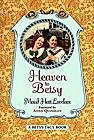
When girls check out Maud Hart Lovelace's Heaven to Betsy, I tell them if it compels them to make fudge, they have to bring me some. Set in the 1890's in Minnesota, I loved the depiction of family and school life at the time. Different from today's life, and yet oddly similar, I read these in high school, mainly in the orchestra pit when I was in musicals, and often did have to make fudge, because Betsy does so often. There is a series of these, and even a Lovelace fan club. Originally published in the 1950s, these can be hard to find.
Thursday, November 29, 2007

Douglas Rees ROCKS!

This is my favorite vampire book for many reasons. Appeals to both boys and girls, is funny, doesn't take itself too seriously, and doesn't have blood and gore. Okay, this makes it less appealing to some students, but the two copies of this we have in the library are never on the shelves. The premise is so clever-- there's a vampire magnet school, and they recruit 'regular' teens because the state requires them to have a swim team!

One of my hobbies is writing authors thank you letters, and Mr. Rees very nicely replied to me recently with the exciting news that he is working on a sequel! My students want it right now! This is one book I have recommended to several of my adult friends, who have also enjoyed it.

Since I read Lightning Time this summer, it has been checked out frequently my my boys who can't get enough war fiction.


I love the French cover (and title) of Vampire High, too. To find out more about this fun author, check out:

1,000 reasons never to kiss a boy by Martha Freeman


Warning: not a middle school book. Unclad frolicking on page 119.

This was a surprise from this author, who usually writes for a much younger audience. I liked the book, I liked Jane, and she ultimately makes the right decisions, but I still am not going to hand this book to any students.

Remember the rule, authors. Objectionable material within first ten pages, please!

Wednesday, November 28, 2007

Narinder Dhami

Bindi Babes, Bollywood Babes and Bhangra Babes all circulate very well in my library. The continuing story of a family of girls living in London, it offers an enticing look into the Indian lifestyle that is new to my students. I was impressed by the tiny details-- differences in cooking, household decorating, and family interaction. Bollywood Babes was especially fun, bringing in an Indian actress from Bollywood films.

I had written to Ms. Dhami a while back, thanking her for writing, and she VERY graciously replied and sent me two books not available in the U.S.-- Dani's Diary and Sunita's Secret. I read the first last night and loved it. It goes back and forth between Dani's adjustment with her new step family, and her grandmother's journal that was kept when her grandmother first came to the UK. I think it's great that Dani has to translate the diary from Punjabi. The problems of fitting in to a new country and dealing with a step family are brilliantly portrayed, and again, the details of a slightly different way of life are fun to read.


Ms. Dhami has a wonderful web site. Check it out to see the much bright UK covers.
http://www.narinderdhami.com/

Sorrells' First Shot

You're a student in a tough military type academy. Your father is the head master and doesn't cut you any breaks. Does it get any worse? Yes. If you're David, your mother has been murdered, and you think that it's a pretty good bet that your father did it.

For a book that is almost 300 pages long, this read very quickly. Between the unpleasantness at school, David's longing to excel at the sport of shooting with the help of a new transfer student who happens to be a girl, and the mystery of his mother's death, this is the best page turner I've picked up since Morgenroth's Jude. This book thankfully eschews the salty language and offers a raw portrayal of a boy trying to get through very difficult circumstances.

Another excellent mystery from the author of Fake ID and Club Dread.

Susan Shaw's Safe

It's a rare book about rape that would be appropriate for most middle school libraries, and this would be the book. 13-year-old Tracy is attacked and almost killed on her way home, by the brother of a boy in her class. Told in a gripping but not graphic way, it's easy to understand the range of emotions that she goes through, and hard to watch her get through each day that follows. This is an important book that would be useful if there were a student who was raped and needed to read an example of one way of coping with the situation, or her friends needed insight into how she might feel. In general, this will be popular with the girls who like problem novels, because it is so very well done. This author's other books, The Boy From the Basement and Black-eyed Susie are also well-crafted and sensitively written.

Tuesday, November 27, 2007

Need some pink books?

Susanna Sees Stars, by Mary Hogan, is one I will buy in its horrible Gibraltar binding, or perhaps a prebind version of the paperback, because it will circulate nonstop for ten years and then stay on the shelf, worn-out and dated. It is one of the many books out now dealing with run ins with celebrity that seem to be so appealing. It's like The Devil Wore Prada for the YA set. Add this to the list containing Douglas' True Confessions of a Hollywood Starlet and Calonita's Secrets of My Hollywood Life.

Kadohata's Weedflower

Kira-Kira, by this author, was very depressing and set during an odd historical period, so it's hard to get students to read it. This book, however, is a very vivid portrait of a family removed from their flower farm and sent to an internment camp because of the national feeling against the Japanese during WWII. This is a fine addition to a limited but interesting body of fiction that includes:
Denenberg: The Journal of Ben Uchinda
Otsuka: When the Emperor Was Divine
Salisbury: Eyes of the Emperor
Garrigue: The Eternal Spring of Mr. Ito
Uchida: Jar of Dreams

Durst's Into the Wild

This book gets five stars for the idea (fairy tale characters have escaped from their world of repetition to our world, only to be sucked back in), and fewer for execution. I loved the idea of Rapunzel's daughter trying to save her mother and all of her friends from "the Wild", but got very confused as to how this all happened.

I loved all of the allusions to the Grimm tales, and thought it was because my own ill-considered half-written novel used those tales, but apparently my opinion was shared. My students have been asking for books that includes spins on classic tales like The Rumpelstiltskin Problem by Vivian Vande Velde (2000) and McKinley's Spindle's End (2000) and Beauty (1978). Napoli's books, especially Zel, are popular, so it's fun to see Rapunzel appear in this one as well. There's a lot of action and adventure, and there is room for another book. 

I enjoyed this, but have to agree with this assessment: "Although the logic of the Wild doesn't bear close scrutiny, the concept behind the story is sufficiently clever that many readers will forgive its inconsistencies." (Booklist)

Milton Meltzer's Tough Times

This is a thin historical novel, but it should not be underestimated. It is the rawest and most personal account of living through the depression that I have ever read. When I was done, I thought "This is autobiographical!", and sure enough, Meltzer was born in 1915, making him `6 when this book was set. We should all write so well at 92!

The details of this book were breath taking. What was it like to have your father's business slowly become less and less viable, until you had to get a job instead of going to school? How hard was it to see a professional man you admire lose his job, and your friend also sink into hard times? When everything around you seemed so dire, how did you go on?

All of my students need to read this. Maybe they would complain less. At the very least, they would learn a lot abou the Great Depression, something which figured very largely in the lives of my grandparents, and which young people today know so little about.

Thanksgiving reading-- unfortunately won't purchase.

Pat Murphy's The Wild Girls is nostalgic and discusses what it's like to feel different while growing up, in the great '50s tradition of expressing this difference by wanting to be a writer. I'm getting old if so many people are writing books set in the '70s now! I loved it, but my daughter, who will read anything, just couldn't get into it, and I can't think of a single student I would give this to.

John Smelcer's The Trap was a wilderness survival story that lacked action, which is what most students want from this sort of fiction.

Loved Elizabeth Levy's Tackling Dad, about a girl who really wants to play football but whose football playing dad doesn't want her to. The problem-- I have three or four books about football playing girls and one football playing girl every five years. Can't get others to read them. Levy did a great job with this one-- love the picture of her in the pads!

Laura Resau's What the Moon Saw was an interesting account of a girl's visit with her grandparents in a very remote area of Mexico, but also had a lot of magic and fantasy elements that were sort of odd. Intriguing, but again, can't think of readers.

Kirkpatrick Hill's Do Not Pass Go, about a boy whose father is incarcerated on a minor drug charge, was also well done, and I am thinking about buying this after hearing a student talking about a relative who was in jail. I'm still not sure.

Francine Prose's Bullyville sounded great in the reviews but started off annoyingly (all of the slang names for the places) and never reeled me in. I had to get it through interlibrary loan, so it must not have intrigued others, either.

Not buying books is hard. So is weeding books that haven't circulated well. Sigh.

Books sent to me randomly by an author

Karen Kingsbury, who is "America's favorite inspirational author" (I never know these things) very kindly sent me two copies of her book A Thousand Tomorrows. In the cover letter, it is described as " a clean love story about a bull rider and a barrel racer, and it deals with cystic fibrosis". This didn't entice me to read the book, but it was better than the letter indicated.

I would describe this as a romance about two people who love each other and pursue their dreams despite the odds, in a Lurlene McDaniel sort of way. Ali rides horses even though her lungs can't handle it-- its the only time she feels really alive. Cody gives up riding briefly to donate part of a lung to her. There is just depressing event after depressing event, and you know it's not going to end well. Again, for girls who want to read something sad, what could be more perfect?

Ms. Kingsbury is donating books to libraries in honor of her brother, Dave Kingsbury, who died unexpectedly. This is very nice of her. I will definitely put this is the collection (I have a student who has just about finished all my McDaniel) but may send the second to another middle school library so that they can have one, too. Many thanks for this kind donation.

Books loaned to me by students

It's always great when students loan me books. It means they trust me with their books, and they believe that I will get them back quickly. I try.

Sarah loaned me Rachel Hawthorne's Caribbean Cruising, an Avon paperback which I enjoyed very much but won't buy for the library. A fluffy beach read about a girl who has graduated from high school on a cruise as part of her mother's honeymoon, it is about her "to-do list" for the cruise. The major thing was rather inappropriate, ala Meg Cabot in Ready or Not.

Elizabeth loaned me a V.C. Andrews' book-- Butterfly, the first in the Orphans series. Having been a big fan of the Flowers in the Attic series in high school (embarassing fact-- owned the whole series in paperback and could not begin to tell you why.), I was intrigued when she had a V.C. Andrews for YA book. Huh, I thought. Since FItA was not the most appropriate book for, well, anyone, I was compelled to pick it up. Butterfly is the somwhat improbable tale of an orphan girl adopted by a paralyzed ballerina and forced to dance. The abuse and unhappiness of earlier works is in evidence here-- they never end happily.

So why do I want to borrow the next one in the series? These would appeal very much to girls in that developmental stage where they love to read about people whose lives are worse than their own.

Tuesday, November 20, 2007

Sure Fire by Jack Higgins with Justin Richards

Notice the wonderful fiery helicopters and the tag line under the title: "Grow Up Fast- Or Else!" That's exactly what Jade and Rich do when their mother dies and they end up with the father they didn't know they had-- a father who happens to be a spy involved in a dangerous bid to secure the formula for a superfuel. (Okay, it ends up being something more sinister, but I won't ruin it for you.) With shade of Alex Rider, the children hunt down bad guys and work on saving their father, and, by coincidence, the entire free world.

Fairly standard plot, but it is the type of story that children crave. Given the number of political/spy thrillers for adults, this should not be a surprise. Apparently this Higgins is "one of the world's most popular authors". I've never heard of him, although Justin Richards is the author of the wonderful The Death Collector. (And the new The Chaos Code, which sounds great.)

This is well-crafted and highly readable, and the children will adore it. Add it to the growing list of spy novels starting with Alex Rider; Jimmy Coates, Traitor and Payback, and the Robert Muchamore. Buy two and be glad for the inevitable sequel!

Two War Books

Sonya Hartnett's The Silver Donkey is set during World War I and follows the story of a blinded soldier trying to make his way home. He is found and helped by two sisters and a brother, who feed him and try to get him to where he is traveling. He amuses them by telling them stories involving donkeys, since his good luck charm is a donkey. A bit vague in the details, this is a lyrical book, and beautifully bound. It is gentle and sweet, and shows that bravery and loyalty are good qualities. Parents and critics will love it. Middle school students won't.


What they really want is what H.R. DeMallie delivers beautifully in Behind Enemy Lines: A Yound Pilot's Story. This covers his enlistment and training on how to fly a B-17 bomber (with a diagram! Map!), then the fateful air battle, in riveting detail, that caused him and his crew to parachute into occupied Holland. From there, DeMallie survived with the help of the people of Holland but was eventually captured and spent the remainder of the war as a POW.

Written using notes that the author kept in 1945, this is raw, immediate, and gives the authentic detail of a real WWII experience that my boys crave. The language is not elegant ("Gee, I was hungry.), but I was riveted by the fact that this was a real story, one that was no doubt repeated time and again. Sterling Point Books, the publisher, has several other volumes of memoirs out that I am looking quite seriously into buying. This will NEVER be on the shelf. Buy two.

On page 8 there is a wonderful quote: "Someone once said "Young men enlist in the service during war time primarily for adventure." I will try to remember that this is why they like to read books about war as well.

Monday, November 19, 2007

Novels in verse

Let it be duly noted that I wasn't liking anything I picked up this weekend, so I was apparently in a difficult mood. I gave up and watched The Prize Winner of Defiance, Ohio, which was a good book AND movie.

The two books I did pick up both happened to be in verse. Such a hard sell, both to me and to students. The first was Trash, by Sharon Darrow. This was the description from Follett: "Graffiti artists Sissy Lexie and younger brother Boy try to maintain a sense of family while living in a series of foster homes and staying with their older sister, until a tragic accident forces Sissy to make decisions about her future."

The poetry was very free verse, and I had a hard time getting that. Students who like to read books about problems such as these are frequently struggling readers, and the use of imagery and poetic language makes this hard to read.

The other was Norma Fox Mazer's What I Believe. This incorporates the problems that her work normally does (father loses job and family must relocate), but is done is a very experimental style. Very good try on lots of poetic forms. Poetically, this is good, but it makes the story hard to read. I think this is the only book by this author that I will be lacking on the shelves.

For aspiring writers thinking about writing a book in verse: please don't. Just don't. I know that college professors of children's literature think they are great, but run the text by an actual young adult first. Please.

Thursday, November 15, 2007

Crossing the Panther's Path

One of my students was a somewhat reluctant reader for the last two years but came in the first week craving books on Native Americans. He's read them insatiably, even the 50 year old biographies. I have been looking for additional titles for him, and came across Elizabeth Adler's book. Just what I needed. For some reasons, many of the books are from the point of view of a girl, and are more about the settlers and the "evil" Indians. This is based on the true story of Billy Calder, who had an Irish father and a Mohawk mother, and who became an interpreter for Tecumseh and helped him try to win back land from the Americans.

This stars out with an arduous trek through the snow from Detroit to his parents' home, and keeps going with strategies, adventure, and battles. While it supported the Native Americans cause, neither the British were portrayed as evil, just with their own agendas. Billy learns a lot about the different tribes, and I think my student will really enjoy this.

Other titles that we've located this year that have been fairly successful were:
Carbone's Blood on the River
Cooney's The Ransom of Mercy Carter
Edmond's In The Hands of the Senecas
Keene's I Am Regina
McGraw's Moccasin Trail
O'Dell's Streams to the River, Rivers to the Sea
Pearsall's Crooked River
Richter's Light in the Forest
Speare's Sign of the Beaver

Combine this with two biographies, and that is a lot of reading! I am so proud of this student, who signed up for a public library card and has even gotten "in trouble" for reading during class. "The right book for the right child at the right time" is certainly working out in this case!

My Apologies to Wendy Mass

I am afraid that I may just not like anything this author has written. The books always sound intriguing, and I pick them up, but just don't get along with them. A Mango-Shaped Space was not something students would ask for, I didn't like the character in Leap Day, and Jeremy Fink just didn't hit the right notes. Heaven Looks a Lot Like the Mall sounded great: girl is hit with dodge ball and dies temporarily, reviews her life through the things she obtained at the mall, and learns to become a better person. Great Cover. Just great.

Objection Number 1: It's a "novel in verse". BIG nose wrinkles when I show these to middle schoolers, and with the very notable exception of Helen Frost, these books are not actually in anything that involves rhyme, meter, alliteration, etc. so to me are not verse. They are simply prose cut up into short lines. Now, I am especially picky about this, since I write traditional poetry.

Objection Number 2: Too heavy on the life lessons. Yes, students are trying to establish identity, but you can't hit them over the head with it. Verging on preachy.

I wanted to like it, but am somehow sad I didn't. Sigh.

Wednesday, November 14, 2007

Tattoo

Jennifer Lynn Barnes' second book, Tattoo, was one I had to pick up because the description was so tempting. Four friends at the mall get temporary tattoo that give them supernatural powers that they need to fight against evil that is set to take over the world-- starting at their prom.

Which they do. There is a lot of Celtic lore and whatnot dealing with how they get their powers and what evil is encroaching, but what I really liked about this book was the snappy, laugh out loud dialog. "I'm on the cheerleading squad. I know what REAL evil looks like." I'd quote more, but my daughter ran off with the book.

A fabulous choice for either girls who liked Twilight or who have to read fantasy against their will. Both will find this fun. The only down side is that it is available only in paperback or the dreaded Gibraltar Bound, a library binding that in reality falls apart the first time a student looks at it. Sigh.

Don't Read These Two on the Same Night

Andrew Clements, of course, does middle grade novels about teachers who don't quite get what wonderful social changes students are trying to effect. Having learned about Ghandi's protests, the 5th graders in No Talking decide that they will have a contest to see who can talk the least, and it gets them into trouble for no particularly good reasons. It's funny, with a sly humor that appeals to all ages, but more importantly, empowers children. This is the case in all of the Clements' books that, as my son puts it, "have a child holding something in front of his face on the cover." Reluctant or struggling readers in middle school turn to these for comfort, so I will buy this one.


If this isn't a glowing review, it's because I read it on the heels of James St. James' Freak Show, about one gay/transgendered boy who moves to Florida and attends a very conservative, preppy school. This is not a middle school book. Much, much language. I'm not even sure it's a high school book. It's meant to be funny, but touch the deeper issues of "Everyone is a freak in some way so we should be understanding of everyone."

I couldn't stomach it, because the main character, Billy, goes out of his way to make himself a target. Sure, in a perfect world we would all be able to show the world who we really are, but in reality, this is a bad, bad idea. So I had trouble feeling sympathy for Billy when he wanted to start the school year and "blend in" by wearing a ruffled pirate shirt. No. Not in high school. Do I, as an adult, wear polyester prom dresses from the '70s to work? Yes. But people do not really see me and do not care. Would I have done this in middle school? No. While amusing, I can't see this as a constructive book to give any student, especially one having trouble fitting in.